


Gold continues to be a top asset in 2026. Even though prices have dropped from their highs earlier this year, gold trades at elevated levels. Investors are looking for protection against inflation, geopolitical issues, rising government debt, and slowing economic growth.
This gold market differs from past rallies. Today, several long-term trends support it. Central banks are buying gold at near-record levels. Investment demand is growing, mine supply is limited, and uncertainty in global monetary policy boosts gold’s status as a safe-haven asset.
Many analysts expect gold to stay above historical averages through 2026 and beyond, attracting both institutional and retail investors.
Gold Prices Ease After Record Rally
Gold started 2026 on a strong note, hitting a high of US$5,600 per ounce. Recently, prices have pulled back to around US$4,100 per ounce as of mid-July. This is still over 20% higher than last year and well above the decade’s average.
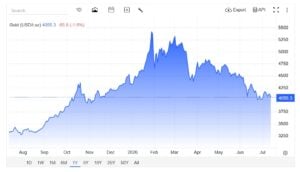
The recent dip is largely due to strong U.S. economic data and expectations that the Federal Reserve may keep interest rates high longer. Higher rates usually strengthen the U.S. dollar and boost bond yields, making gold less attractive.
However, analysts believe this pullback is more of a consolidation than a long-term decline.
According to Reuters, renewed geopolitical tensions and ongoing global trade uncertainty often push investors back to gold during market volatility. Safe-haven buying helps limit the downside, even with rising Treasury yields.
Trading Economics shows that gold remains above its long-term trend. This indicates that structural demand outweighs temporary economic challenges.
Analysts Stay Positive Despite Short-Term Volatility
Leading financial institutions maintain positive views on gold, though their forecasts vary based on interest rate and growth expectations.
- Research firm Metals Focus anticipates gold prices will average around US$4,920 per ounce in 2026. They cite ongoing central bank purchases, strong investment demand, and limited mine supply.
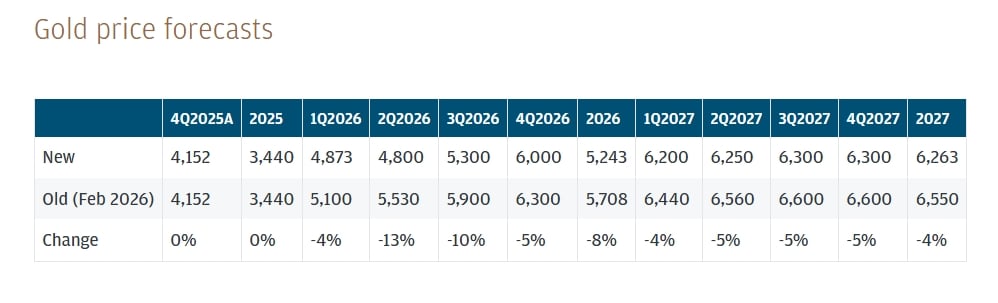
- HSBC has lowered its short-term price forecasts, saying higher real interest rates and a stronger dollar might limit gains. Still, they expect prices to stay well above historical averages due to strong structural demand. It expects gold to trade between $3,800 and $4,700 for the rest of 2026, ending the year at $4,750 before rising to $5,025 by the end of 2027.
- On the contrary, JPMorgan thinks gold could reach US$6,000 per ounce in Q4 2026 if inflation stays high and central banks cut interest rates.
Most analysts agree that gold may see short-term volatility, but the long-term fundamentals are solid.
2026 Gold Demand: ETF Inflows and Bars Reshape the Gold Market
Investor demand has improved in the past year.
Exchange-traded funds (ETFs) faced heavy outflows when interest rates rose. Now, they are attracting new inflows. Investors are getting ready for slower economic growth and possible monetary easing.
Demand for gold bars and coins is high. Many people want to diversify their portfolios.
- The WGC noted that global gold demand exceeded 5,000 tonnes in 2025, including over-the-counter (OTC) activity—the highest ever recorded.
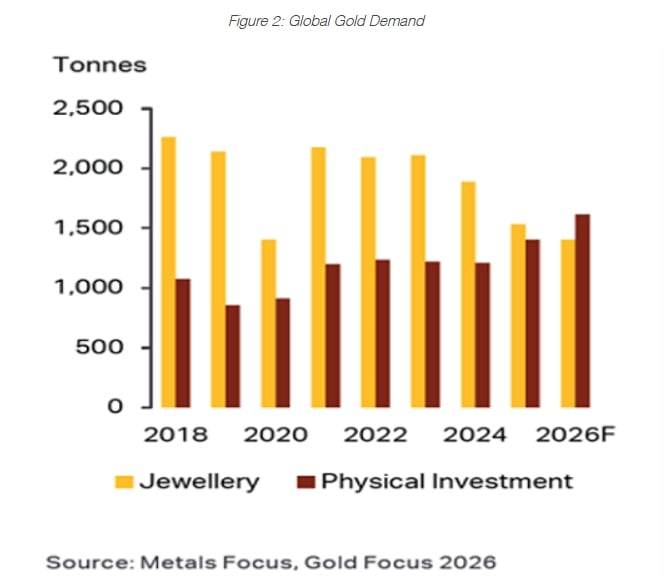
While high prices have reduced jewelry consumption in sensitive markets like India, strong investment buying has more than made up for it.
- According to Metals Focus, total gold demand is expected to decline by 2.3% in 2026, as sharp drops in jewellery consumption and central bank purchases outweigh gains in other segments. However, stronger demand for physical gold bars and coins is projected to make physical investment the largest source of gold demand for the first time, overtaking jewellery.
Central Banks Still Drive Global Demand
Central banks now play a major role in the gold market. The World Gold Council (WGC) says central banks are now big gold buyers. Governments are moving reserves from the U.S. dollar and boosting their physical gold holdings.
Global central bank purchases have topped 1,000 tonnes a year for three years. This shows a strong buying trend.
Countries in Asia, the Middle East, and emerging markets are adding gold to their reserves. This move aims to boost financial security during times of geopolitical uncertainty.
This steady buying has created a price floor not seen in previous cycles.
Supply Growth Remains Limited
Nonetheless, gold production does not increase quickly with rising prices. Developing a new gold mine often takes over a decade due to exploration, permitting, financing, and construction.
Furthermore, existing producers also face challenges. Ore grades are declining in many mature mining areas, and operating costs are high due to inflation. And new discoveries are harder to find.
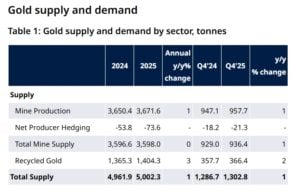
- However, Metals Focus estimates global gold supply will grow by only about 3% in 2026, with modest gains from mine production and recycled gold.
- In 2025, total gold supply was 5,002.3 tonnes, as reported by WGC
Recycling tends to rise when prices go up, as more people sell old jewelry. However, recycled supply alone can’t meet long-term demand. This slow supply growth supports higher prices.
Factors That Could Move Gold in 2026
Several key factors could influence gold prices in the coming months.
- The biggest is U.S. monetary policy. If the Federal Reserve signals plans to lower interest rates, bond yields may drop, weakening the dollar. This would create a better environment for gold.
- Inflation is another crucial factor. Although pressures have eased, inflation is still above many central bank targets. Gold has historically done well during inflationary periods as investors see it as a safe store of value.
- Geopolitical developments also affect the market. Conflicts in the Middle East and tensions between major economies have often triggered safe-haven buying this year.
- Lastly, government debt levels are increasingly important. Rising fiscal deficits in major economies strengthen the case for hard assets like gold, especially for institutional investors.
What This Means for Gold Investors
Today’s gold market offers a different opportunity than past cycles.
Investors are now paying more attention to companies that can generate strong cash flow during the commodity cycle. Higher gold prices often boost mining margins because production costs increase more slowly than gold prices.
They look for miners with low operating costs, long-life reserves, strong balance sheets, and stable operations. Companies with these traits can better benefit from high gold prices and manage risks.
However, gold mining stocks can be more volatile than physical gold. Their performance is influenced by bullion prices, production growth, operating costs, and project execution. Quality and efficiency matter just as much as the gold price itself.
Central banks are buying gold, supply is limited, and economic uncertainty is high. This keeps the outlook strong for bullion and good gold producers. Short-term volatility may persist, but many analysts see solid drivers behind the current gold bull market.