

The push for new nuclear power plants in the U.S. is accelerating. Electricity demand is rising due to artificial intelligence (AI), data centers, and industrial electrification. Recently, Blue Energy received a strategic investment from Constellation Technology Ventures, the venture capital branch of Constellation Energy (NASDAQ: CEG).
This investment highlights increased support for small modular reactors (SMRs) as the U.S. seeks reliable, carbon-free electricity that can be deployed faster than traditional nuclear plants.
Blue Energy’s Nuclear Model Focuses on Speed, Scale, and Lower Risk
Blue Energy, a startup focused on prefabricated nuclear power plants, announced that Constellation Technology Ventures has invested to enhance its innovative nuclear deployment model.
While financial terms remain undisclosed, this marks Constellation Technology Ventures’ first investment in a U.S.-based SMR developer.
Blue Energy plans to deploy the GE Vernova Hitachi BWRX-300, one of the most advanced SMR designs. Instead of building plants mostly on-site, often leading to delays, the company will manufacture large sections in shipyards using robotic fabrication before transporting them for final assembly.
The BWRX-300 can generate about 300 MW of carbon-free electricity—enough for hundreds of thousands of homes. This design builds on decades of experience with boiling water reactors, adding passive safety systems and simpler construction.
This approach aims to reduce construction risks, shorten project timelines, and attract traditional infrastructure investors.

Jake Jurewicz, Blue Energy’s CEO, noted that rising electricity demand requires a new nuclear development approach. He believes partnering with Constellation combines proven reactor technology with an experienced operator and introduces financing models that make nuclear projects more predictable and scalable.
David Dardis, Constellation’s Senior Executive Vice President, stated that the investment shows their commitment to innovating ways to speed up advanced nuclear deployment while managing project risks.
Constellation Sees Opportunity
Constellation is the largest producer of carbon-free energy in the U.S. It operates the biggest fleet of nuclear power plants in the country.
The company owns 21 nuclear reactors across 12 stations, providing about 22 gigawatts (GW) of capacity. These reactors power millions of homes and help avoid tens of millions of metric tons of carbon emissions each year.
Nuclear plants run almost continuously, offering reliable baseload electricity that complements intermittent sources like wind and solar.
Constellation believes expanding nuclear generation is crucial as electricity demand grows. The company reports that demand is rising at its fastest rate in decades, driven mainly by AI data centers and electrification in various industries.
The investment in Blue Energy supports technologies that could bring new nuclear capacity online much faster than traditional projects.
- ALSO READ: Constellation Secures Groundbreaking $1 Billion Clean Nuclear Energy Deal with Federal Government
Why Small Modular Reactors Matter
SMRs are a key focus of U.S. energy policy. They offer many benefits of conventional nuclear power while lowering financial and construction risks.
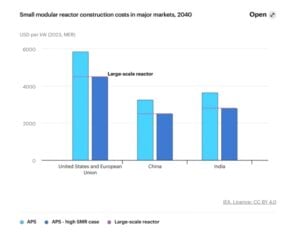
Unlike traditional reactors that generate over 1,000 megawatts (MW), SMRs typically produce up to 300 MW each. Multiple modules can combine to meet larger power needs. Furthermore, experts believe factory-built components could significantly cut project costs and timelines compared to traditional nuclear plants.
Thus, SMRs are increasingly seen as a solution to meet energy needs.
- FURTHER DETAILS: SMRs Set for Breakout: Global Nuclear Capacity Forecast to Jump Nearly Sixfold by 2030
Financing Nuclear Like Infrastructure
One of Blue Energy’s key goals is to tackle a long-standing issue in the nuclear sector: financing. Traditional nuclear projects often need billions upfront and take over a decade to finish. This makes investors wary due to delays and cost overruns.
Blue Energy aims to change this by merging standardized reactor technology with modular manufacturing and financing structures common in offshore energy and infrastructure projects.
Large sections of each plant will be made in controlled shipyards using robotic manufacturing before being sent to project sites for assembly. The company argues that standardization can improve cost certainty, reduce risks, and help lenders finance projects like conventional infrastructure assets.
If successful, this approach could speed up deployment and lower financing costs for future nuclear projects.
Building on Earlier Momentum
The Constellation investment follows several key milestones for Blue Energy in 2026.
Earlier this year, the company raised $380 million and teamed up with GE Vernova to develop multi-gigawatt gas-to-nuclear projects. This hybrid strategy lets developers generate electricity with natural gas while preparing sites for nuclear generation, meeting immediate power needs without waiting for full reactor construction.
Blue Energy also reached an important U.S. Nuclear Regulatory Commission licensing milestone, supporting its goal of delivering nuclear power in 48 months or less under its phased deployment model.
- The company plans to start early site work for its first Texas project in 2026, aiming for a final investment decision in 2027.
Rising Demand Creates New Opportunities
Interest in SMRs is growing as the U.S. faces its strongest electricity demand in years.
The U.S. Department of Energy says data centers might use 12% of total U.S. electricity by 2028. To be more precise, the EIA projects that data center server electricity consumption alone could reach 818 billion kilowatt-hours by 2050 under its High Electricity Demand case.
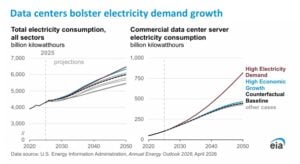
And this rise is mainly due to AI infrastructure. Utilities and tech firms are looking for steady, carbon-free power sources to meet this demand.
- The White House aims to expand U.S. nuclear capacity to 400 GW by 2050, while supporting 5 GW of new nuclear generation and reactor uprates by 2030.
- Additionally, it offers tax incentives, loan programs, and licensing reforms. These efforts aim to cut development timelines.
These initiatives, along with private investment from major energy firms like Constellation, show that advanced nuclear is entering a new phase of commercialization.
Blue Energy’s partnership with the country’s largest nuclear operator brings validation and expertise. This helps them commercialize a model that makes nuclear power faster to build, easier to finance, and better for meeting America’s rising electricity demands.