

Europe reaches a key milestone in carbon removal. Puro.earth has certified the first permanent carbon removal project. This project captures biogenic carbon dioxide (CO₂) from biogas and stores it underground.
Developed by Inherit Carbon Solutions at Norway’s VEAS wastewater treatment plant, this project is the first biogas-based bioenergy with carbon capture and storage (BECCS) to earn CO₂ Removal Certificates (CORCs). It’s also Puro.earth’s first certified BECCS project in Europe.
This achievement highlights how wastewater treatment plants can aid in permanent carbon removal and support Europe’s climate goals.
First Certified BECCS Project for Biogas in Europe
Puro.earth validated the VEAS project after a third-party audit. This certification follows its Geologically Stored Carbon methodology, ensuring that captured carbon is permanently removed from the atmosphere.
- In its first four months of operation, from February to May 2026, the project earned over 700 CO₂ Removal Certificates (CORCs). More certificates will follow as monitoring continues.
Unlike traditional carbon capture projects, this one captures biogenic CO₂ released during biogas production. Since this carbon comes from organic waste, storing it creates negative emissions, effectively removing carbon from the natural cycle.
This project is a key example of engineered carbon dioxide removal (CDR), an industry expected to grow for global net-zero targets.
Jan-Willem Bode, President, Puro.earth, commented:
“Inherit’s issuance shows what’s possible when biogas infrastructure and carbon storage infrastructure are combined through one succinct process. Biogenic CO2 that would otherwise have been released is instead captured and permanently stored. This is exactly the kind of innovative approach to BECCS that the Puro Standard and Registry was built for. Inherit is a true pioneer in this field, and we’re proud to certify the world’s first project of its kind. With the scale of biogas production across Norway, the Nordics and more widely across Europe, the potential for BECCS regionally is significant.”
Turning Wastewater Into Permanent Carbon Removal
The project operates at the VEAS wastewater treatment plant in Slemmestad, Norway, serving over 800,000 residents in Oslo, Bærum, and Asker.
As wastewater is processed, organic material breaks down, producing biogas. This process releases biogenic CO₂. Instead of letting that CO₂ escape, project partners capture and permanently store it.
Three companies work together on this project, each handling a different stage:
- Inherit Carbon Solutions develops and manages the carbon removal project.
- HoopCO2 captures and liquefies biogenic CO₂.
- Northern Lights transports and stores the CO₂ beneath the North Sea.
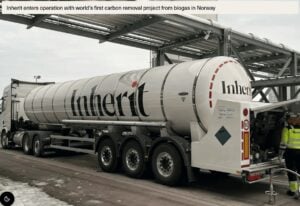
Once captured, the liquefied CO₂ is trucked to Northern Lights’ terminal in Øygarden, west of Bergen. From there, it moves through pipelines to a geological storage site about 2,600 meters below the seabed, where it remains trapped.
Northern Lights began commercial offshore CO₂ storage in 2025, mainly for fossil-based emissions. The VEAS project is its first operation for biogenic CO₂, marking a shift towards permanent carbon removal.
Under the current agreement, Northern Lights will store up to 7,000 metric tons of biogenic CO₂ each year from the VEAS facility.
On this development, Kaja Voss, CEO, Inherit Carbon Solutions, added,
“Working with Puro.earth through this certification has given us a clear and credible pathway to bring these credits to market. This project shows just how much potential there is across the biogas supply chain for capturing and permanently storing biogenic CO2. The collaboration with HoopCO2 and Northern Lights has been strong, and we’re excited about what this pilot means for scaling biogenic CO2 removal from biogas facilities more broadly.”
A Model That Can Scale Across the Biogas Industry
This project stands out because it uses existing infrastructure.
Many wastewater treatment plants and biogas facilities produce biogenic CO₂. By adding capture equipment and connecting to transport and storage networks, they can turn routine waste processing into permanent carbon removal.
This approach avoids building new systems from scratch. Instead, it upgrades existing facilities to provide real climate benefits. Since wastewater plants and biogas facilities operate in many countries, this model could spread across Europe and beyond.
Smaller BECCS projects like VEAS also need lower upfront investments and shorter development times than large carbon capture facilities. This allows developers to launch projects faster while proving commercial viability.
For companies buying durable carbon removal credits, projects like VEAS offer verified removals backed by strict monitoring and permanent geological storage.
- READ MORE: Frontier Backs Norway’s First Carbon Capture Retrofit! Is This the Future of Waste-to-Energy?
BECCS Could Power Europe’s Path to Net-Zero
Bioenergy with carbon capture and storage is vital for Europe’s climate strategy.
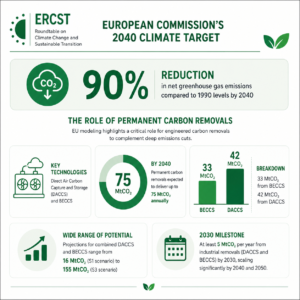
The European Commission’s proposed 2040 climate target aims for a 90% reduction in net greenhouse gas emissions compared to 1990 levels. To reach that goal, emissions cuts alone won’t suffice. Europe expects engineered carbon removal technologies to eliminate millions of tons of CO₂ from the atmosphere each year.
Current estimates suggest that by 2040:
- BECCS could remove around 33 million metric tons of CO₂ annually.
- Direct Air Carbon Capture and Storage (DACCS) could add another 42 million metric tons.
- Together, these technologies could remove up to 75 million metric tons of CO₂ each year.
Some climate scenarios estimate that combined BECCS and DACCS could range from 16 million to 155 million metric tons annually, depending on technology growth and policy support.
The Commission expects industrial carbon removal to reach at least 5 million metric tons per year by 2030, with significant growth in the following decade.
Europe Has Much Greater BECCS Potential
Recent analysis shows Europe could remove even more carbon than current targets require.
As per Bioenergy Europe data, adding carbon capture to 38% of Europe’s biomass facilities could yield about 80 million metric tons of CO₂ removals annually—enough to meet the EU’s projected 2040 needs.
- If carbon capture expands to half of existing biomass plants, annual removals could reach about 105 million metric tons.
Europe produces around 220 million metric tons of biogenic CO₂ yearly from bioenergy facilities. Capturing and storing half of that would surpass many climate projections.
The biggest opportunities lie in:
- Combined heat and power (CHP) plants
- Pulp and paper mills
- Waste-to-energy facilities
- Biogas production plants
Countries like Sweden, Germany, Finland, and the UK have strong potential due to their large bioenergy sectors. France, Italy, and Austria also have significant untapped opportunities.
Policy Support Will Determine Future Growth
While the technology is available, experts believe that policy support will dictate how quickly BECCS grows in Europe.
Developers are urging stronger demand for durable carbon removals through climate laws, financial incentives, and carbon credit markets. And so investing in CO₂ transport pipelines, shipping terminals, and storage sites will be crucial as more projects begin.
Clear permitting guidelines and stable regulations could lower project risks and attract private investment.
Projects like VEAS show that permanent carbon removal is moving from pilot stages to commercial use. As governments and companies invest in engineered carbon removal, similar BECCS facilities may play a vital role in Europe’s net-zero and net-negative goals. They will also boost the clean energy economy.