

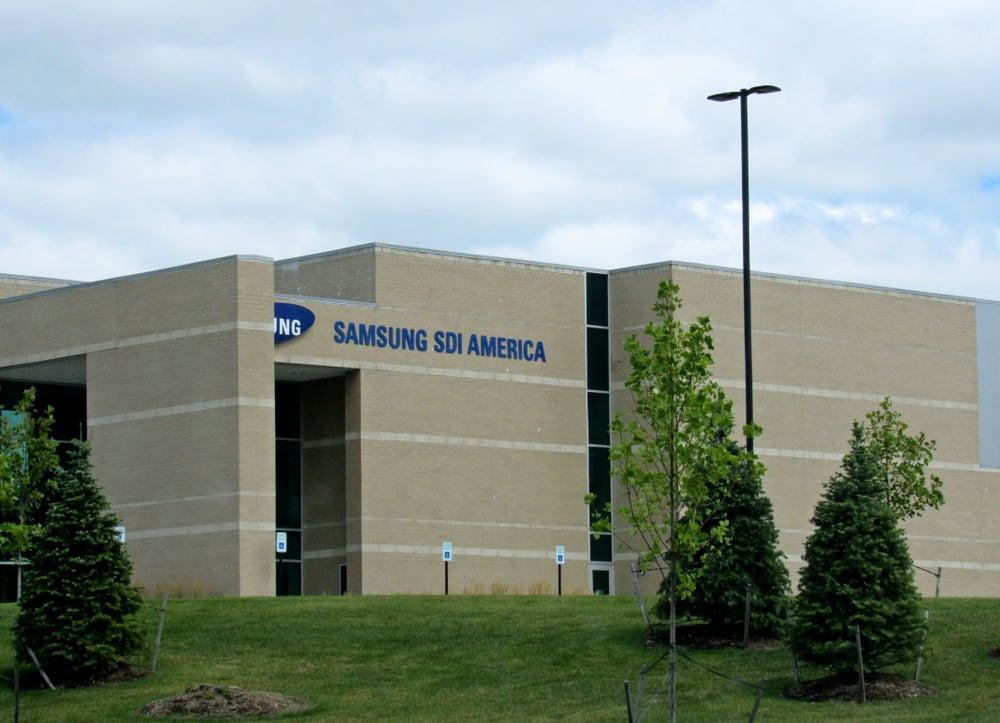
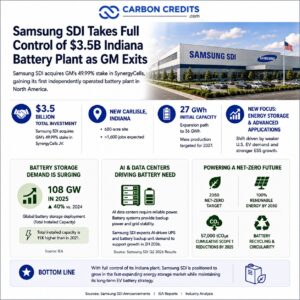
Samsung SDI is taking full control of a $3.5 billion battery plant in Indiana after General Motors decided to exit its joint venture. The South Korean battery maker will acquire GM’s 49.99% stake in SynergyCells, the joint venture developing the facility in New Carlisle, Indiana. The move gives Samsung SDI full ownership of the project and its first independently operated battery production facility in North America.
The companies originally planned the plant to produce electric vehicle (EV) batteries. Samsung SDI and GM agreed in 2024 to invest about $3.5 billion, with an initial annual capacity of 27 gigawatt-hours (GWh) and an expansion path to 36 GWh.
Mass production was targeted for 2027, but market conditions have changed. Samsung SDI now plans to use the facility initially for energy storage system (ESS) batteries and other advanced applications. The decision reflects slower-than-expected EV demand in the U.S. while battery storage demand continues to grow.
Samsung SDI Takes the Wheel in Indiana as GM Exits
Samsung SDI and GM announced their battery partnership in 2023. They finalized the Indiana joint venture in August 2024.
The project is located on a 680-acre site in New Carlisle. The original plan called for more than 1,600 jobs and annual battery production of 27 GWh in the first phase. The companies also planned to expand the facility to 36 GWh.
GM will now sell its 49.99% interest to Samsung SDI. The purchase price has not been disclosed.
The ownership change reflects the weaker-than-expected growth of EV demand, according to Samsung SDI. The two companies will end the joint venture but continue their broader strategic relationship.
They have also agreed to jointly develop next-generation prismatic battery cells for future EV applications. This keeps GM connected to Samsung SDI’s battery technology without requiring the automaker to remain an owner of the Indiana facility.
Indiana Plant Gets a New Market
The biggest change is the planned shift toward energy storage. Samsung SDI said the Indiana facility can respond to growing demand for ESS batteries in the U.S. The company has not publicly specified how much of the plant’s eventual capacity will be dedicated to ESS products.
That flexibility could become important as the battery market expands beyond electric cars. The International Energy Agency (IEA) reported that global battery storage deployment reached 108 GW in 2025, up 40% from 2024. Utility-scale systems accounted for about 87 GW, or roughly four-fifths of the total. Other industry analysis shows the following gross capacity for the battery energy storage systems (BESS) market.
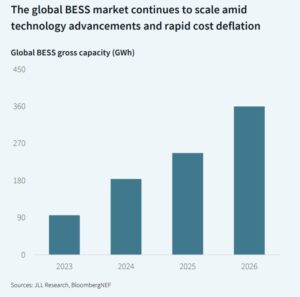
Battery storage has become one of the fastest-growing technologies in the global power sector. Total installed battery storage capacity is now 11 times higher than in 2021, according to the IEA. The shift toward BESS therefore gives Samsung SDI another market for a factory that was originally designed around EV demand.
AI Is Adding to Battery Storage Demand
The growth of artificial intelligence is creating another source of demand for batteries. AI data centers require large amounts of electricity and highly reliable power. Battery systems can provide backup power and help manage short-term changes in electricity supply.
Samsung SDI has been targeting this market.
In its second-quarter 2026 results, the company said it expects AI-driven UPS and battery backup unit demand to support its business in the second half of the year. It also pointed to U.S. prismatic LFP battery production and expansion of EV projects as growth drivers.
Global Battery Demand Still Has Long-Term Growth
The Indiana strategy does not mean EV batteries are losing their long-term importance. The IEA’s Global EV Outlook 2026 found that global EV battery deployment reached 1.2 TWh in 2025, almost 30% higher than in 2024. EVs accounted for more than 70% of total battery deployment last year.
The agency expects global EV battery deployment to reach almost 3 TWh by 2030 under both its Current Policies Scenario and Stated Policies Scenario.
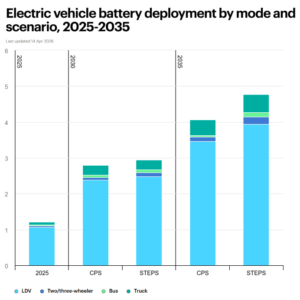
Electric trucks are also becoming a larger source of battery demand. They accounted for about 8% of global EV battery deployment in 2025, up from less than 5% in 2024. The IEA expects that share to reach about 10% by 2030.
Battery manufacturing capacity is expanding as well. Global battery cell manufacturing capacity grew almost 30% in 2024, reaching more than 3 TWh. U.S. manufacturing capacity grew almost 50%, with Korean companies accounting for nearly 70% of that increase.
This supports Samsung SDI’s decision to maintain a large U.S. manufacturing presence even as the immediate EV market outlook changes.
Samsung SDI Pairs U.S. Expansion With a Net-Zero Push
The Indiana expansion also fits into Samsung SDI’s wider environmental strategy. The company has a 2050 net-zero target and joined the RE100 initiative in 2022. Its environmental strategy includes shifting to renewable electricity, reducing direct greenhouse gas emissions, moving business vehicles to zero-emission vehicles, and expanding battery recycling.
Samsung SDI’s latest sustainability report sets a goal of 100% renewable energy use by 2050 across its operations. The company is also working to reduce direct emissions and expand the use of recycled battery materials.
The company reported that it reduced a significant amount of greenhouse gas emissions across its facilities in 2024 as part of its climate roadmap. It also reported that its cumulative direct (Scope 1) greenhouse gas reductions reached 32,000 tons by 2024, which grew to a total of 57,000 tons the following year.
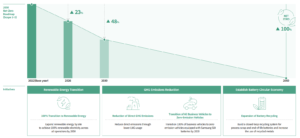
Samsung SDI is also investing in battery circularity. Its sustainability strategy includes developing closed-loop systems for production scrap and used batteries and increasing the use of recycled metals. These measures will become more important as the company expands its manufacturing footprint in North America.
Battery Strategy Is Becoming More Flexible
Samsung SDI’s takeover reflects a wider change in the battery industry. Battery manufacturers are still preparing for strong long-term EV growth, but they are also responding to changing demand in the near term. Energy storage, data centers, and other power-intensive industries are creating new markets for battery technology.
The IEA’s latest data supports this broader view. Battery storage grew 40% globally in 2025, while EV battery deployment also increased almost 30%.
For Samsung SDI, the ability to serve both markets could make the Indiana plant more valuable. The company will have greater control over the facility after acquiring GM’s stake. It can also adjust its production strategy as demand changes.
At the same time, the company still has a relationship with GM through the development of next-generation prismatic EV batteries.
A New Role for Samsung SDI’s Indiana Plant
Samsung SDI’s decision to take full control of the Indiana facility changes the project’s original purpose but not its broader strategic importance.
The $3.5 billion plant was initially planned as a major U.S. EV battery hub, with 27 GWh of initial annual capacity, an expansion path to 36 GWh, and more than 1,600 expected jobs.
Now, its first major role could be in the BESS market. That shift comes as global battery storage reaches record levels and AI increases demand for reliable electricity infrastructure. At the same time, EV battery demand continues to grow and is expected to approach 3 TWh annually by 2030.
Samsung SDI’s move shows how the battery industry is adapting to a changing market. Rather than relying on EV demand alone, the company is positioning its Indiana investment to serve a broader mix of electric mobility, grid storage, and emerging power needs.