

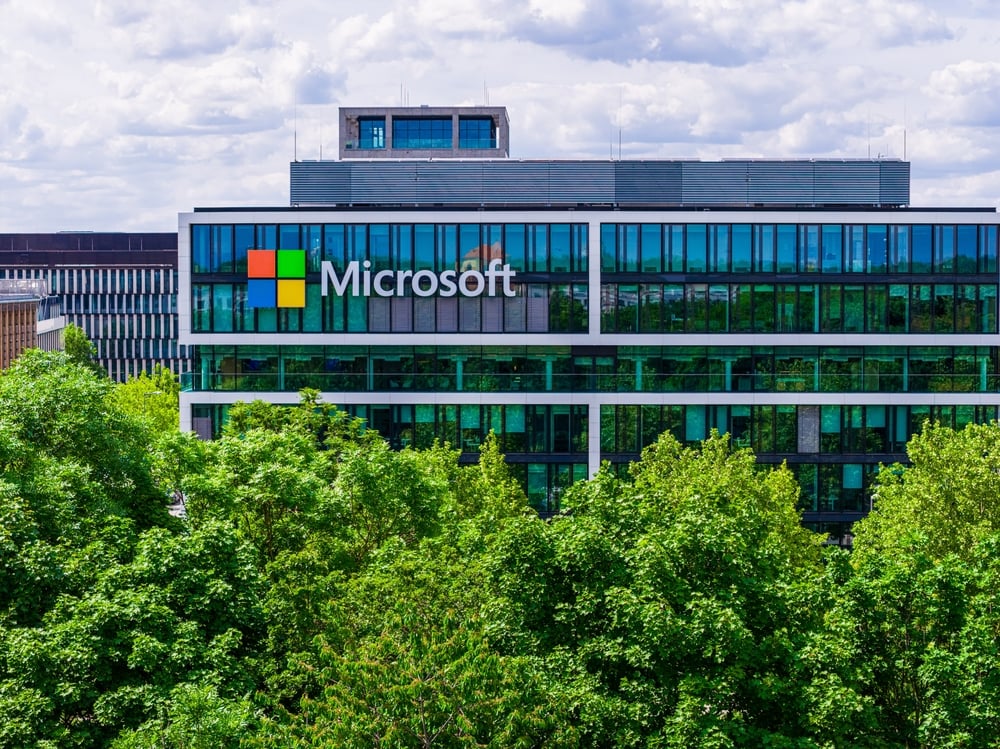
Aker Solutions and Microsoft (MSFT) are joining forces to help move carbon capture and storage (CCS) and carbon dioxide removal (CDR) projects from early-stage concepts to construction and operations.
The companies signed an agreement at ONS 2026 in Stavanger, Norway, as the carbon management industry faces a familiar challenge: plenty of proposed projects, but not enough financing, firm buyers and execution-ready developments.
Aker Solutions Targets Faster, More Bankable CCS and CDR Projects
Under the agreement, Aker Solutions will work with project developers, industrial emitters, transport and storage companies, governments and other stakeholders. The goal is to improve project economics, reduce execution risks and make projects more attractive to investors.
The partnership also aims to help projects reach final investment decisions (FID) faster.
Microsoft brings digital technology, artificial intelligence (AI), data, carbon markets and monitoring, reporting and verification (MRV) expertise. Aker Solutions brings techno-economic advisory services and engineering, procurement and construction capabilities.
Together, the companies intend to create a more integrated path from feasibility studies to project delivery and operations.
Kjetel Digre, CEO at Aker Solutions, said,
“Many carbon capture and removal projects face similar challenges as they move from concept to reality. As the market matures, success will depend on strong collaboration across the value chain. Joining forces with Microsoft, we aim to help project developers navigate complexity, strengthen business cases, and support the next wave of CCS and CDR projects.”
Microsoft’s Carbon Challenge Is Growing
The partnership comes as Microsoft faces a tougher emissions challenge from the rapid expansion of artificial intelligence and cloud infrastructure.
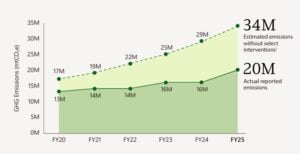
- Microsoft’s latest Environmental Sustainability Report shows that its total Scope 1, 2 and 3 emissions rose 25% year over year in fiscal 2025.
- The company reported about 20.3 million metric tons of CO2 equivalent in FY25, up from roughly 16.2 million tons in FY24.
The increase was primarily due to the expansion of its data center infrastructure and a change in its use of non-additional, unbundled renewable energy certificates.
Scope 3 emissions remain the largest part of Microsoft’s footprint. At the same time, Scope 2 emissions increased sharply as the company expanded its electricity demand. Scope 2 accounted for about 13% of total emissions in FY25, compared with nearly 2% in the previous year.
Microsoft said it matched 100% of its annual global electricity consumption with renewable energy in FY25. However, the company is increasingly focused on adding new carbon-free electricity to grids rather than relying on unbundled certificates alone.
The rise in emissions makes carbon removal an increasingly important part of Microsoft’s strategy. It has committed to becoming carbon negative by 2030 and removing the equivalent of all its historical emissions by 2050. But the company has also stressed that removals cannot replace direct emissions reductions.
That puts pressure on Microsoft to expand both its clean-energy investments and its carbon removal portfolio.
Darryl Willis, corporate vice president, energy and resources at Microsoft, said:
“Microsoft supports collaborations that look holistically across the entire value chain, connecting physical infrastructure with trusted data, AI and digital MRV to help projects reduce risk, and move from ambition to execution. We are working with Aker Solutions to bring these complementary capabilities together and help accelerate credible CCS and carbon removal projects globally.”
- SEE MORE: Microsoft Cuts Carbon Removal Buying by 80% as AI Emissions Put Climate Goals Under Pressure
Microsoft Has Become the Biggest CDR Buyer
Microsoft has played an outsized role in building the market for durable carbon removal.
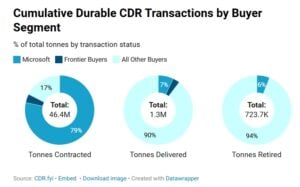
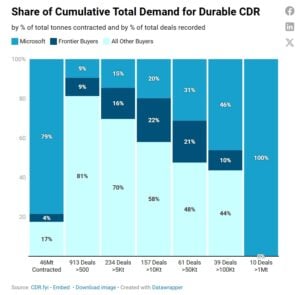
CDR.fyi estimates that Microsoft had contracted 36.4 million tonnes of durable carbon removal by April 2026. That represented 78.5% of all disclosed durable CDR tonnes contracted at the time.
Frontier-linked buyers accounted for another 4%, while all other buyers represented 17.5%.
Its position is even more significant when looking at large-scale deals. CDR.fyi says Microsoft is the only buyer to have signed disclosed purchase agreements exceeding 1 million tonnes.
Its portfolio is also heavily concentrated in bioenergy with carbon capture and storage, or BECCS, which represented about 76% of its disclosed durable CDR volume as of April.
Microsoft continued buying carbon removal in 2026. In the first quarter, it signed a 1-million-tonne agreement that helped push total durable CDR contracting to 2.3 million tonnes, the largest first quarter on record. Microsoft accounted for about 43% of Q1 contracted volume.
The company has also expanded into other removal approaches. In January 2026, Microsoft signed a 12-year agreement to purchase 2.85 million soil carbon removal credits from Indigo Ag. The deal was described as the largest voluntary soil carbon transaction to date.
CDR Supply Still Faces a Financing Gap
The growing number of purchases does not mean enough carbon removal capacity is ready to meet future demand.
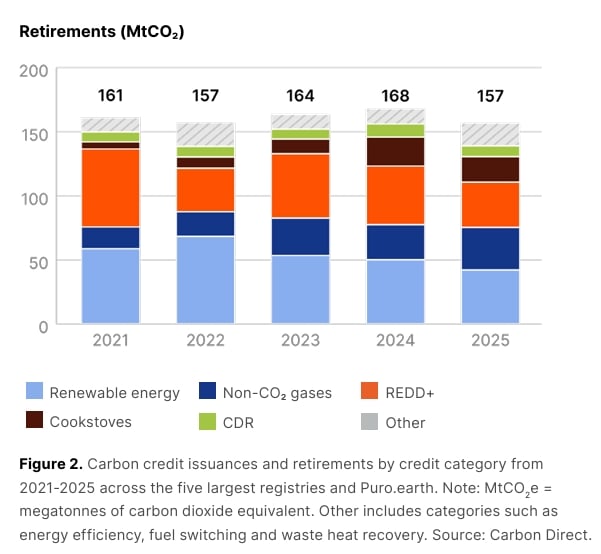
Carbon Direct’s 2026 State of the Voluntary Carbon Market report analyzed 288 million tonnes of credits and found that more than 80% of high-durability CDR supply planned for 2030 is at risk of not being realized without additional offtake commitments and financing.
The report also identified an estimated $18 billion financing gap across CDR pathways.
That creates a major bottleneck for technologies such as direct air capture, BECCS and other forms of durable carbon removal. Developers need long-term buyers before they can secure financing, while buyers need confidence that projects will actually be built and deliver verified removals.
This is where the Microsoft-Aker Solutions agreement could become important.
From Carbon Credits to Bankable Projects
Aker Solutions will help developers improve project maturity and bankability before construction begins.
That could include assessing project economics, engineering requirements, infrastructure needs and execution risks. Microsoft can complement this work with digital tools, AI, data systems, carbon-market knowledge and MRV capabilities.
The companies will also work across the wider CCS and CDR value chain.
That matters because carbon management projects are not standalone facilities. A CCS project needs an emitter, capture technology, transportation infrastructure, a storage site and a system for measuring and verifying the captured CO2.
CDR projects face similar challenges. Developers need reliable technology, financing, monitoring systems, storage or durable carbon sinks, and buyers willing to sign long-term contracts.
Aker Solutions and Microsoft aim to connect these pieces earlier in the development process.
If projects move successfully through FID, the companies plan to provide integrated engineering and execution support through construction and into operations.
A Critical Test for the CDR Market
The partnership arrives at a turning point for carbon removal.
CDR demand is growing, but the market remains heavily concentrated among a small number of buyers. CDR.fyi found that buyers other than Microsoft and Frontier accounted for 90% of delivered and 94% of retired durable CDR tonnes, despite representing a much smaller share of contracted volume.
That highlights the market’s central challenge: large future purchase agreements do not automatically translate into delivered removals. And for the wider industry, the partnership reflects a shift in focus from announcing carbon removal projects to making them financeable, buildable and operational.
The next phase of the CDR market will depend less on ambitious targets and more on whether developers can secure capital, buyers and infrastructure to deliver real, verified removals at scale.