

CF Industries, JERA and Mitsui are moving ahead with one of the world’s largest low-carbon ammonia projects, as demand grows for cleaner fertilizer and lower-emission energy products. The three companies have broken ground on the Blue Point One ammonia plant in Modeste, Louisiana. The project represents a $3.7 billion investment and is expected to produce 1.4 million metric tons of ammonia annually when it begins operations in 2029.
The scale is significant. Blue Point One is expected to become the world’s largest ammonia plant once operational, while creating more than 100 permanent manufacturing jobs and an estimated 3,900 construction jobs over four years.
U.S. Secretary of Agriculture Brooke Rollins joined federal, state and local officials at the groundbreaking, highlighting the project’s importance to both domestic agriculture and America’s industrial base. For investors, however, the bigger story is the project’s position at the intersection of fertilizer security, carbon capture and the emerging global market for low-carbon ammonia.
A Major Bet on U.S. Ammonia Production
CF Industries owns 40% of Blue Point One, while Japan’s JERA owns 35% and Mitsui holds the remaining 25%.
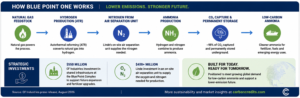
The companies are targeting 2029 for the start of production. The plant will use autothermal reforming, or ATR, to produce hydrogen, which is then combined with nitrogen to make ammonia.
- The key difference is what happens to the carbon dioxide generated during production.
Blue Point One Targets 98% CO₂ Capture
Blue Point One is designed to capture and permanently store about 98% of the CO₂ produced by the facility. A joint venture between Occidental subsidiary 1PointFive and Enbridge will handle the transportation and permanent sequestration of the captured carbon.
That could give the project one of the lowest carbon footprints among large-scale ammonia facilities.
The project is also designed to serve two markets. Traditional customers will use the ammonia for fertilizer, while emerging applications could include low-carbon fuels and energy-related uses.
That flexibility matters because ammonia is moving beyond its traditional role in agriculture.
Around 70% of global ammonia production is currently used for fertilizer, but the molecule is increasingly being considered as an energy carrier and fuel for sectors that are difficult to electrify.
CF Industries and Linde Create Expansion Potential
CF Industries is making another $550 million investment at the Blue Point Complex over the next four years. The spending will support shared infrastructure that can accommodate future ammonia production and fertilizer upgrades.
This creates an important option for expansion. Rather than building every piece of infrastructure from scratch for future projects, the companies can use the shared facilities already being developed around Blue Point One.
Linde is also investing more than $400 million in an on-site air separation unit. The facility will supply the oxygen and nitrogen needed for ammonia production.
Together, these investments create a broader industrial platform rather than a standalone ammonia plant. This could become increasingly valuable if demand for low-carbon ammonia accelerates through the end of the decade.
CF Industries President and Chief Executive Officer Chris Bohn said,
“We are proud to break ground on the Blue Point One joint venture, a transformative project that brings together American energy resources, world-class engineering and partnerships, and trusted global allies. Most importantly, this facility will serve people, growing access to the reliable, domestic nitrogen supply American farmers need to feed the world, expanding our nation’s export capacity through shipping American-made energy to global markets and creating jobs in Louisiana.”
Global Low-Carbon Ammonia Demand Is Growing, but Supply Is Still Limited
The timing of Blue Point One reflects a broader shift in the ammonia industry.
Global ammonia production is highly emissions-intensive. The International Energy Agency estimates that direct emissions from ammonia production are around 450 million metric tons of CO₂ annually. More than 70% of production currently relies on natural-gas-based steam reforming, with much of the remainder produced using coal.
At the same time, demand for ammonia is not disappearing. Population growth and rising food demand are expected to support continued fertilizer consumption, while new markets could emerge in shipping, power generation and other energy applications.
The supply side, however, remains at an early stage.
- The IEA says announced and existing near-zero-emission ammonia projects have been expanding, but low-emission production remains a small share of the global market.
- A 2025 assessment found that low-emissions ammonia projects for fertilizer accounted for about 19 million tonnes of production capacity, including operational projects that had reached final investment decision or completed feasibility studies.
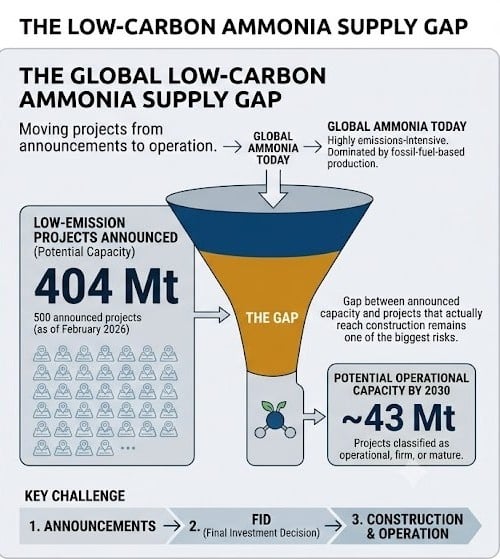
The project pipeline is much larger than current operating capacity. The Ammonia Energy Association identified 500 announced low-emission and transitional ammonia projects as of February 2026, representing 404 million tonnes of potential capacity. However, only about 43 million tonnes of that capacity could be operational by 2030 based on projects classified as operational, firm, or mature.
This gap between announced capacity and projects that actually reach construction remains one of the biggest risks for the sector.
JERA Connects Blue Point One to Global Markets
JERA’s involvement also gives Blue Point One an international dimension. It is Japan’s largest power generation company and a major player in the global energy market. Founded in 2015, it supplies about one-third of Japan’s electricity and ranks among the world’s largest buyers of liquefied natural gas (LNG).
The company operates across the energy supply chain, from gas exploration and LNG projects to fuel procurement, transportation and power generation. JERA is also expanding its focus on lower-carbon energy as part of its transition strategy. It aims to reach net-zero CO₂ emissions across its domestic and international operations by 2050.
JERA Global Energy Solutions Chief Executive Officer, JERA Senior Managing Executive Officer, Chief Operating Officer of Low Carbon Fuels Business Irtiza Sayyed:
“Today’s groundbreaking marks an important milestone for Blue Point One and brings us one step closer to establishing a reliable low-carbon ammonia value chain. At JERA, we believe that energy transition must be supported by practical projects and strong partnerships across the value chain. Blue Point One reflects this belief, bringing together partners with a shared commitment to build the foundation needed to scale lower-carbon ammonia for the future.”
Japan is one of the countries exploring ammonia as part of its strategy to reduce emissions from power generation and diversify energy supplies. Ammonia can be transported using established shipping infrastructure, making it easier to move between production hubs and overseas markets than hydrogen in some applications.
The IEA expects long-term bilateral contracts to play an important role in emerging hydrogen and ammonia trade, particularly because buyers need confidence that low-carbon fuel supplies will actually be delivered.
That creates an opportunity for U.S. producers with access to natural gas, carbon-storage infrastructure and export terminals.
Blue Point One brings those elements together.
Cost Remains the Critical Question
Low-carbon ammonia still has to compete with conventional production on price.
The IEA estimates that natural gas-based ammonia with carbon capture could reach production costs of roughly $230 to $440 per tonne by 2030 in regions with low-cost gas and suitable CO₂ storage. Electrolysis-based production could cost roughly $400 to $620 per tonne in regions with excellent renewable resources.
That makes carbon capture an important route for scaling lower-carbon ammonia, particularly in regions such as the U.S. Gulf Coast where natural gas, industrial infrastructure and potential CO₂ storage resources are available.
The economics could improve further as carbon prices, clean-fuel standards and corporate demand create premiums for lower-emission ammonia.
Blue Point Could Become a Platform for Future Growth
The biggest investment takeaway may not be the 1.4 million tonnes of annual production alone.
The additional infrastructure spending gives CF Industries and its partners room to expand the site as demand develops. That optionality could become valuable if fertilizer customers increasingly seek lower-carbon products or if shipping and power markets begin adopting ammonia at a larger scale.
All in all, the project therefore sits at the center of several major investment themes: U.S. manufacturing, fertilizer security, carbon capture, energy exports and the development of low-carbon fuels. The real test will come after groundbreaking. Blue Point One must move from construction to reliable production while proving that large-scale ammonia can be made with significantly lower emissions at a competitive cost.
If it succeeds, Louisiana could become an important hub in the next generation of global ammonia supply.