

The textile industry is facing a difficult climate equation. Global demand for clothing and other textile products continues to grow, while the industry is under increasing pressure to reduce emissions across energy use, raw materials, manufacturing and transportation.
The scale of the challenge is becoming clearer. The United Nations Environment Programme estimates that the fashion and textile sector accounts for 2% to 8% of global greenhouse gas emissions. The sector also consumes about 215 trillion liters of water annually, highlighting how closely its climate footprint is tied to broader resource use.
More recent data suggests that emissions are not falling fast enough.
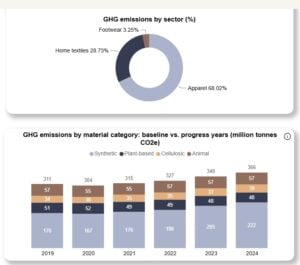
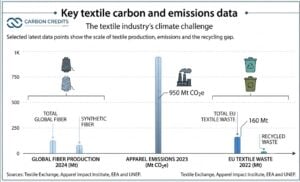
The Apparel Impact Institute calculated that global apparel emissions reached 944 million metric tons of CO₂e in 2023, up 7.5% from the previous year. The increase represented the first year-over-year rise in the institute’s series and was driven largely by higher apparel production and growing dependence on virgin polyester.
At the same time, the industry’s raw-material base continues to expand.
Global Fiber Production Hits Another Record
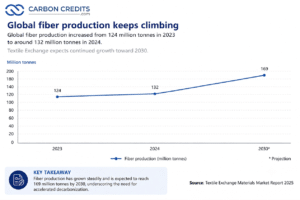
Textile Exchange reported that global fiber production climbed to approximately 132 million tonnes in 2024, up from 125 million tonnes in 2023. That means production has increased by roughly 34 million tonnes since the Paris Agreement was adopted in 2015. Textile Exchange expects continued growth toward 2030, and polyester sits at the center of this problem..
The trend matters because additional production can offset efficiency improvements. Even if individual factories become cleaner, total emissions can continue rising when the industry produces more material.
- Textile Exchange said polyester production reached approximately 78 million tonnes in 2024, accounting for about 59% of global fiber production. Synthetic fibers as a whole represented around 69% of the market.
The problem is that most polyester remains fossil-fuel-based. The industry therefore faces a double challenge: reducing the emissions associated with manufacturing textiles while also limiting the growth of virgin fossil-based materials.
Recycling is growing, but not quickly enough.
The share of recycled fibers was about 7.6% of the global fiber market in 2024, according to Textile Exchange. Yet less than 1% of global fiber production came from recycled pre- and post-consumer textiles. Most recycled polyester still comes from plastic bottles rather than old clothing.
That leaves manufacturers with a large decarbonization opportunity.
Where Textile Emissions Come From?
Textile emissions do not come from a single stage of production.
The footprint starts with raw materials. Producing polyester requires fossil feedstocks, while cotton can carry emissions from fertilizer, irrigation, farm machinery and land use.
The next major source is manufacturing.
Spinning, weaving, knitting, dyeing, finishing and drying can require substantial amounts of electricity and heat. In countries where factories rely heavily on coal and natural gas, the carbon intensity of textile production can be particularly high.
Transportation further boosts the emissions.
Recent corporate disclosures show how quickly logistics emissions can rise when brands depend on air freight. Shein reported 8.52 million tonnes of CO₂e from transportation in 2024, up 13.7% from 2023. Inditex reported 2.61 million tonnes of transport-related emissions in its 2024 financial year, up 10%.
The figures demonstrate why textile decarbonization cannot focus solely on fabric.
It needs to address the entire value chain.
Textile Carbon Credits Could Create a New Financial Incentive
This is where carbon markets become increasingly relevant.
A textile carbon credit can represent a verified reduction or removal of greenhouse gas emissions. In practical terms, a factory could reduce its emissions through measures such as renewable electricity, energy-efficiency improvements, fuel switching or cleaner industrial heat.
If the reduction qualifies under an approved carbon-crediting system, the resulting environmental benefit could potentially become a tradable asset.
That creates a direct economic incentive to reduce the amount of emissions generated per unit of textile production.
And the system is moving closer to implementation.
In August 2026, the Bureau of Energy Efficiency opened a tender to engage agencies for baseline energy and greenhouse-gas emissions data collection for the textile sector under CCTS.
This is an important development because reliable baselines are essential before factories can accurately determine how much they have reduced emissions.
What Textile Factories Can Do to Generate Reductions?
The biggest opportunities are likely to come from technologies that reduce fossil-fuel consumption.
Factories can replace coal- or gas-fired thermal systems with electric equipment where technically feasible. Renewable electricity can also reduce emissions from spinning, weaving and other electricity-intensive processes.
Energy efficiency offers another relatively immediate opportunity.
Efficient boilers, motors, compressors, heat recovery systems and process controls can reduce energy consumption without necessarily requiring a complete redesign of a factory.
Fuel switching could become particularly important for dyeing and finishing, where industrial heat represents a significant energy requirement.
Carbon-credit revenues could help improve the economics of these investments.
But there is an important caveat.
A company should not treat carbon credits as a substitute for cutting its own emissions. High-quality climate strategies prioritize direct reductions first. Credits can then provide an additional financial mechanism for verified reductions that meet strict accounting and verification requirements.
The Bigger Opportunity is Supply-Chain Finance
The textile industry’s carbon problem extends far beyond major fashion brands.
Thousands of manufacturers produce yarn, fabric, dyes, garments and finished products for global brands. Many smaller suppliers lack the capital to install renewable energy, modern boilers or advanced efficiency systems.
Carbon finance could potentially help bridge that gap.
This is particularly relevant to Scope 3 emissions. Verra’s emerging Scope 3 Standard program is designed to certify value-chain interventions and issue units associated with verified greenhouse-gas benefits. Its development work specifically includes textiles as a potential value-chain application.
That could eventually allow brands to help finance emissions reductions at supplier facilities while establishing a clearer link between the investment and the resulting climate benefit.
The model could look something like this:
- Brand financing → Factory investment → Verified emissions reduction → Carbon unit → Revenue/Scope 3 accounting
The key will be credible measurement.
Without accurate production data, energy data, and emissions baselines, it becomes difficult to determine whether a claimed reduction is real and additional.
Europe is Adding Another Layer of Pressure
The economics of textile emissions are also changing because governments are targeting waste and overproduction.
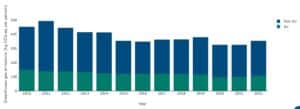
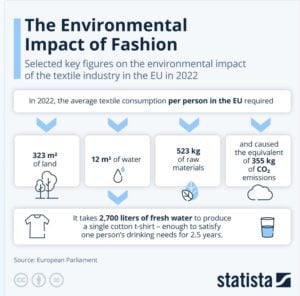
- EU textile consumption reached 19 kg per person in 2022, up from 17 kg in 2019. EU households’ textile consumption generated an estimated 159 million tonnes of CO₂e in 2022, equal to about 355 kg per person.
- Europe also generated approximately 6.94 million tonnes of textile waste in 2022, or 16 kg per person.
Greenhouse gas emissions from the EU’s textile consumption
The EU is moving toward stronger producer-responsibility and circularity requirements, while France has already introduced environmental fees targeting ultra-fast-fashion businesses such as Shein and Temu. And this could make low-carbon production increasingly important for exporters.
But Carbon Credits Are Not the Whole Solution
The textile industry’s climate challenge is ultimately a production problem.
Textile Exchange’s Climate+ strategy calls for a 45% reduction in greenhouse-gas emissions from fiber and raw-material production by 2030. Yet the organization says the industry remains off track to meet that target. This gap explains why carbon finance is attracting attention.
The opportunity is not simply to create another market for offsets. It is to direct capital toward factories and supply chains that can produce measurable, permanent and additional emissions reductions.
For investors, the most interesting opportunities may therefore sit behind the clothing brands—in renewable industrial heat, energy efficiency, low-carbon dyes, recycled fibers, textile-to-textile recycling and cleaner manufacturing.
For textile manufacturers, the message is even more direct.
Carbon is becoming a cost. But with credible measurement and the right market structure, it can also become a source of financing for the transition.
The companies that reduce emissions most efficiently could eventually gain an advantage not only in compliance but also in access to global customers demanding lower-carbon supply chains.
A summary of key textile carbon and emissions data
Bottom Line
Textile carbon credits are still an emerging market, but India’s inclusion of textiles in its compliance carbon market could be a major turning point. The combination of emissions-intensity targets, factory-level baselines and tradable certificates could turn decarbonization from a sustainability expense into a measurable financial incentive.