


Brazil is looking to China as a potential buyer of its carbon credits as it works to build a stronger international carbon market. Brazilian officials are preparing for talks with China that could lead to a bilateral carbon market agreement by COP31 in November. The discussions will focus on whether China could purchase Brazilian Internationally Transferred Mitigation Outcomes (ITMOs) under Article 6 of the Paris Agreement.
The talks come as Brazil builds its own regulated carbon market and China expands the world’s largest emissions trading system. A deal would connect two major emerging carbon markets and could create a new channel for climate finance in Brazil.
Brazil Targets China for Carbon Credit Demand
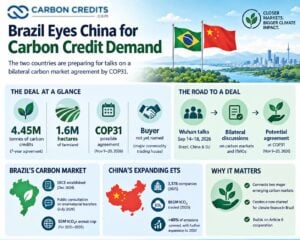
Brazil will send a carbon market delegation to Wuhan from September 14 to 18. Officials from Brazil, China, and the European Union will meet there as part of a larger carbon market coalition.
Brazil’s Ministry of Finance confirmed that the Wuhan meetings will include bilateral discussions between Brazil and China on carbon markets. The talks follow earlier discussions at the China-Brazil High-Level Coordination and Cooperation Committee, or COSBAN, held in Beijing in June.
Brazilian carbon market officials are also exploring whether China could become a buyer of Brazilian ITMOs.
If it works, this deal would be important. China lacks an official bilateral ITMO trading agreement with any other country, according to Brazilian officials mentioned by Reuters.
Brazil wants to move quickly enough to potentially announce an agreement at COP31 in Antalya, Türkiye, which runs from November 9 to 20. However, talks have not yet resulted in a finalized deal. The two countries still need to agree on the rules, eligible projects, and other conditions for any future transfers.
Brazil Is Building Its Own Carbon Market
The push toward international carbon trading comes as Brazil develops its domestic carbon market. The nation established the Brazilian Emissions Trading System (SBCE) through Law No. 15,042 in December 2024. The system aims to build a regulated market for emissions and carbon assets. It also supports the country’s climate goals.
The government is now working through the detailed rules needed to make the system operational.
In July, Brazil opened a public consultation on rules for international carbon credit transfers. The proposal allows Brazil to join Article 6 cooperation but limits overseas mitigation transfers.
The proposed framework includes a global ceiling of 50 million tonnes of CO₂ equivalent (MtCO₂e) for international transfers. The limit could later be adjusted based on Brazil’s emissions and the economic performance of the mechanism. The proposed rules apply to mitigation outcomes generated during 2031–2035.
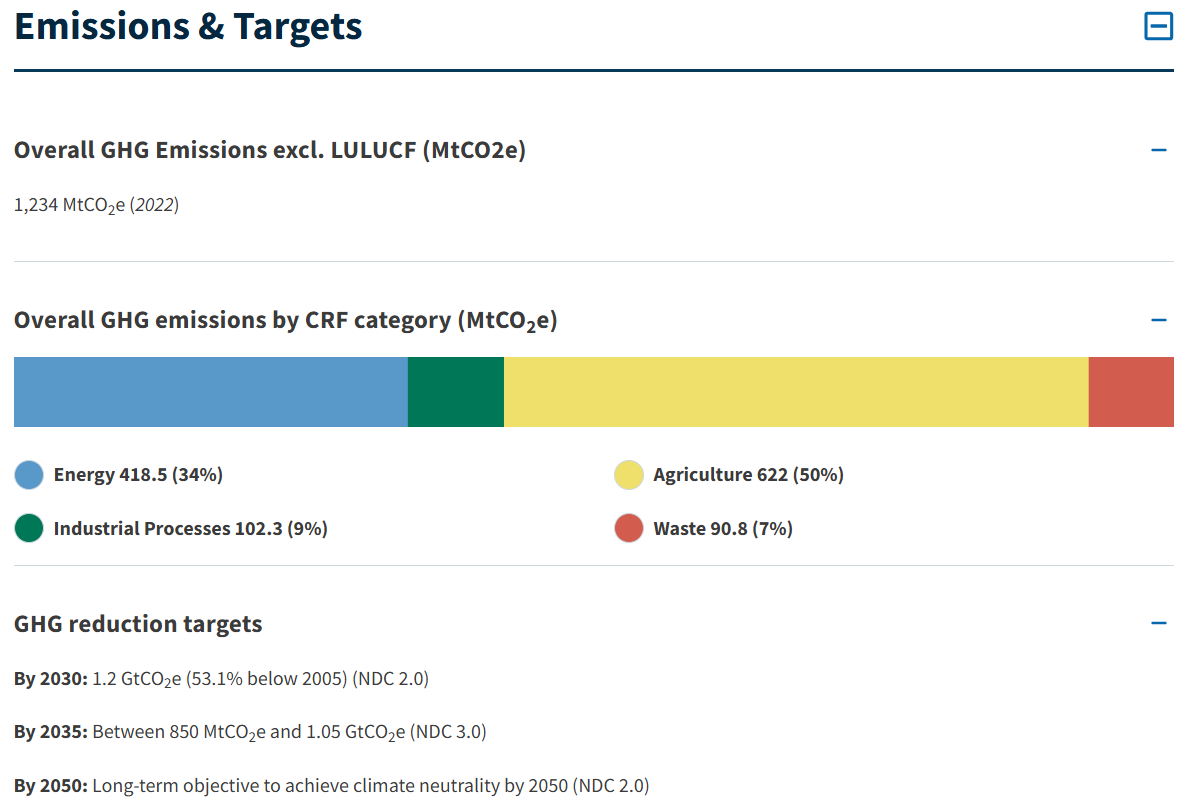
Brazil is setting up the legal framework for international carbon trading. However, large-scale exports of ITMOs won’t happen right away.
Why ITMOs Matter
ITMOs are different from ordinary voluntary carbon credits. Under Article 6.2 of the Paris Agreement, countries can cooperate directly and transfer mitigation outcomes toward their climate targets. These transfers need accounting rules. This stops both countries from counting the same emissions reductions.
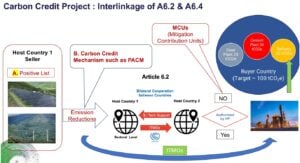
This is where the corresponding adjustment becomes important.
When Brazil authorizes a mitigation outcome for export, it must make the required adjustment to its emissions accounting. This prevents Brazil from using the same reduction toward its own nationally determined contribution (NDC) after another country has used it toward its target.
For Brazil, the system could turn high-quality emissions reductions and removals into a source of international climate finance. The country must choose wisely which reductions to send abroad. It needs to meet its own climate goals too.
Ana Paula Cavalcante, Brazil’s deputy secretary, said:
“Both the coalition and the closer relationship with China can help scale up carbon markets and unlock investment flows for Brazil as it seeks to reindustrialize around new technologies.”
China’s Carbon Market Is Expanding
China represents an important potential buyer because its domestic carbon market is becoming larger and more sophisticated. Its national emissions trading system covered 3,378 companies in 2025, including power, steel, cement, and aluminum producers.
Those companies took part in a market that traded 865 million tonnes of carbon allowances. This was worth 57.663 billion yuan for the year. China is also continuing to expand the system.
In 2025, steel, cement, and primary aluminum were added to the national ETS. The expansion means the national market now includes over 60% of China’s total carbon emissions, says China’s Ministry of Ecology and Environment.
China aims to make its national carbon market more comprehensive by 2030. This includes broader coverage, better allowance controls, and a voluntary market that aligns more closely with international standards.
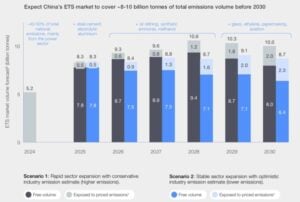
That makes China a potentially important future participant in international carbon market cooperation.
Brazil and China Are Already Building Market Links
The potential bilateral agreement is also part of a broader effort to make different carbon markets more compatible. Brazil launched the Open Coalition for Regulated Carbon Markets at COP30. China and the European Union are among its participants.
The coalition focuses on areas such as monitoring, reporting, and verification (MRV), carbon accounting, offset rules, and market interoperability. Brazil says the longer-term goal is to make regulated carbon markets more compatible and potentially allow deeper connections between them.
The coalition now has an important next step in Wuhan.
Brazil, China, and the EU are expected to advance a work plan for improving compatibility between their carbon markets. The group has expanded beyond its original members and now represents a significant share of global emissions.
This wider cooperation could simplify future carbon credit trading. It would create consistent rules for measuring and tracking emissions reductions.
High-Integrity Credits Will Be the Price of Entry
For Brazil, access to China’s market would only be valuable if the credits could meet strict quality requirements.
Brazilian carbon market officials have emphasized the need for high-integrity credits before any international transactions take place. The government’s plan requires that internationally transferred credits follow approved methods. They must also get authorization from Brazil’s national authority.
That requirement is especially important because Brazil has a large pipeline of nature-based climate projects, including forest conservation and restoration.
The government will need to ensure that exported mitigation outcomes are real, measurable, and properly accounted for. Otherwise, international transfers could create risks for Brazil’s own climate targets. The same issue applies to China. Any future bilateral market must provide confidence that credits bought by Chinese entities or the Chinese government represent genuine emissions reductions.
COP31 Could Become the Next Carbon Market Milestone
The next two months could be important for Brazil’s international carbon market strategy. The September 14–18 Wuhan meetings could advance Brazil-China talks, while COP31 in November could provide a potential deadline for announcing a bilateral framework.
Still, expectations should remain measured. Brazil is implementing its domestic carbon market, while its international transfer rules are still being developed. China is also refining its own ETS.
A Brazil-China agreement would not immediately create a large carbon credit market. Instead, it could establish the rules and institutional foundation for future ITMO transactions.
That would still be significant. Brazil has major potential for emissions reductions and removals, while China has a large and expanding carbon market. Linking the two could open a new channel for climate finance and strengthen Article 6 trading among two major emerging economies.
The bigger question is whether they can build a system that makes cross-border carbon trading credible, transparent, and scalable. If an agreement is reached by COP31, it could become an important test of how major developing economies use Article 6 to finance decarbonization.