Oracle (NYSE: ORCL)) latest earnings show how fast AI is changing its cloud business. They also point to a growing challenge. The company needs to build more data centers to meet AI demand. At the same time, it must manage the emissions, electricity, and water that come with that growth. The growth creates a major opportunity for Oracle.
But it also raises a key question: how much power and water will the company need to support the next phase of AI growth?
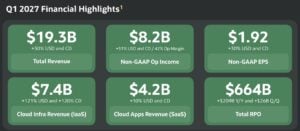
Oracle reported fiscal first-quarter 2027 revenue of $19.3 billion, up 30% from a year earlier. Cloud revenue rose 62% to $11.6 billion. Cloud infrastructure revenue more than doubled, rising 121% to $7.4 billion.
GAAP earnings per share increased 55% to $1.56. Adjusted EPS rose 30% to $1.92. Net income reached $4.76 billion, up 63%.
The company also added more than $30 billion in AI cloud contracts during the quarter. Its remaining performance obligations reached $664 billion.
Additionally, it delivered 850 megawatts of additional data center capacity during the quarter. It said demand for AI training and inference services still exceeds available supply.
ORCL Stock Faces the Cost of AI Expansion
The strong earnings came as Oracle continued to spend heavily on infrastructure. The company invested $28.5 billion in capital expenditures during the first quarter.
Oracle expects fiscal 2027 capital spending to reach about $90 billion to $95 billion. Free cash flow was negative $5 billion in the first quarter as the company continued to expand its cloud infrastructure.
This spending also has a sustainability impact.
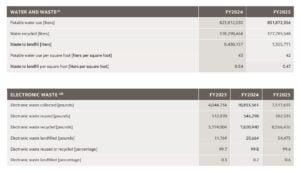
Every new data center requires power, cooling systems, construction materials, and water. The efficiency of those systems will affect both Oracle’s environmental footprint and the cost of expanding its cloud business.
On September 15, ORCL closed at about $140.35, down 3.07% for the session. Oracle shares have gone down 16.5% over five sessions.

Oracle’s Net-Zero Plan Covers Its Supply Chain
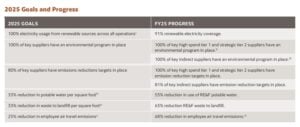
Oracle has set a net-zero emissions target for 2050. It also plans to cut Scope 1, Scope 2, and Scope 3 emissions by 50% from a 2020 baseline by 2030.
The company says it will focus first on direct emissions cuts. It plans to use high-quality carbon offsets for no more than 10% of its base-year emissions that it cannot eliminate directly.
And the Exponential Roadmap Initiative has approved Oracle’s targets.
Scope 1, 2, and 3 Data
Oracle’s latest emissions data also shows the impact of its rapid infrastructure growth. It reported 27,532 metric tons of Scope 1 emissions in FY2025. That was down from 29,930 tons in FY2024.
Market-based Scope 2 emissions also fell. They declined to 237,251 tons from 271,188 tons.
However, Scope 3 emissions moved in the opposite direction. They were 8.53 million metric tons in FY2025. That compares with 2.69 million tons in FY2024.
Capital goods made up about 6.96 million tons of the FY2025 Scope 3 total. This category includes emissions linked to infrastructure and equipment purchases.
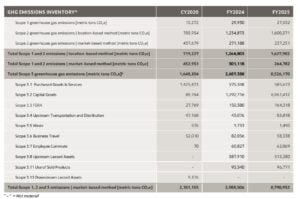
- Overall, Oracle reported 8.79 million metric tons of combined Scope 1, 2 and 3 emissions on a market-based basis in FY2025. The figure was 2.99 million tons in FY2024.
The increase shows how infrastructure spending can affect a cloud company’s wider carbon footprint.
Renewable Power Is Expanding
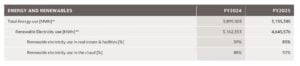
In the sustainability report, renewable electricity covered 92% of electricity used in its cloud operations in FY2025. That was up from 88% in FY2024.
Across its real estate and facilities, renewable electricity coverage reached 85%.
More importantly, Oracle has also set a target to reduce carbon emissions per megawatt of IT capacity by 20% by 2030. As AI workloads require more computing power, improving the emissions intensity of each megawatt will become more important.