


Skyborn Renewables has reached financial close on the Gennaker offshore wind farm, securing a €2.1 billion financing package, or roughly $2.4 billion, for one of Germany’s largest new renewable energy projects. The project, located in the German Baltic Sea, will have up to 976.5 megawatts (MW) of capacity. More than €3 billion in total investment is expected to be mobilized.
Gennaker will start commercial operations by the end of 2028. It aims to generate enough electricity for about 1 million German households.
The financing comes from 16 commercial lenders and the European Investment Bank (EIB). The EIB previously approved up to €700 million for the project, whose total cost was estimated at about €3.1 billion.
Nicola Beer, Vice-President of the European Investment Bank (EIB), noted:
“Gennaker shows Europe turning its clean‑energy goals into real benefits for people. Built off the coast of Mecklenburg‑Western Pomerania, where winds are strong and reliable, this wind farm will help Germany produce more of its own power and lower dependence on imported energy. Once running, it will supply clean electricity to around one million homes and businesses across the country, helping to bring down energy bills from Schwerin to Munich.”
The deal is also significant for BlackRock. Skyborn is a portfolio company of Global Infrastructure Partners (GIP), which has been part of BlackRock since it completed its acquisition of GIP in October 2024.
Gennaker Secures €2.1B to Move Into Construction
Financial close means the major financing, supply, power sales, and ownership agreements are now in place. Skyborn developed Gennaker from the ground up and will lead construction management and long-term asset management.
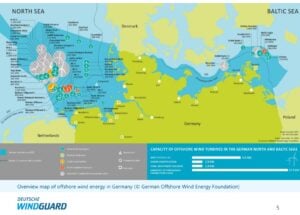
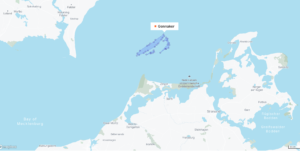
The project is located about 15 kilometers north of the Fischland-Darß-Zingst peninsula in Mecklenburg-Western Pomerania. Once complete, its nearly 1 GW capacity will make it the largest offshore wind farm in Germany’s Baltic Sea.
The wind project secured its construction and operations permit in December 2025. Major supply and installation contracts were also signed for foundations, cables, and wind turbines.
Siemens Gamesa is supplying the turbines, while other contractors include EEW, Seaway 7, Boskalis, and Fred. Olsen Windcarrier. Stadtwerke München, or SWM, is also now a 25% equity partner in the project, leaving Skyborn with a 75% stake.
Amazon and Uniper Lock In 700 MW of Power
Gennaker has also secured major buyers for its electricity. In June, Amazon signed a 600 MW power purchase agreement (PPA) covering about 61% of the project’s total capacity. Skyborn and Amazon described it as the largest single PPA ever signed in Germany.
The long-term contract was an important step because it gives the project predictable revenue from electricity sales.
Uniper also signed a 100 MW PPA with Skyborn. The agreement runs for an initial 10 years after commercial operation, with an option to extend. Together, the two contracts cover 700 MW, or roughly 72% of Gennaker’s maximum capacity.
These agreements illustrate how PPAs are becoming an important financing tool for large renewable projects. Long-term electricity contracts can provide revenue visibility that helps banks assess the project’s ability to repay debt.
Germany Needs Gennaker and Many More Like It
Gennaker arrives as Germany tries to expand offshore wind rapidly. The country has set a target of at least 30 GW of offshore wind capacity by 2030, 40 GW by 2035 and 70 GW by 2045.
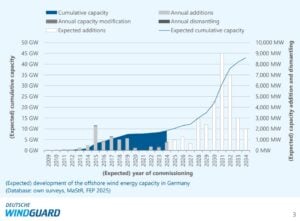
The country is also targeting 80% renewable electricity by 2030. Gennaker’s 976.5 MW would equal about 3.3% of Germany’s 2030 offshore wind target once fully operational.
The project will, therefore, make a meaningful contribution, but Germany will need many more large projects to reach its targets.
Moreover, offshore development remains challenging. Germany postponed offshore wind auctions originally planned for 2026 until 2027 as part of changes to its offshore wind development plan. The government said the delay would not affect the long-term 70 GW target for 2045.
A Large Bet on Energy Security
Offshore wind is also becoming part of Germany’s energy security strategy. The country is trying to reduce its dependence on imported fossil fuels while increasing domestic electricity production.
Gennaker will add nearly 1 GW of renewable capacity in the Baltic Sea and provide power to the German grid. That can help reduce the need for fossil fuel generation when wind conditions allow.
The project will also support Germany’s industrial base. It will involve European manufacturers, marine contractors, and others in the offshore wind supply chain. The EIB expects the project to create economic value in Mecklenburg-Western Pomerania, where Gennaker is being developed.
Europe’s Offshore Wind Investment Is Accelerating
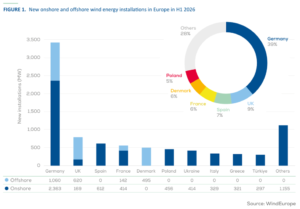
Gennaker is part of a broader recovery in European offshore wind investment. Europe had 40.9 GW of offshore wind capacity by the end of June 2026, after adding 2.3 GW in the first half of the year.
Governments also awarded 8.4 GW of offshore wind capacity through auctions during the period. Germany led additions with 3.4 GW.
Investment is picking up as well. Europe raised €9 billion for new wind projects in H1 2026, including about €0.6 billion for offshore wind. In 2025, six large offshore projects reached final investment decisions, representing 5.6 GW and €22 billion of investment.
The longer-term opportunity is much larger. Nine North Sea countries signed a 2026 Investment Pact targeting 15 GW of new offshore wind each year from 2031 to 2040, with industry estimating up to €1 trillion in related economic activity.
However, investment still faces challenges. Grid capacity, permitting, supply chain constraints, and higher project costs remain major barriers. That makes successful financings such as Gennaker important signals that Europe’s offshore wind market can still attract large-scale capital.
Offshore Wind Has a Direct Climate Benefit
Wind power produces electricity without the direct CO2 emissions associated with coal and natural gas generation. Replacing fossil fuel generation with renewable electricity can therefore lower power sector emissions, depending on the generation it displaces.
However, Gennaker should not be described as a carbon credit project. The wind farm will generate renewable electricity rather than voluntary carbon credits. Its climate value comes from replacing carbon-heavy electricity. It also supplies low-carbon power to the grid and contracted customers.
This distinction is important as demand for renewable energy grows alongside carbon markets.
Companies such as Amazon are increasingly using long-term PPAs to secure renewable electricity for their operations and support their emissions goals. However, a renewable energy PPA is not the same as a carbon credit purchase.
BlackRock Expands Its Renewable Infrastructure Footprint
The project also fits into a larger trend in infrastructure investment. BlackRock completed its acquisition of GIP in October 2024, creating a much larger infrastructure investment platform. At completion, the combined platform had about $170 billion in assets under management and more than 300 active investments.
GIP invests across energy, transport, digital infrastructure, and other sectors. Offshore wind matches that strategy. Projects need a lot of upfront money, but they can bring in steady income from power sales over time.
Gennaker’s financing structure shows how public and private capital can work together. Commercial banks provide most of the debt, while the EIB supports the project as a major European climate and infrastructure investment.
A Nearly 1 GW Bet on Germany’s Clean Power Future
Gennaker is moving from development to construction. For Germany, the project adds a significant amount of new offshore wind capacity as the country works toward its 30 GW target for 2030.
Skyborn, backed by BlackRock, shows how to finance big renewable projects. They combine institutional capital, bank debt, equity, and long-term power contracts.
Gennaker points out an important fact for the energy transition: to decarbonize electricity, we need billions of dollars for infrastructure first. Only then will the emissions benefits reach the grid. Projects like Gennaker will become increasingly important to Germany’s effort to expand clean power while reducing its reliance on fossil fuels.