

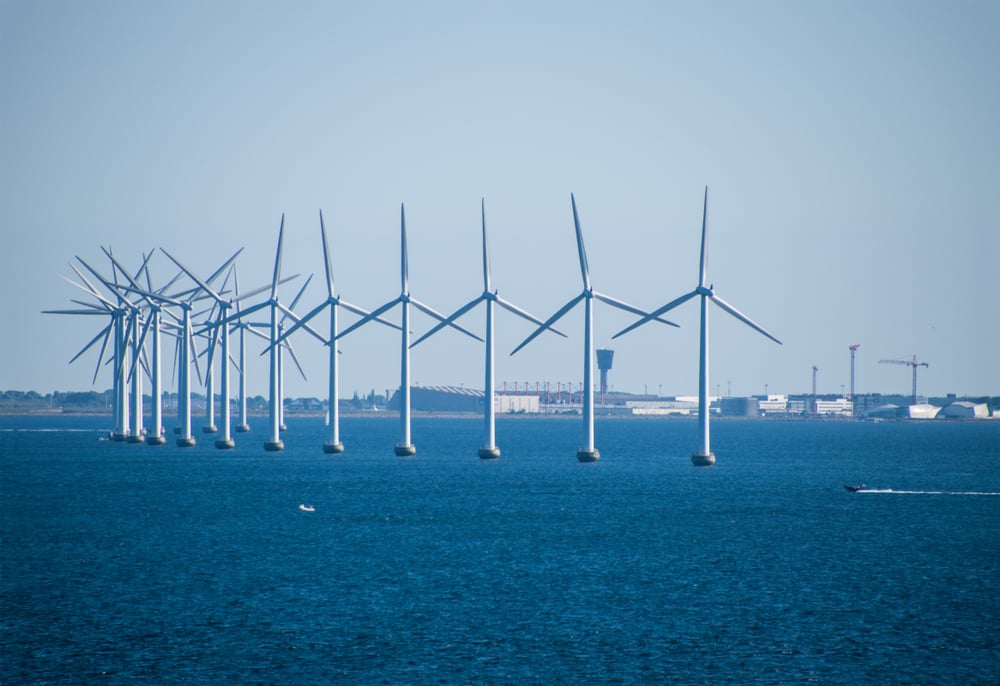
Amazon has signed Germany’s biggest-ever corporate clean energy deal, marking another major step in Europe’s renewable energy transition. The tech giant has entered into a 600-MW power purchase agreement (PPA) with offshore wind developer Skyborn Renewables for electricity from the Gennaker offshore wind farm in the German Baltic Sea.
The agreement is not only the largest single PPA ever signed in Germany but also ranks among the biggest corporate renewable energy contracts in Europe, according to BloombergNEF. The deal covers about 61% of Gennaker’s planned 976.5 MW capacity, providing the financial certainty Skyborn needs to begin construction.
The project also strengthens Amazon’s position as Europe’s largest corporate buyer of carbon-free electricity while supporting Germany’s ambitious renewable energy and climate targets.
Amazon’s Long-Term Commitment Unlocks Gennaker Project
Large renewable energy projects often depend on long-term electricity buyers before investors and lenders are willing to commit billions of dollars in financing. Amazon’s agreement provides that certainty.
Backed by the PPA, Skyborn plans to move ahead with financial close during the summer of 2026, with construction beginning shortly afterward. Commercial operations are expected by the end of 2028.
Once completed, Gennaker will become the largest offshore wind farm in Germany’s Baltic Sea. Located around 15 kilometers north of the Fischland-Darß-Zingst peninsula in Mecklenburg-Western Pomerania, the project will feature 63 next-generation offshore wind turbines, each rated at 15 MW.
Together, the turbines will generate enough carbon-free electricity to supply the equivalent of more than one million German households every year.
- The project also supports Germany’s goal of installing 30 gigawatts (GW) of offshore wind capacity by 2030, while improving the country’s energy security through greater domestic renewable power generation.
Skyborn Builds on Strong Offshore Wind Experience
Skyborn Renewables has developed Gennaker from its earliest planning stages and secured the project’s construction permit in December 2025.
The company specializes in developing, building, and operating offshore wind projects across the entire value chain. Its strategy focuses on mature markets and proven technologies while maintaining responsibility for project development through operation.
Skyborn has already arranged financing for nearly 2 GW of offshore wind capacity and has worked with international banks, development finance institutions, and export credit agencies.
Its portfolio includes several major European and Asian offshore wind projects:
- Butendiek (288 MW)
- Nordergründe (111 MW)
- Yunlin (640 MW)
- Fécamp (500 MW)
- Calvados (450 MW)
As part of Global Infrastructure Partners (GIP), Skyborn combines technical offshore wind expertise with access to large-scale infrastructure investment.
Adam Thomsen, Chief Development Officer of Skyborn Renewables, said:
“This agreement with Amazon marks a defining milestone for Gennaker and Skyborn. As our blueprint project, Gennaker demonstrates how large-scale offshore wind can be delivered in a reliable, scalable way. It also reflects the growing need to connect renewable electricity generation with robust and forward-looking infrastructure that enables a resilient energy system. I am extremely proud of our teams to make this happen.”
€3 Billion Investment Supports Local Jobs and Industry
Beyond clean electricity, Gennaker represents one of the largest industrial investments ever made in Mecklenburg-Western Pomerania.
The project will inject around €3 billion into the regional economy while supporting German manufacturing and skilled employment.
The press release further highlights that a key contract has already been awarded to EEW Special Pipe Constructions GmbH (EEW SPC) in Rostock. The company will manufacture the monopile foundations used to support the offshore turbines.
Since EEW SPC employs roughly 1,000 workers, the contract helps secure existing jobs while strengthening Germany’s offshore wind supply chain close to the project site.
Amazon Continues Expanding Its Renewable Energy Portfolio
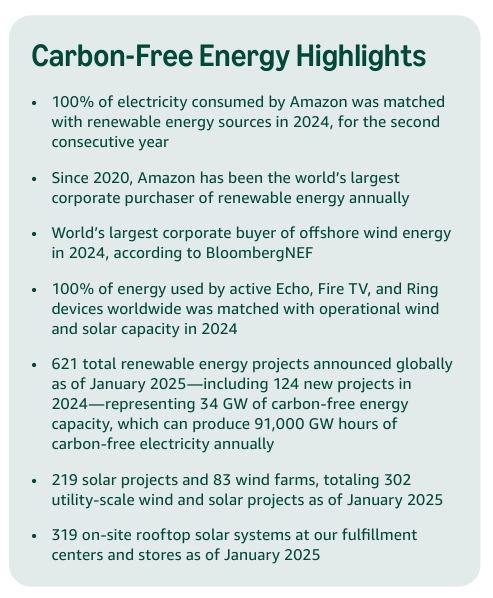
Globally, Amazon has built one of the world’s largest corporate renewable energy portfolios. And the Gennaker agreement becomes the biggest contract in Germany.
- The company now supports 12 renewable energy projects across Germany with a combined capacity exceeding 1.3 GW.
- Once all projects become operational, they are expected to produce enough carbon-free electricity to supply the equivalent of more than 1.8 million German homes each year.
Globally, it has invested in more than 700 carbon-free energy projects, representing over 40 GW of generating capacity. That amount of electricity could power approximately 12.1 million U.S. homes annually.
Commitment to The Climate Pledge
These investments form part of Amazon’s commitment under The Climate Pledge, which the company co-founded in 2019. The initiative targets net-zero carbon emissions across Amazon’s operations by 2040, ten years ahead of the Paris Agreement timeline.
Amazon has also pioneered corporate renewable energy procurement in countries including India, Ireland, South Africa, Japan, and Indonesia, helping developers finance utility-scale clean energy projects.
Offshore Wind Becomes a Strategic Priority
Amazon has emerged as the world’s leading corporate purchaser of offshore wind power.
- Across Europe, the company now supports nearly 1.7 GW of offshore wind capacity through six projects. Once fully operational, these wind farms are expected to generate enough electricity to power about 1.8 million European homes.
One milestone came last year when the Amazon-Shell HKN Offshore Wind Project off the Dutch coast entered commercial operation. The project delivers more than 750 MW of renewable electricity.
Amazon is also working with developers to improve turbine technology, helping increase electricity generation and improve project efficiency.
- According to the United Nations, offshore wind has the technical potential to provide more than one-third of global electricity demand, making it a critical technology for long-term decarbonization.
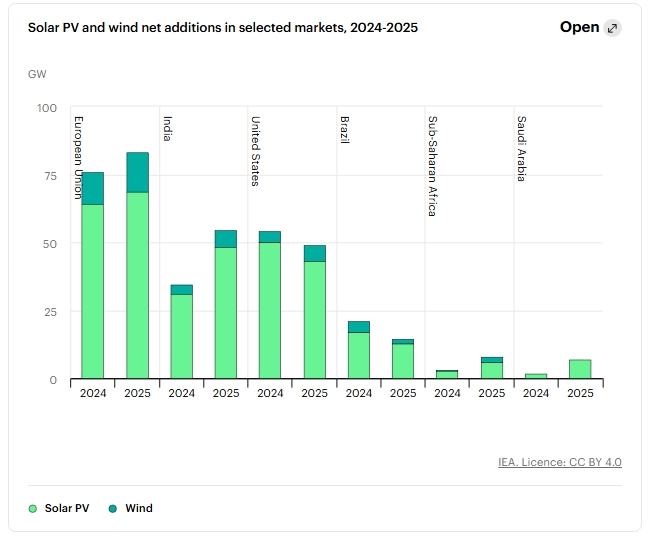
- IEA revealed that in 2025, the European Union added nearly 85 GW of new renewable capacity, of which ~ 15 GW was wind energy.
Germany Faces a Challenging Path to Offshore Wind Targets
Although Germany continues expanding renewable electricity, offshore wind deployment still lags behind official goals.
As per reports, the country aims to increase renewable energy’s share of electricity generation from just over 57% in 2025 to 80% by 2030, with a fully greenhouse gas-neutral electricity system targeted by 2045.
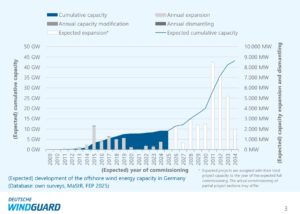
- At the beginning of 2026, Germany had 1,680 offshore wind turbines operating in its territorial waters, providing around 9.7 GW of installed capacity.
Reaching the government’s 30 GW target by 2030 would require installed capacity to more than triple within five years.
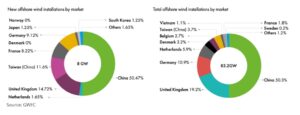
Progress has remained slower than expected. During 2025, only 41 new offshore turbines, totaling 0.5 GW, were connected to the grid. Industry groups, therefore, estimate Germany may reach only around 20 GW of offshore wind capacity by the end of the decade unless project development accelerates significantly.
Still, offshore wind continues gaining importance. It supplied 6.2% of Germany’s electricity in 2025, a dramatic increase from only 0.1% in 2014, despite weaker wind conditions reducing generation during part of the year.
The government has maintained long-term expansion goals of 40 GW by 2035 and 70 GW by 2045, even as policymakers review near-term capacity plans in response to slower electricity demand growth.
Investor Confidence Depends on Policy Stability
Projects like Gennaker highlight how corporate power purchase agreements can unlock billions of euros in renewable energy investment. However, private financing alone will not determine Germany’s offshore wind future.
Investor confidence also depends heavily on consistent government policies, predictable permitting processes, and continued support for offshore wind deployment. Although the sector has achieved significant cost reductions over the past decade, developers still face high upfront investment costs, supply chain pressures, and lengthy approval timelines.
If Germany maintains a stable policy framework while attracting more long-term corporate buyers like Amazon, projects such as Gennaker could accelerate offshore wind deployment, strengthen domestic energy security, create thousands of skilled jobs, and move the country closer to its climate and net-zero goals.
- FURTHER READING: Google Locks In 100 MW of Offshore Wind to Power Europe’s AI Growth