

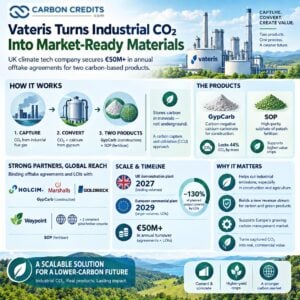
UK climate technology company Vateris has secured binding offtake agreements and letters of intent worth more than €50 million in annual turnover with six international construction and fertilizer companies. The deals include two products that turn industrial carbon dioxide (CO2) into minerals.
The first is GypCarb, a carbon-negative calcium carbonate used in construction. The second is sulphate of potash (SOP), a high-purity fertilizer. The partners include Holcim, Marshalls and Goldbeck for GypCarb, while Waypoint and two unnamed global fertilizer companies have committed to SOP.
The agreements connect binding volumes from a UK demonstration plant planned for 2027. They also include letters of intent for larger volumes from a European commercial plant planned for 2029.
The main plant letters cover about 130% of its planned output, according to Vateris. This deal is important because it gives a carbon utilization technology a potential customer base before full commercial-scale production begins.
Turning Industrial CO₂ Into Commercial Materials
Vateris, formerly known as Concrete4Change, uses a process designed to capture CO2 from industrial flue gas and convert it into useful mineral products. Its first product, GypCarb, is an engineered form of vaterite-based calcium carbonate.
The company says the product permanently locks 44% of CO2 by mass into the mineral and is designed as a drop-in additive for cement and concrete.
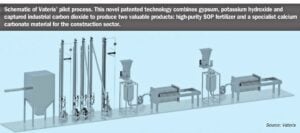
The process uses calcium from gypsum and converts it, along with captured CO2, into calcium carbonate. The remaining sulphate is used to make high-purity SOP fertilizer. This creates two products from the same process while storing captured carbon in minerals.
That is different from conventional carbon capture and storage, where CO2 is captured and then transported to an underground storage site. Vateris instead uses carbon capture and utilization (CCU) to turn the carbon into materials that can be used commercially.
GypCarb Targets One of Industry’s Biggest Emitters
The construction industry is a major target because cement and concrete have large carbon footprints. The International Energy Agency reports that CO2 emissions from cement production are still higher than in 2015. The sector must cut emissions faster to meet net-zero goals.
The IEA points to greater use of alternative materials, improved efficiency, and carbon capture among the solutions. GypCarb is designed to address two parts of this problem.
First, the product stores captured CO2 permanently in mineral form. Second, Vateris says its reactive calcium carbonate can improve concrete performance and reduce the amount of cement needed.
The company reported strong results from testing with Heidelberg Materials. One trial showed a 40% increase in one-day compressive strength using a small amount of GypCarb. Further testing is aimed at reducing cement content while maintaining performance.
With cement production responsible for significant industrial emissions, materials that can reduce cement use while storing CO2 could offer a second source of emissions savings.
Construction Companies Are Already Signing Up
The new agreements provide early commercial validation for the technology. Holcim, Marshalls and Goldbeck have committed to GypCarb for cement, concrete and other construction applications.
Goldbeck has been working with Vateris on integrating the product into its precast concrete operations. The companies say the technology has shown potential to reduce cement use while maintaining early strength.
First GypCarb deliveries to Goldbeck are targeted for late 2027. This matters because industrial climate technologies often struggle to move from pilot testing to commercial markets.
An offtake agreement can give a technology developer a clearer route to revenue while giving customers early access to a new material. However, the €50 million figure should be read carefully.
It represents annual turnover associated with the agreements and letters of intent, not cash already received by Vateris. The binding agreements cover demonstration-plant volumes, while the larger main-plant commitments are currently non-binding letters of intent.
Fertilizer Gives Captured CO₂ a Second Market
Vateris is also targeting agriculture through SOP. Sulfate of potash is a potassium and sulphur fertilizer used in higher-value crops. The company plans to produce a high-purity version using the sulphate left over from its carbon mineralization process.
This gives the company a second commercial market and reduces its reliance on construction materials. The timing could also be favorable for fertilizer supply chains.
The European Commission says the EU remains dependent on imports for mineral fertilizers and key raw materials. It estimates that the bloc imports about 40% of its potassium fertilizers.
That dependence has become more important as geopolitical disruptions have affected global fertilizer and energy markets. A European source of SOP made from industrial waste streams could thus offer both carbon benefits and greater supply resilience.
Europe’s Carbon Management Market Is Expanding
Vateris is also entering a wider European push to build carbon management infrastructure.
The EU has set a target of at least 50 million tonnes of annual CO2 injection capacity by 2030 for permanent geological storage. The European Commission expects around 280 million tonnes of CO2 to need capture by 2040 and around 450 million tonnes by 2050 to support climate neutrality.
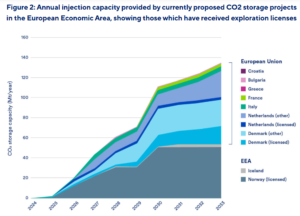
Those targets focus mainly on carbon capture and storage, but they also support a broader market for carbon management, including technologies that use captured CO2.
The EU is funding carbon capture, utilization, and storage through its Innovation Fund, including projects in cement, chemicals, and other hard-to-abate industries. Vateris could benefit from that growing market if it can show that its process works at much larger industrial scale.
From Pilot Plant to Commercial Scale
Vateris raised its total funding to $10 million after a financing round involving Holcim Maqer Ventures and Kiilto Ventures in April 2026. The company has since shifted its focus from pilot validation toward industrial scale-up.
Its planned UK demonstration plant is expected to begin production in 2027. A larger European first-of-a-kind commercial plant is targeted for 2029. The current offtake agreements are designed to support this transition.
Vateris says the demo plant will show the technology works at a commercial scale. The main plant will supply larger volumes for construction and agricultural customers.
- The new agreements show a strong signal: potential customer demand is already higher than the planned output for Vateris’ first full-scale European plant.
The letters of intent cover about 130% of the plant’s expected production, according to the company. That is encouraging, but it is not yet guaranteed revenue.
Letters of intent aren’t binding purchase agreements. The commercial plant still needs financing, construction, and a successful technical scale-up. The demonstration plant will, therefore, be a critical milestone.
If Vateris proves it can turn industrial CO2 into cost-effective construction and fertilizer products, it could build a new business model around carbon use.
The Next Test Is Turning CO₂ Into Revenue
The broader significance of Vateris is its attempt to change the role of captured CO2. The company isn’t just viewing industrial CO2 as waste to bury. Instead, it aims to convert it into a raw material for products that already have established markets.
The new agreements show that large industrial companies are willing to explore this model. The next test is scale.
A successful demonstration plant in 2027 could help turn the more than €50 million annual commercial pipeline into actual sales and support the larger European plant planned for 2029.
For the carbon market, the story is also a reminder that decarbonization will not rely on one solution. Permanent storage, carbon removals, carbon capture, and carbon utilization can each play different roles.
Vateris is betting that one of those roles will be to turn industrial emissions into materials that Europe already needs.