

Google has signed its largest carbon removal purchase to date with climate company Terradot, backing a major project in southern Brazil that combines methane reduction from rice farming with permanent carbon removal.
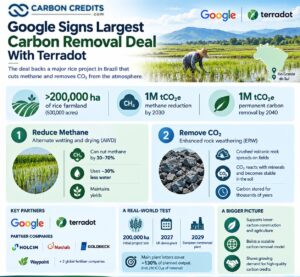
The project will cover more than 200,000 hectares or 500,000 acres of rice farmland in Rio Grande do Sul. It will use two different climate solutions:
- Alternate wetting and drying (AWD) to reduce methane from rice fields and
- Enhanced rock weathering (ERW) to remove CO2 from the atmosphere.
Google will purchase 1 million tonnes of CO2e of methane elimination by 2030 and another 1 million tonnes of permanent carbon removal by 2040. The two volumes should not be treated as 2 million tonnes of permanent carbon removal. Methane reduction and carbon dioxide removal have different climate effects and time scales.
Still, the agreement is significant. It is the largest ERW project publicly announced so far and the first project at this scale to combine near-term methane cuts with long-term carbon removal.
Randy Spock, Head of Carbon Removal, noted:
“We hope this agreement will serve as a template to other buyers, suppliers, and governments aiming to maximize their climate impact. We look forward to continuing to help scale superpollutant elimination and carbon removal in tandem — so we can put an immediate and lasting dent in warming with the urgency the planet demands.”
One Rice Project, Two Climate Solutions
Rice farming is a major source of methane because fields are often kept flooded. Waterlogged soils create conditions that allow methane-producing microbes to thrive.
The first part of the Terradot project uses alternate wetting and drying, which periodically drains rice fields before they are flooded again.
The approach can cut methane emissions by about 30% to 70% without reducing yields, according to the International Rice Research Institute. It can also reduce water use by about 30%. That makes AWD attractive for farmers as well as carbon buyers.
The approach also targets an important source of global methane. The Food and Agriculture Organization estimates that rice cultivation makes up about 8% of methane emissions from humans. In total, agriculture contributes around 40%.
Methane remains in the atmosphere for much less time than CO2, but it has a much stronger warming effect over shorter periods. Google is therefore treating methane reduction as a way to slow near-term warming while the second part of the project builds more permanent climate benefits.
Turning Volcanic Rock Into Carbon Removal
Terradot will also spread crushed volcanic rock across the same rice fields.
Over time, rainwater and soil moisture react with the rock’s minerals. This speeds up a natural process known as enhanced rock weathering, which removes CO2 from the atmosphere and stores the carbon in stable forms. This carbon removal is designed to last for thousands of years.
The approach is attractive because it does not require underground CO2 storage or large industrial capture equipment. Instead, it uses agricultural land as the setting for a natural mineral reaction.
However, ERW still faces challenges. Developers must measure the CO2 removed. They also need to consider emissions from mining and transporting rock. Finally, they must ensure that the carbon stays stored for the required time.
That makes measurement, reporting, and verification especially important as ERW projects become larger.
Brazil Offers ERW a Massive Testing Ground
Southern Brazil is well suited to Terradot’s model. Google says the region has warm and wet conditions that can help speed up rock weathering. Basalt quarries are also located relatively close to the rice-growing areas.
The scale of the project is significant. Brazil has about 1.5 million hectares of rice under cultivation, according to Google. That means the project’s more than 200,000 hectares could eventually cover about 13% of the country’s rice area if the approach is expanded.
Rio Grande do Sul is Brazil’s main rice-producing state. IBGE estimated about 932,870 hectares of rice area for the 2025 crop. The project’s 200,000-plus hectares would, therefore, equal roughly 21% of the state’s rice area, highlighting its potential scale.
The model could eventually be tested in other major rice-producing countries. Google says it is supporting research into how AWD could work across different rice systems worldwide, while Terradot sees Brazil as the first step toward wider expansion.
Google Is Increasing Its Carbon Removal Buying
The Terradot agreement builds on Google’s earlier support for ERW. In December 2024, Google agreed to purchase 200,000 tonnes of carbon removal credits from Terradot, to be delivered by the early 2030s. At the time, Google called it the largest ERW deal announced.
The new agreement is five times larger on the permanent carbon removal side, at 1 million tonnes.
Google has also expanded its focus beyond CO2 removal. In March 2026, the company pledged to spend at least $50 million through 2030 on projects targeting methane and other short-lived superpollutants.
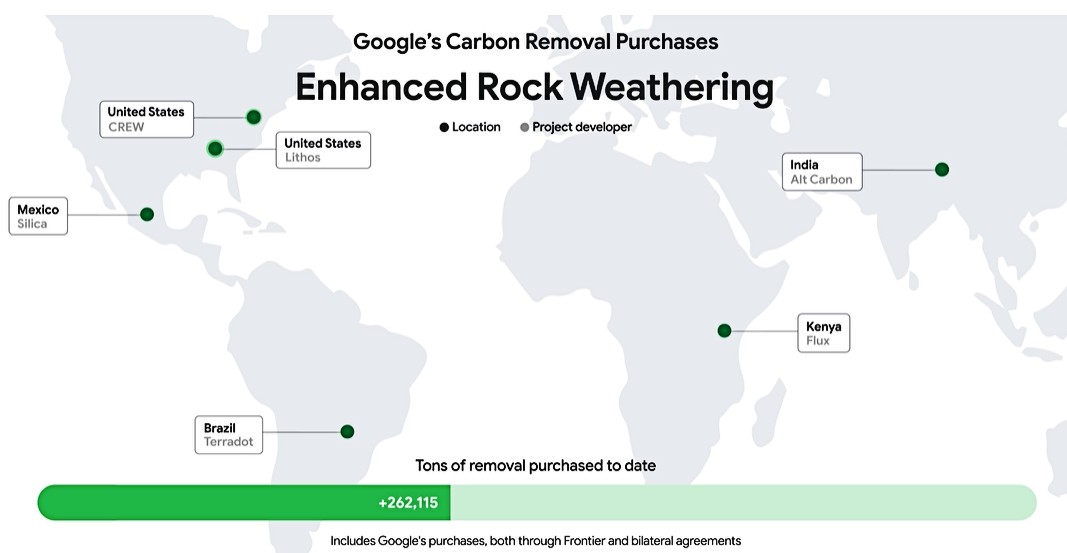
The Terradot deal brings those two strategies together.
AI Emissions Raise the Stakes for Google
The purchase also comes as Google’s environmental footprint is changing quickly because of AI. Google’s 2026 Environmental Report says its electricity demand rose 37% in 2025, the largest annual increase in the company’s history. At the same time, its supply chain increased 25%, while operational emissions fell 2%.
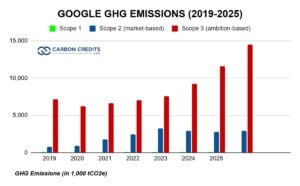
The company also signed agreements for more than 12 GW of new clean energy in 2025, bringing its cumulative clean energy procurement since 2010 to nearly 35 GW.
Google has a goal of reaching net-zero emissions across its operations and value chain by 2030. The company says carbon removal is one part of that strategy, alongside direct emissions reductions, clean energy procurement, and efficiency improvements.
This distinction matters. The Terradot purchase does not remove the need for Google to reduce its own emissions. Instead, durable carbon removal is intended to address residual emissions that remain difficult to eliminate.
Carbon Removal Demand Is Growing, But Delivery Matters
The Google deal arrives as the durable carbon removal market becomes more mature and more selective.
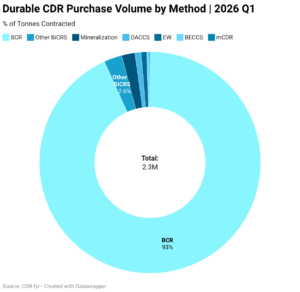
CDR.fyi says durable CDR purchases grew at a 151% compound annual rate between 2021 and 2025, excluding purchases from Microsoft and Frontier. Deliveries have also grown rapidly, but the market remains far smaller than the scale needed for global climate goals.
The gap is substantial. The IPCC says climate pathways consistent with limiting warming to 1.5°C or 2°C require large-scale carbon removal later this century. Its assessed pathways include several gigatonnes of annual removal by 2050.
That is far above today’s market. This creates a major opportunity for technologies such as ERW, but also raises the bar for proving that each tonne is real and measurable.
The Cost Challenge Remains
One of the biggest hurdles for ERW is cost. The technology requires mining or sourcing rock, crushing it, and transporting it to farms. Those activities consume energy and can create emissions that must be included in the project’s carbon accounting.
Reuters reported that the cost of Terradot’s removal remains above the $100-per-tonne level often viewed as important for wider market adoption, although the company expects costs to fall as operations scale.
Large purchase agreements can help solve part of this problem. Long-term commitments provide developers with demand visibility, which can support investment in equipment, project development and measurement systems.
Can Rice Fields Become the Next Carbon Removal Platform?
The Terradot agreement stands out because it combines short-term methane reduction with long-term carbon removal in the same farming system. AWD can reduce methane emissions quickly. ERW takes longer to remove CO2 but can store carbon for a much longer period.
Google says the model is designed to become a blueprint for other rice-growing regions. For the carbon removal market, however, the deal sends a strong signal.
Large corporate buyers are moving beyond small pilot purchases and backing larger projects designed to deliver millions of tonnes over time.
If Terradot can deliver at the planned scale, the project could help show how agricultural land can become a platform for both methane reduction and durable carbon removal—and provide a model that could be replicated across major rice markets worldwide.