

Disseminated on behalf of Sierra Madre Gold & Silver Ltd.
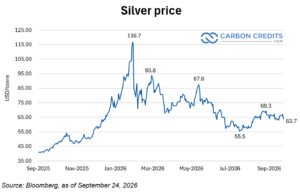
Silver has had a volatile 2026. It has pulled back sharply from its 2026 peak. The metal reached a 52-week high of about $115 per ounce in January before falling sharply during the year.
By mid-September, silver futures had dropped to about $63 per ounce, roughly 45% below that peak. Prices later recovered to around $66.70 by September 18.
That move highlights an important shift for silver producers. The market is no longer simply a story of rising prices. Producers now have to operate through a much wider price range while managing costs, production growth, and capital spending.
The decline has changed the operating backdrop for silver producers, but the underlying supply picture remains tight.
According to the World Silver Survey 2026, global silver mine production increased 3% in 2025 to 846.6 million ounces. Recycling added another 197.6 million ounces. Yet, total demand reached 1.13 billion ounces, leaving the market with a 40.3 million-ounce deficit, the fifth consecutive annual shortfall.
Metals Focus expects another deficit in 2026, estimated at 46.3 million ounces. That backdrop matters for Sierra Madre Gold & Silver as it moves from restarting one mine to building a larger production base.
The changing silver price environment, therefore, tests the company’s strategy: how does an operating producer manage growth when the commodity price can move sharply in either direction?
Silver’s 2026 Rally Gives Way to a Sharp Reset
Silver entered 2026 at elevated levels after a strong run in late 2025 and early 2026, but it significantly dropped this month. The decline was not driven by one factor alone.
Higher U.S. Treasury yields, a stronger dollar, and changing expectations for Federal Reserve policy have affected precious metals. Silver can also experience larger price swings than gold because it combines investment demand with industrial uses.
Recently, silver had recovered to over $66 per ounce. That rebound, however, does not erase the earlier decline. Instead, it shows why mining companies must plan around changing commodity prices rather than rely on a single price environment.
For Sierra Madre, that distinction matters because the company is already generating revenue from an operating mine.
La Guitarra Is Already Generating Silver Revenue
La Guitarra is no longer simply a development project. Sierra Madre restarted commercial production at the Mexican mine on January 1, 2025. The operation includes an underground mine and a processing plant that previously operated at 500 tonnes per day.
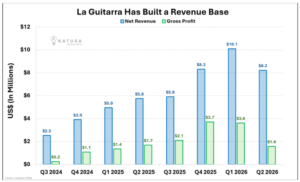
Moreover, the company reported 66,691 ounces of silver sold in Q2 2026, compared with 65,683 ounces in the same quarter of 2025.
The mine generated US$25 million of revenue and US$8.9 million of gross profit in 2025, its first full year back in production.
In the first half of 2026, La Guitarra generated another US$18.3 million of revenue and US$3.5 million of adjusted EBITDA. Sierra Madre also repaid its US$5 million First Majestic loan in July and ended June with US$22.2 million in cash and US$25 million in working capital.
The company received US$75.65 per silver-equivalent ounce sold in Q2 2026, compared with US$33.22 a year earlier.
Those figures show the effect that higher realized metal prices had on revenue. But they also highlight why future results cannot simply be extrapolated from the second quarter.
The spot and futures market has since moved below the $75.65 realized silver price reported for Q2. If lower prices persist, the company could face lower revenue per ounce even as production increases. That makes the production ramp-up increasingly important.
That higher realized price helped offset higher costs during a development-heavy quarter.
Sierra Madre reported all-in sustaining costs of US$54.73 per ounce produced, up from US$32.54 a year earlier. The company attributed the increase to development ore, lower recoveries, power outages, a stronger Mexican peso, and higher royalties.
The cost increase shows why the silver price pullback matters. Higher metal prices can support revenue and margins, but production growth can also bring temporary cost pressure.
SEE MORE: Sierra Madre: Breathing New Life into Mexico’s Silver and Gold Heartland
Sierra Madre Pushes La Guitarra Toward Higher Throughput
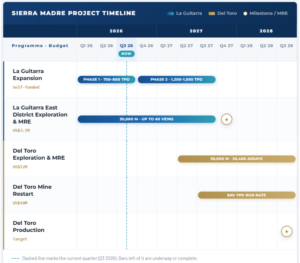
Sierra Madre is working to increase processing capacity at La Guitarra. The first phase is expected to bring capacity to about 750–800 tonnes per day, with the company expecting the expansion to come online before the end of Q3 2026.
- A second phase is planned to increase capacity to 1,200–1,500 tonnes per day by Q3 2027.
The company reported that throughput had reached as high as 672 tonnes per day in August, as it continued to ramp up the operation. This timing matters.
Higher throughput can increase the number of ounces produced and sold, although the actual financial benefit will depend on factors including grades, recoveries, operating costs, capital requirements and the silver and gold prices received.
Sierra Madre reported Q2 2026 cash costs of $49.28 per silver-equivalent ounce produced, compared with $26.89 in Q2 2025. Its all-in sustaining cash cost was $54.73 per silver-equivalent ounce, versus $32.54 a year earlier.
The company said it expects higher production from the expansion, along with a reduction in costs as the operation scales up. That makes the next stage of the ramp-up particularly important in a lower-price environment.
Del Toro Adds Another Mexican Silver Asset
Sierra Madre added a second permitted silver mine to its portfolio in June 2026 with the acquisition of the Del Toro Silver Mine in Zacatecas, Mexico.
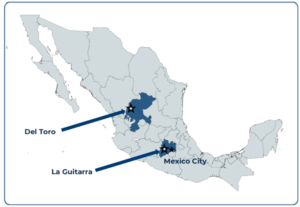
The company closed the deal with First Majestic Silver on June 22, 2026. First Majestic previously operated Del Toro from 2013 to 2019 and invested about US$175 million to build the operation.
The site includes three underground mines — San Juan, Perseverancia and Dolores — with more than 60 kilometres of underground development. It also has a 3,000-tonne-per-day flotation circuit and about 3,650 tpd of installed mill capacity.
Del Toro has a production history. It averaged 2.54 million silver-equivalent ounces per year from 2015 to 2018 under First Majestic.
Sierra Madre plans to restart the mine at a smaller scale. The company expects to spend about US$10 million initially, targeting 800 tpd, with a potential increase to 1,600 tpd. The restart is targeted for mid-2027, with production expected to begin in mid-2028.
Exploration will also be important. Sierra Madre has identified 23 deposits at Del Toro and plans about 30,000 metres of diamond drilling at a cost of roughly US$12 million.
A 2020 historical estimate reported 7.57 million silver-equivalent ounces of measured and indicated material and 11.18 million ounces of inferred material. These figures are historical and are not current mineral resources.
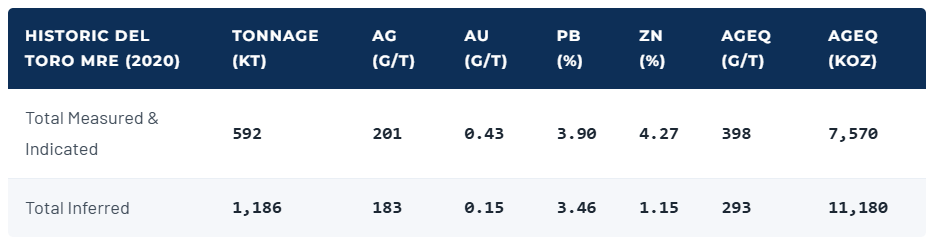
Sierra Madre plans new drilling and resource modelling to establish an updated resource.
The acquisition gives the company another developed Mexican silver asset with existing infrastructure, past production and exploration upside, while the company continues expanding La Guitarra.
Mexico Matters to the Silver Supply Story
Del Toro also places Sierra Madre in one of the world’s most important silver-producing countries.
Mexico produced 172.9 million ounces of silver in 2025, down 5% from 181.1 million ounces in 2024. Still, it remained the world’s largest silver-producing country and accounted for about 20% of global mine supply.
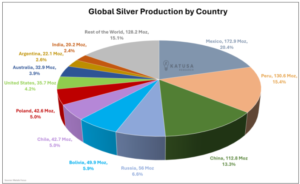
That makes Mexico an important part of the global supply story, while Zacatecas itself has a long history of silver production.
The Katusa Research report notes that roughly half of global silver production comes from Latin America, with Mexico accounting for about one-fifth of global output.
Sierra Madre’s strategy therefore combines existing Mexican infrastructure with a market where new supply remains difficult to bring online quickly.
Lower Silver Prices Put More Focus on Mine Execution
The silver pullback changes the economics of new production, even if the longer-term supply deficit remains. For Sierra Madre, the key issue is no longer simply whether silver prices are rising. The company now has to execute two different stages of growth.
La Guitarra needs to increase throughput while bringing costs under control. Del Toro needs to move through drilling, resource definition, mine planning, and restart work before it can contribute production.
The company is therefore entering a more demanding phase. The next stage of Sierra Madre’s story will depend on how efficiently it converts existing infrastructure, resources, and permits into production.
For now, La Guitarra provides an operating base while Del Toro offers a second potential source of growth. The silver price has pulled back, but Sierra Madre’s production strategy is moving forward.
DISCLAIMER
New Era Publishing Inc. and/or CarbonCredits.com (“We” or “Us”) are not securities dealers or brokers, investment advisers, or financial advisers, and you should not rely on the information herein as investment advice. Sierra Madre Gold and Silver Ltd. (“Company”) made a one-time payment of $25,000 to provide marketing services for a term of one month. None of the owners, members, directors, or employees of New Era Publishing Inc. and/or CarbonCredits.com currently hold, or have any beneficial ownership in, any shares, stocks, or options of the companies mentioned.
This article is informational only and is solely for use by prospective investors in determining whether to seek additional information. It does not constitute an offer to sell or a solicitation of an offer to buy any securities. Examples that we provide of share price increases pertaining to a particular issuer from one referenced date to another represent arbitrarily chosen time periods and are no indication whatsoever of future stock prices for that issuer and are of no predictive value.
Our stock profiles are intended to highlight certain companies for your further investigation; they are not stock recommendations or an offer or sale of the referenced securities. The securities issued by the companies we profile should be considered high-risk; if you do invest despite these warnings, you may lose your entire investment. Please do your own research before investing, including reviewing the companies’ SEDAR+ and SEC filings, press releases, and risk disclosures.
It is our policy that information contained in this profile was provided by the company, extracted from SEDAR+ and SEC filings, company websites, and other publicly available sources. We believe the sources and information are accurate and reliable but we cannot guarantee them.
CAUTIONARY STATEMENT AND FORWARD-LOOKING INFORMATION
Certain statements contained in this news release may constitute “forward-looking information” within the meaning of applicable securities laws. Forward-looking information generally can be identified by words such as “anticipate,” “expect,” “estimate,” “forecast,” “plan,” and similar expressions suggesting future outcomes or events. Forward-looking information is based on current expectations of management; however, it is subject to known and unknown risks, uncertainties, and other factors that may cause actual results to differ materially from those anticipated.
These factors include, without limitation, statements relating to the Company’s exploration and development plans, the potential of its mineral projects, financing activities, regulatory approvals, market conditions, and future objectives. Forward-looking information involves numerous risks and uncertainties and actual results might differ materially from results suggested in any forward-looking information. These risks and uncertainties include, among other things, market volatility, the state of financial markets for the Company’s securities, fluctuations in commodity prices, operational challenges, and changes in business plans.
Forward-looking information is based on several key expectations and assumptions, including, without limitation, that the Company will continue with its stated business objectives and will be able to raise additional capital as required. Although management of the Company has attempted to identify important factors that could cause actual results to differ materially, there may be other factors that cause results not to be as anticipated, estimated, or intended.
There can be no assurance that such forward-looking information will prove to be accurate, as actual results and future events could differ materially. Accordingly, readers should not place undue reliance on forward-looking information. Additional information about risks and uncertainties is contained in the Company’s management’s discussion and analysis and annual information form for the year ended December 31, 2025, copies of which are available on SEDAR+ at www.sedarplus.ca.
The forward-looking information contained herein is expressly qualified in its entirety by this cautionary statement. Forward-looking information reflects management’s current beliefs and is based on information currently available to the Company. The forward-looking information is made as of the date of this news release, and the Company assumes no obligation to update or revise such information to reflect new events or circumstances except as may be required by applicable law.
For more information on the Company, investors should review the Company’s continuous disclosure filings available on SEDAR+ at www.sedarplus.ca.
Disclosure: Owners, members, directors, and employees of carboncredits.com have/may have stock or option positions in any of the companies mentioned: None.
Carboncredits.com receives compensation for this publication and has a business relationship with any company whose stock(s) is/are mentioned in this article.
Additional disclosure: This communication serves the sole purpose of adding value to the research process and is for information only. Please do your own due diligence. Every investment in securities mentioned in publications of carboncredits.com involves risks that could lead to a total loss of the invested capital.