

Gabon has agreed to sell around 6 million forest carbon credits to SEFE, a German state-owned energy company. The deal marks a major step in the country’s efforts to earn revenue from protecting its forests and could open the door to more international sales of sovereign carbon credits.
The Gabonese Republic, represented by the Gabonese Agency for the Development of the Green Economy (AGADEV), and SEFE, formerly known as Securing Energy for Europe, signed the agreements on November 3, 2026.
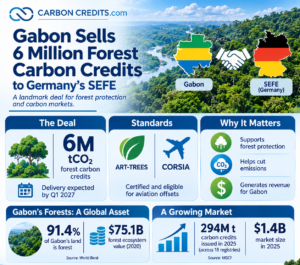
The deal covers about 6 million metric tons of carbon dioxide (CO₂). The credits are certified under the ART-TREES standard and are eligible for the aviation sector’s Carbon Offsetting and Reduction Scheme for International Aviation (CORSIA). Deliveries are expected by the first quarter of 2027.
The agreement marks a major commercial step, but the final financial value remains unknown as the parties have not disclosed the sale price or expected revenue. The official note cited by state news agency AGP said:
“This signing embodies an ambition: to make Gabon’s natural wealth a lever for sovereignty, prosperity and climate responsibility. It constitutes a first step towards new transactions for the benefit of the national economy.”
Gabon Turns Forest Protection Into Carbon Market Revenue
The transaction is based on carbon credits generated through the protection of Gabon’s forests. Sovereign or jurisdictional credits differ from project-specific credits. They are granted for emissions reductions measured over a country or large area.
This approach allows governments to earn revenue from national efforts to reduce deforestation and forest degradation. It can also support wider forest protection policies rather than relying on separate projects in specific locations.
Gabon says it is the first African country to sell sovereign forest carbon credits eligible for CORSIA. The government has also stressed that the deal does not involve selling land or forests. Their ownership and management will remain with the Gabonese state.
SEFE is wholly owned by the German federal government. The company operates across the energy supply chain, including gas and power trading, sales, transport, and storage. It supplies more than 200 terawatt-hours of gas and power each year, according to its company profile.
Why Gabon’s Forests Matter to the Carbon Market
Gabon has one of the world’s most forested national territories. World Bank data sourced from the Food and Agriculture Organization show that forests covered 91.4% of the country’s land area in 2024.
Forest Area by African country, Africa API
The country’s forests form part of the Congo Basin, the world’s second-largest tropical forest region after the Amazon. They store large amounts of carbon, support biodiversity, and provide resources and livelihoods for local communities.
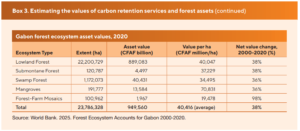
The World Bank’s 2025 Gabon Economic Update found that in 2020, the value of Gabon’s forest ecosystem services hit $75.1 billion. This amount is almost twice what it was in 2000. About 99% of that value came from carbon retention.
- The report also estimated that Gabon’s forests retained the equivalent of 29.8 billion metric tons of CO₂ in 2020.
Despite this value, Gabon has struggled to receive enough financial support for protecting its forests. The World Bank has called for stronger financing mechanisms to compensate countries for the climate benefits their forests provide.
The carbon credit sale could help address that gap by giving the government a way to earn money from verified forest protection results.
How Sovereign Forest Credits Work
Sovereign carbon credits are generated from emissions reductions measured across a country or large administrative area. They are different from project-based credits, which come from activities like protecting a specific forest, restoring degraded land, or planting trees.
Under a jurisdictional approach, governments measure changes in forest-related emissions against an agreed reference level. They can then issue credits for verified reductions below that level.
One standard used for this type of crediting is the REDD+ Environmental Excellence Standard (TREES). The Architecture for REDD+ Transactions (ART) manages it and sets rules for measuring, monitoring, reporting, and verifying forest emissions reductions.
TREES needs independent checks and safeguards for people and the environment. It must also address risks like deforestation moving to new areas or forests losing stored carbon later. Credits are recorded as serialized units on a public registry.
These rules are crucial because forest carbon credits face questions about whether claimed emissions reductions are real and lasting. Buyers also need confidence that the same reductions are not counted more than once.
- SEE MORE: BTG Pactual Closes Record $1.24B Reforestation Fund as Forest Carbon Markets Enter the Big Leagues
How Large is the Market?
Market reports often mix sovereign forest credits with other voluntary carbon credits. The wider carbon credit market remained active in 2025, but buyers became more selective about credit quality.
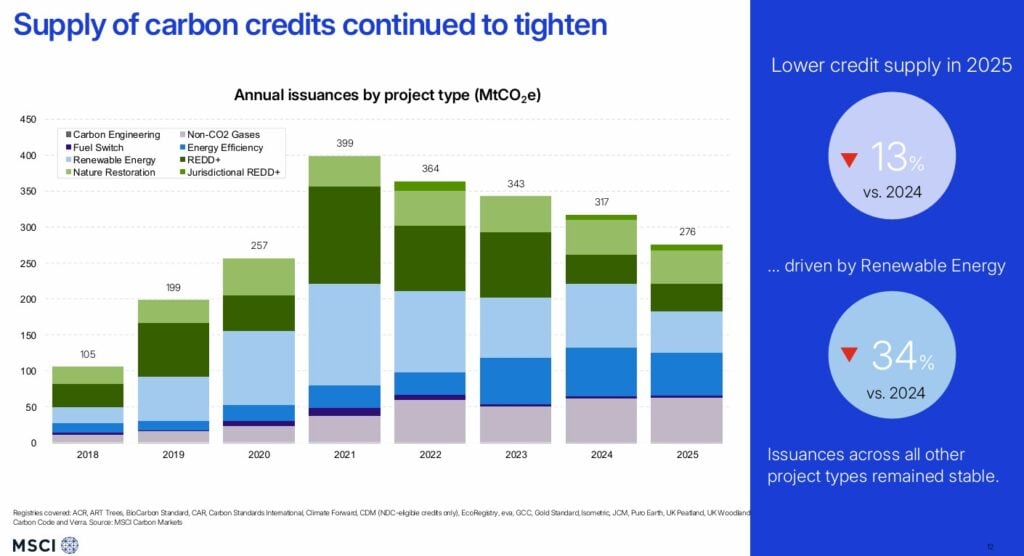
According to MSCI, projects across 18 major carbon credit registries issued 294 million metric tons of credits in 2025. This brought cumulative issuance across the registries to more than 2.6 billion credits since 2016.
The primary carbon credit market was worth about $1.4 billion in 2025, remaining broadly stable for a fourth consecutive year. Global credit retirements also increased by 3%, reaching their highest level since 2021, per MSCI data.
The World Bank reported that total issuance across independent and government-run crediting mechanisms reached 432 million credits in 2025, up 8% from 2024. Government-run mechanisms recorded particularly strong growth, with issuance rising nearly 40% to 53 million credits.
Registry data provide another view of the jurisdictional market. As of June 1, 2026, ART TREES had recorded about 59 million credits issued and 13 million retired across its listed projects. This is a cumulative figure for the ART program, not the amount traded in 2025 or the volume of sovereign forest credits sold in a single year.
CORSIA Eligibility Could Open Access to Aviation Buyers
The deal also highlights the role of CORSIA in creating demand for forest carbon credits. CORSIA is a global scheme established by the International Civil Aviation Organization (ICAO) to address the growth of international aviation emissions. It requires covered airlines to meet their offsetting obligations by cancelling eligible emissions units.
ICAO approves crediting programs that meet its eligibility rules. The approved programs and eligible periods are listed in its official documents.
Gabon says the credits in its agreement with SEFE qualify for the scheme. This could attract buyers looking for units for aviation compliance. However, the agreement doesn’t confirm that SEFE will use the credits for this purpose.
CORSIA eligibility can widen the potential buyer base, but it does not guarantee demand, a particular price, or future sales.
Revenue Sharing and Community Benefits Remain Key
The financial details of the deal remain undisclosed. Gabon’s government said the state’s share of the revenue will be held in a dedicated account until the national regulatory framework takes effect. That framework will include a benefit-sharing mechanism for communities.
- However, the government has not yet provided details on how much revenue will go to local communities, who will qualify, or how payments will be managed.
These details are important because communities and Indigenous groups play an important role in protecting forest areas. Their land rights, access to resources, and livelihoods must be considered when governments earn revenue from forest carbon.
Gabonese environmental group Brainforest has called for transparency on prices and revenue management, fair benefit-sharing, and respect for community rights. These safeguards will help determine whether the deal delivers benefits beyond government revenue.
Gabon Deal Could Set a Path for Sovereign Forest Credits
Gabon’s agreement with SEFE could help create a wider market for sovereign forest carbon credits in Africa and other forest-rich countries. It offers a way to reward governments for protecting large forest areas and supporting national climate goals.
But the deal’s long-term impact will depend on more than the 6 million tonnes covered by the agreement. Buyers and communities will also need clear information on credit quality, delivery, pricing, and how revenue is shared.
For Gabon, the next steps include delivering the credits, putting its benefit-sharing rules into practice, and showing that forest protection continues. If done openly, this transaction could show how forest conservation can fund climate efforts.