

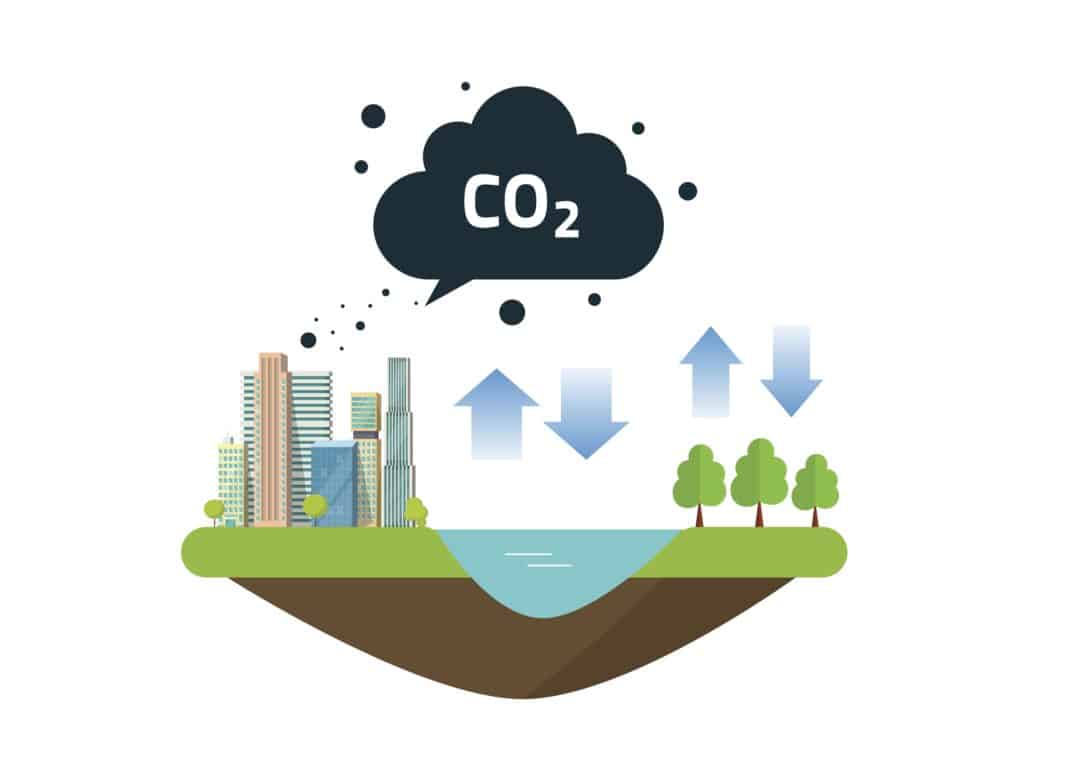
Carbon is the foundation of all life on Earth. Humans are made of carbon. We eat carbon and almost everything is built on carbon.
Carbon is the 4th most abundant element in the entire universe. It’s also plenty in our atmosphere in the form of carbon dioxide (CO2).
It helps regulate the planet’s temperature but any changes that put it into the atmosphere cause temperatures to rise. And so, it turns out to be the most serious concern we face today – climate change.
This article explains what happens during the carbon cycle and how it causes global warming. It will also talk about the carbon cycle in relation to the water cycle and how they both affect the earth’s temperature.
How Carbon Cycle Takes Place
Most of Earth’s carbon, which is around 65,500 billion metric tons, is found in rocks. The rest of it is in the soil, plants, fossil fuels, oceans, and the atmosphere. They’re the reservoirs or sinks through which carbon cycles.
Carbon cycle is the exchange through which carbon flows between each of those sinks. Any change in the cycle that lets carbon flows out of one sink creates more carbon in the other sinks.
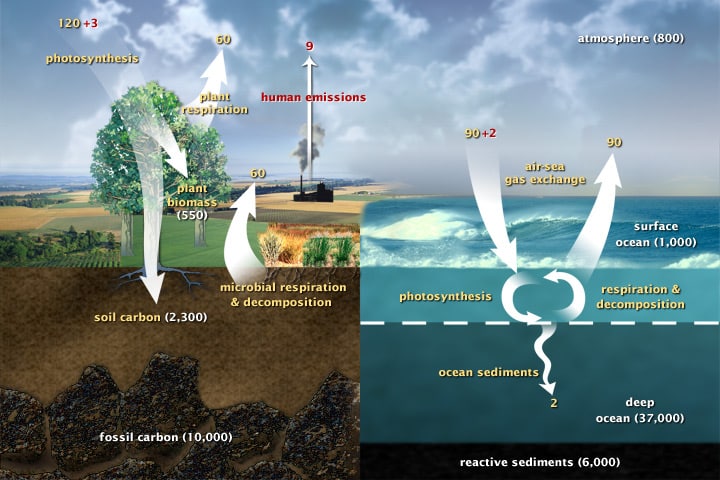
In the long run, the carbon cycle seems to keep the balance that avoids carbon from entering the atmosphere or from being stored in rocks. This balance helps keep the planet’s temperature stable.
But for some time scales, parts of the carbon cycle may amplify temperature changes that can happen for shorter time periods. This instance often occurs over tens to a hundred thousand years.
In the same manner, over very long time periods, millions to tens of millions of years, geological changes can also cause carbon to seep from the Earth’s core. This also changes the planet’s temperature from extreme hot (Cretaceous era) to extra cold (Pleistocene era).
Today, carbon escapes the sinks and reaches the atmosphere when organisms die, wildfires breakout, fossil fuels get burned, and so on.
And humans have a big role in the carbon cycle through their activities such as too much logging, burning of fossil fuels, excessive fishing, and land development. As a result, the amount of CO2 in the air has been rising so fast.
- In fact, it’s already greater today than at any time in the last 800,000 years.
In the case of the ocean, the carbon cycle takes place between the ocean’s surface waters and the atmosphere.
The carbon cycle happens either in slow pace or fast pace.
The slow carbon cycle involves a series of chemical reactions and tectonic activity that moves carbon between different reservoirs. The process also takes place between 100 to 200 million years to complete.
On the contrary, the fast carbon cycle occurs in a lifespan and involves the movement of carbon through various life forms.
In other words, this carbon cycle moves via the biosphere. About 1,000 – 100,000 million metric tons of carbon move through this cycle each year.
For the purposes of this article, we’ll focus on this short-term, fast carbon cycle. It only takes days, months, or years for carbon to cycle through this process.
The fast (biological) carbon cycle
Plants and phytoplankton (very tiny organisms in the ocean) are the main components of the fast or biological carbon cycle. Photosynthesis is the process that forms the foundation of this carbon cycle.
During photosynthesis, plants absorb CO2 and sunlight to form sugar and oxygen they need to grow.
Next, animals and humans eat the plants or plankton, breaking down the plant sugar to get energy. During food consumption, CO2 is released into the atmosphere due to cell respiration.
Then plants and plankton die and decay, and get eaten by bacteria. Or fires can also consume the plants and release the carbon back into the atmosphere.
Changes in the Carbon Cycle
In the past years, the carbon cycle has changed in response to climate change.
Levels of CO2 in the air corresponded closely with the Earth’s temperature over the past 800,000 years. Though the temperature changes were partly due to variations in Earth’s orbit, the increased temperatures released CO2 into the air.
That, in turn, caused the planet to get warmer. That was the case tens of thousands of years ago. But today, changes in the carbon cycle are happening because of humans.
Human activities disturb the natural carbon cycle significantly. By burning coal, oil, and natural gas, we quicken the carbon cycle process, releasing large amounts of carbon into the air each year.
That carbon took millions of years to escape their sinks. As such, we enable the carbon to move from the slow cycle to the fast cycle.
The carbon cycle and the water cycle
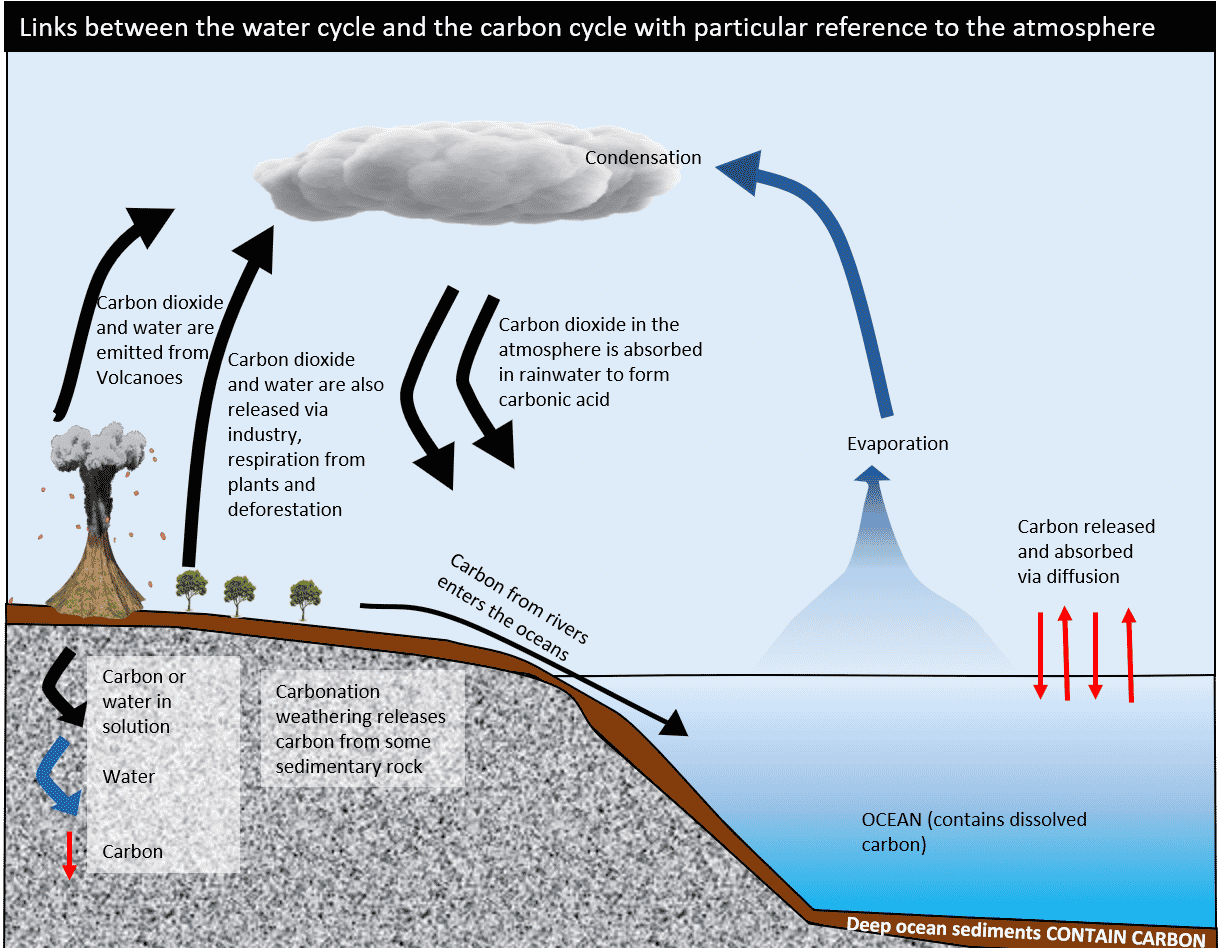
Energy from the sun sets in motion both the carbon and water cycles. Recall that sunlight, CO2 and water are inputs during photosynthesis.
But, changes to the carbon cycle as mentioned above affects the water cycle. With rising global warming due to increasing levels of CO2, the result is super-charging both cycles.
For instance, we’ve seen greater evaporation in regions that created heavier rainfall in some areas and deeper droughts in others. This phenomena shows that the greater amount of carbon in the air is altering the water cycle.
Meanwhile, the water cycle has been altered by the greater amount of carbon in the air. Likewise, plant growth is enhanced by higher carbon levels in the atmosphere.
This, in turn, contributes to more water vapor to the atmosphere during transpiration. It then leads to heavier downpours during rain events.
Hence, both water and carbon are cycling faster and differently than before as the climate changes.
The carbon cycle and the oceans
More CO2 concentrations and warming temperatures are causing changes in the natural carbon cycle. And much of the carbon emitted by humans has been absorbed by the oceans, causing them to become less alkaline.
This helps to slow global warming by removing some CO2 from the atmosphere. But as warmer ocean waters can hold less carbon, it will leave more in the atmosphere.
- About 30% of the CO2 that humans dumped into the air has diffused into the ocean via direct chemical exchange.
Dissolving CO2 in the ocean creates carbonic acid that makes the water more acidic or less alkaline. Since 1750, the pH of the ocean’s surface has dropped by 0.1, a 30% change in acidity.
Warmer oceans, as a product of the greenhouse effect, can decrease the abundance of phytoplankton. These living organisms grow better in cool, nutrient-rich waters. As such, this can limit the ocean’s ability to take carbon from the air through the fast carbon cycle.
On the other hand, CO2 is essential for plant and phytoplankton growth. An increase in CO2 also increases their growth by fertilizing a few species that take CO2 from the water.
Unfortunately, most species are not like that as they’re harmed more by increasing CO2 levels in the ocean.
Feedbacks within and between cycles
The burning of fossil fuels, deforestation, and land use changes have changed the carbon budget. But it’s only the first or primary stage in the entire cycle story.
Changes in one part of the carbon and water cycles can lead to unexpected outcomes. These changes are the secondary ones which are also known as climate feedbacks.
Scientists worry that climate feedbacks can further worsen global warming due to CO2 alone.
For instance, snow and ice are melting in the Northern Hemisphere. Warming temperatures are also melting more parts of Arctic sea ice, exposing dark ocean water during hot summer days. While snow cover on land is also declining in many parts of the world.
As snow and ice cover decreases these areas absorb more sunlight instead of reflecting it. As a result, more energy gets absorbed that causes more warming. Thus, a positive feedback loop takes place.
The same holds true in the case of water vapor, which is the largest feedback factor. As temperature goes up, more water vapor evaporates into the atmosphere. This causes temperatures to climb up even more.
In effect, with more water vapor in the atmosphere we see more clouds. Clouds can both cool the planet (by reflecting sunlight) and warm it (by absorbing heat radiation from the surface). Though clouds have a cooling effect, that can change in a warmer environment.
So, everything with water seems to be closely related to carbon and how it cycles. If CO2 levels change, it goes the same with water and both cycles also change.