


Holcim and Bloomberg Media Studios together created the Circular Cities Barometer – a proprietary algorithm that measures how quick global cities transition from a linear to a circular economy.
In the world’s race to net zero carbon emissions, circular cities play a significant role.
Cities release over 60% of the world’s greenhouse gas emissions, according to the United Nations. But they are also important actors in fighting climate change by adopting a circular economy.
Compared with a linear economy that works around taking, making, and wasting, a circular economy applies the approach of reducing, reusing, and recycling.
The Circular Cities Barometer
To track which cities are circular, the Circular Cities Barometer is using a dozen circularity indicators under four categories.
- Buildings,
- Systems,
- Living, and
- Leadership
Circular Buildings
As per the International Energy Agency, buildings produce about 40% of annual global CO2 emissions. This is why building cities needs a circular approach to construction.
Under this category are three indicators, namely:
- Energy Efficiency: The intensity of energy use of a city’s buildings.
- Urban Temperature: How much higher a city’s temperatures are in comparison to surrounding areas.
- Building Certification: How many of a city’s buildings are certified as green.
Circular Systems
The U.S. recycling industry processes ~130 million tons of recyclables each year, according to the Bureau of International Recycling. Metrics that monitor the circularity of a city’s systems include:
- Renewable Energy Consumption: How much of a city’s energy is sourced from renewables.
- Solid Waste Recycling: How much of a city’s solid waste is diverted from landfills and incineration.
- Water Recycling: How much of a city’s wastewater is safely treated.
Circular Living
Right now, there are around 4 billion people living in cities. And according to the UN estimates, plus 2.5 billion people will live in urban areas by 2050, making it 6.5 billion in all.
Measuring the circularity of urban living takes into account the following indicators:
- Green Space: How much of a city has trees and greenery.
- Transport: How much of a city is within walking distance of public transit.
- Sharing Economy: How many bike-, e-bike- and scooter-sharing programs exist in a city.
Circular Leadership
Over a thousand cities around the world committed to achieve net zero emissions by 2050. The following metrics measure leadership in the urban areas:
- The Paris Agreement: Whether a city committed to measures to limit warming to 1.5℃.
- Policies and Roadmaps: How many commitments and achievements a city has made in the transition to a circular economy.
- Investment: A city’s financial incentives to adopt renewable energy for transport and buildings.
The City of Seattle
Seattle is the U.S. 15th largest city that outscored other metro areas within the Circular Cities Barometer. It earned the number 1 spot among the 25 cities with a score of 100.
That’s partly due to the fact that the city has been dealing with circularity much longer since 1988. The city has a lofty goal to achieve a 60% recycling rate.
While Seattle failed to hit that target within the set deadline, it was still able to go beyond the 50% national recycling rate required by the federal government in 2021.
Moreover, Washington State’s clean energy legislation in 2019 placed Seattle on a path toward 100% carbon neutrality by 2030. The bill also called for utility firms to get rid of coal energy or fossil fuels by 2025.
More remarkably, the city itself plans to reach net zero by 2050 and drive climate action toward these three major areas:
- Net zero emission buildings,
- Zero emission transportation, and
- Clean energy economic opportunities
Seattle has a robust and popular public transportation system that contributes to its circularity. Add to this the city’s plan to have more green spaces that attract walking and reduce temperatures.
In fact, the King County where Seattle is the seat unveiled its aim to plant 3 million new trees by 2025 and conserve over 6,000 acres of forest. Part of the plan is acquiring new green spaces like the Glendale Forest
At a glance, here’s how the top 1 circular city performs under the Barometer scoring criteria.
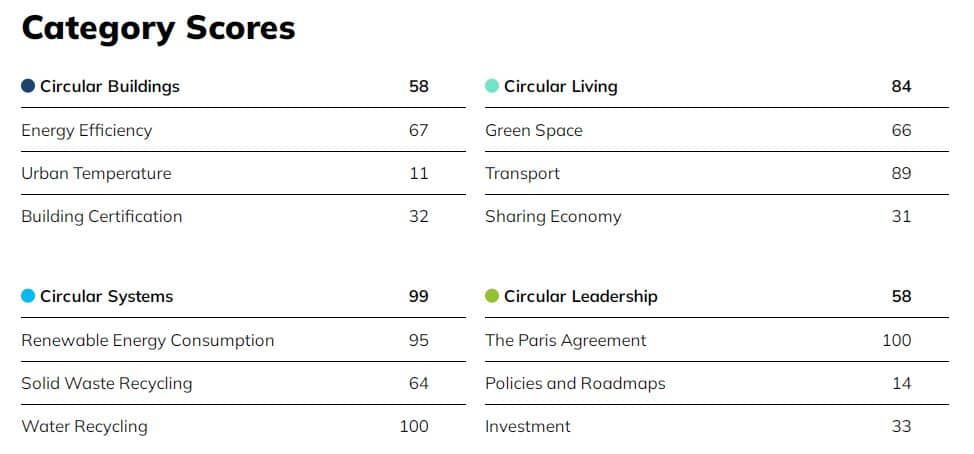
The top 25 cities were from 100 cities worldwide, representing all global regions.
The data for each indicator was normalized in a way that make the comparison “apples to apples.” They are the basis to score each city from 0 to 100 for each of the 12 indicators, each category, and overall circularity.