

The Brazilian standard SOCIALCARBON has finally rolled out a new methodology rewarding conservation efforts of areas of biodiversity importance with carbon credits.
The Standard, managed by the Social Carbon Foundation, focuses on nature-based solutions (NBS) with sustainable impacts that go beyond just carbon but with embedded co-benefits.
The SOCIALCARBON Standard
SOCIALCARBON is an international greenhouse gas (GHG) standard that embeds significant social, environmental and economic benefits (co-benefits) into nature-based projects by default, instead of using another co-benefits standard as what other standards do.
SOCIALCARBON was born out of the Bananal Island Carbon Sequestration Project. It’s a pilot sustainable development forestry project in Brazil in the late 90s.
- Brazil’s Ecologica Institute first developed the standard whose management was later passed down to the Social Carbon Foundation.
What further makes it different from other standards is the flexibility of its criteria and procedures, building in a project by project element. Flexibility is the standard’s basic guideline, which includes the political and social contexts in its approach.
SOCIALCARBON believes that emissions reductions must result from efforts that benefit and improve living conditions for stakeholders involved in climate change projects. And that should be in ways that don’t degrade their resources base.
In other words, projects must embed conservation efforts along with Indigenous peoples and local communities.
All of SOCIALCARBON’s approved NBS methodologies were based on that principle, including its new methodology – SCM0006.
Methodology for the Conservation of Areas of Biodiversity Importance
SCM0006 will issue carbon credits to projects that protect and conserve areas of biodiversity importance. It is focusing on afforestation and reforestation projects under CDM’s Scope 14.
The recently concluded UN Biodiversity Conference (COP15) in Montreal also sought to reverse nature loss and restore biodiversity. And some experts suggested payments for this effort with “biodiversity credits”.
While its pending post-public consultation updates, developers can now carry out projects under SCM0006.
It is using established and reliable sources such as the “VCM methodology VM0015” of Verra and the CDM Tool for the “Estimation of carbon stocks and change in carbon stocks of trees and shrubs in A/R CDM project activities”.
SOCIALCARBON methodology document stated that SCM0006 will:
“…offer a new financing mechanism for conservation efforts worldwide. The methodology quantified net GHG emission removals (NERs) from project activities that conserve terrestrial habitats of significant biodiversity and/or ecosystem value that are threatened by degradation and deforestation.”
Most of NBS carbon projects focus on restoring degraded habitats such as reforestation. But areas that need conservation but with low potential for degradation are not included in carbon markets.
In effect, most nature conservation initiatives get financial support through grants only.
SCM0006 addresses that concern by creating a financing mechanism via carbon credits. It quantifies real carbon removals while embedding biodiversity monitoring and local community cooperation.
- This new methodology quantifies net removals of CO2 only.
The standard is initially approved by CORSIA for vintage credits prior to 2021 only. That’s because it needs to clarify some more things to the offsetting scheme before SMC0006 receives full eligibility status.
SMC0006 Project Qualification & Eligibility Criteria
For a project to qualify for carbon credits generation under SMC0006, it must meet a number of applicability conditions.
First and foremost, the project must be on registered Indigenous land or it’s located within 1km, in partial or full, of a terrestrial area of biodiversity importance.
Also, the project must embed local communities’ knowledge and cultures into its activities that solely focus on restoration and/or restoration of the area.
- Projects that convert the area to non-native habitats or land use will not be legible under the methodology. Example is converting forest to agricultural use.
More importantly, if the area is not conserved, it must be considered vulnerable to deforestation and/or degradation. The project should also outline strategies for removing or managing invasive species in the area.
SOCIALCARBON further requires projects to show that at least 60% of existing or historical conservation works in the are not funded or they depend only on grants/donations.
Lastly, the conservation project must ensure that poaching of keystone species, those that are critical to the overall function of an ecosystem, doesn’t go above 5% of the baseline population.
Otherwise, the project can’t get any carbon credits from SOCIALCARBON for that given year.
Same with Verra’s VM0015 methodology, SMC0006 offers a set of tools for establishing the baseline data and monitoring emission reductions.
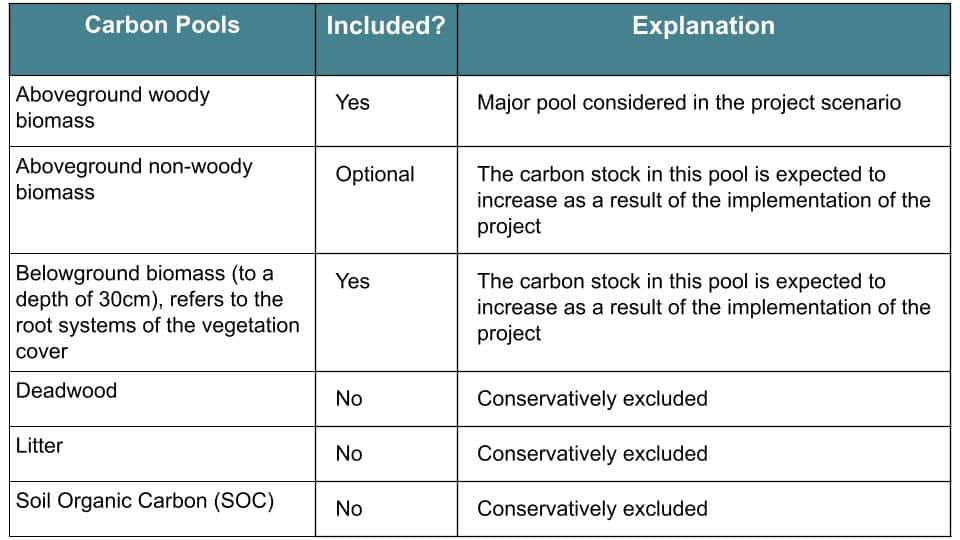
The following are the carbon pools and emission sources included or excluded from the project boundary. Fossil fuel consumption, livestock management and biomass burning are not included as GHG sources.
SOCIALCARBON has also a pending methodology for carbon removals in private conservation areas. It’s under VVB review.
Meanwhile, it has several methodologies under development, including the one for Reduced Emission from Deforestation and Forest Degradation (REDD+). It will support high-quality project-level REDD+.