

Alberta’s industrial carbon price has had only a small effect on the cost of producing oil sands crude, according to a new study from the C.D. Howe Institute.
The report, published by economist G. Kent Fellows, finds that Alberta’s Technology Innovation and Emissions Reduction (TIER) system added an average of just C$0.70 per barrel to oil sands marginal production costs in 2023. On a production-weighted basis, the increase was even smaller at C$0.34 per barrel.
The findings come as Canada and Alberta prepare to raise the industrial carbon price over the next decade. Under their May 2026 agreement, Alberta’s headline TIER price will rise from C$95 per tonne in 2026 to C$115 in 2030, C$130 in 2035 and C$140 in 2040.
Despite those higher headline prices, the study finds that most oil sands projects should continue to face relatively modest carbon costs.
Carbon Price, Small Cost: Oil Sands Barely Feel the Heat
The C.D. Howe analysis uses project-level production and emissions data to estimate how TIER affects the marginal cost of producing oil sands crude.
In 2023, the system’s impact ranged from an effective C$1.09-per-barrel reduction in marginal costs at the low end to an additional C$4.05 per barrel at the high end. The negative figures represent an effective benefit under TIER because some facilities performed better than their emissions benchmarks and received more credits than they needed.
The average facility saw a C$0.70-per-barrel increase. But larger facilities generally performed better against their emissions targets, bringing the production-weighted average down to C$0.34 per barrel.
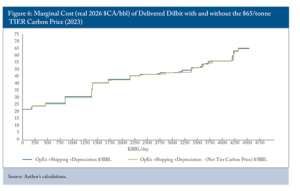
That is small compared with oil sands operating costs. The study says 99% of operators have operating costs between C$21 and C$65 per barrel.
Some major projects, including Horizon Mine, Jackpine Mine, Muskeg River Mine, Kearl and Peace River, actually received a net benefit from TIER on a per-barrel basis.
Why the Headline Carbon Price Is Misleading
The study highlights an important difference between Alberta’s headline carbon price and the actual cost many oil sands facilities face. Under TIER, large industrial emitters do not simply pay the full carbon price on every tonne of emissions. The system uses emissions benchmarks and performance credits.
Facilities must also use fund contributions to meet a minimum portion of their true-up obligation, reducing from 40% in 2023 to 10% in 2026 and beyond. Data from 2023 and 2024 show facilities met only the minimum requirement, opting for cheaper market credits over higher-cost TIER fund contributions.
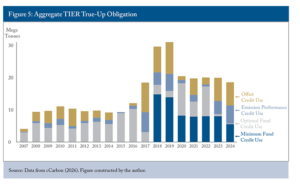
Moreover, facilities that perform better than their benchmark can generate credits. Facilities that perform worse must acquire credits or otherwise meet their compliance obligations.
This means the headline price can rise substantially without creating the same increase in average production costs. That distinction becomes even more important under the new Canada-Alberta agreement.
The headline TIER price will reach C$140 per tonne by 2040, but Canada and Alberta have agreed to target an effective carbon price of C$130 per tonne. Alberta will also introduce a minimum transfer price for TIER credits beginning in 2030. That floor starts at C$60 per tonne in 2030 and rises to C$110 by 2040.
The government says the changes are designed to make Alberta’s industrial carbon market more stable and predictable.
Costs Stay Below C$5 Per Barrel Through 2050
The most important finding for the oil sands is that higher future carbon prices do not translate into extremely high per-barrel costs under the new system.
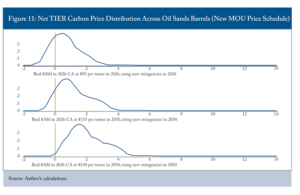
Fellows projects that no oil sands facility analyzed would face carbon pricing costs above C$5 per barrel through 2050 under the updated Canada-Alberta pricing and emissions-intensity schedules.
The study also says the estimates intentionally use assumptions that overstate carbon pricing costs. The results should therefore be viewed as an upper bound rather than a forecast of what companies will actually pay.
- Under the new policy, most projects are expected to remain well below the C$5-per-barrel level.
That matters because oil sands producers sell into global markets. Their carbon costs may affect profitability, but individual producers generally cannot set the global price of crude.
Cheap to Pay, Harder to Decarbonize
The relatively small cost does not mean the oil sands have a small climate impact.
Canada’s oil and gas sector produced 208 million tonnes of pollution in 2024. This was the country’s top source of greenhouse gases, making up 30% of national emissions. These sector emissions were 1.8% higher than the year before and 76% higher than in 1990.
However, newer data shows that the industry is starting to break the link between rising oil production and rising pollution. According to a June 2026 report from S&P Global Energy, absolute greenhouse gas emissions from Canadian oil sands rose by only 2% between 2024 and 2025, reaching an estimated 89 million tonnes.
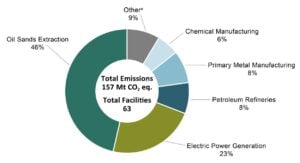
Despite these efficiency gains, oil sands operations still account for a huge chunk of Canada’s heaviest industrial footprints. In the latest federal registry, 63 individual facilities reported over 1 million tonnes of emissions each. Together, they accounted for 157 million tonnes (or 54%) of all emissions tracked under Canada’s federal reporting framework.
- Oil sands extraction sites alone made up 46% of those heavy industrial emissions. This creates a key policy question.
If carbon pricing adds only a small amount to production costs, will it be strong enough to push companies toward major emissions cuts? The answer depends partly on how companies respond to the financial signal.
Carbon Price Is Designed to Drive Investment
Carbon pricing is not intended only to increase operating costs. TIER also creates incentives for companies to invest in lower-emissions technologies and earn credits by improving their performance.
The new Canada-Alberta agreement reinforces that approach. The two governments plan to jointly support 75 million tonnes of emissions reductions through Carbon Contracts for Difference (CCfD), with costs shared equally. These contracts are designed to give companies more certainty about the future value of emissions reductions.
The agreement also sets annual tightening rates for oil sands emissions benchmarks. For large oil sands facilities, the rate is 2% annually from 2027 through 2040. Small oil sands facilities face a 1.5% rate from 2027 to 2030 and 1% from 2031 to 2040.
Those tightening rules could become more important than the headline carbon price itself. As benchmarks become stricter, companies may need to invest more in emissions reduction projects to avoid higher compliance costs.
Carbon Capture Could Change the Equation
The oil sands industry’s biggest proposed emissions reduction project is the Pathways Project, a carbon capture, utilization and storage network backed by major producers.
The May 2026 Canada-Alberta agreement sets a goal of 16 million tonnes per year of emissions reductions from Pathways projects. That includes at least 6 million tonnes per year of CCUS reductions by 2035, another 5 million tonnes by 2040 and a further 5 million tonnes by 2045.
The project is important because carbon capture could allow oil sands producers to reduce emissions without cutting production. Recent industry plans, however, remain under development.
Oil sands companies are targeting a final investment decision in late 2027 or early 2028 for the proposed first phase, according to the Oil Sands Alliance. The project’s cost and the structure of government support remain key issues.
The Real Test: Can a Small Cost Deliver Big Emissions Cuts?
Alberta’s experience shows why the headline carbon price alone does not tell the full story. The province will raise its TIER headline price from C$95 per tonne in 2026 to C$140 in 2040, yet the C.D. Howe study estimates that most oil sands facilities will continue to face carbon costs below C$5 per barrel.
That could make the system easier for producers to absorb. However, it also raises questions about whether the financial signal is strong enough to drive major emissions cuts. The answer will depend on what companies do with the policy incentives.
If producers use TIER credits and carbon contracts to fund carbon capture, efficiency improvements, and other lower-emissions technologies, the system could support both oil production and emissions reductions.
For Alberta, the bigger test is therefore not whether carbon pricing hurts oil sands profits. It is whether the system can turn a relatively modest cost into meaningful emissions cuts.