


The substantial carbon footprint associated with the Super Bowl, one of the most-watched sporting events in the U.S., is not primarily linked to travel or the show’s energy use. Interestingly, it’s largely attributed to the significant environmental impact of the Super Bowl advertising frenzy.
The ads, which last in online promotions before and after the event, raise concerns among environmentally conscious consumers and investors. Unsurprisingly, climate experts emphasize the need to address the massive environmental impact of America’s most-loved and most-viewed sporting event.
Big-Time Sporting Events and Their Giant Environmental Impact
The sport of football or soccer is highly entertaining. But what most fans or spectators don’t know is that the global football industry is responsible for emitting over 30 million tons of carbon dioxide annually. That’s almost equal to Denmark’s annual emissions.
Millions of Americans regularly tune into football games, especially major events like the upcoming Super Bowl LVIII, with last year’s viewership exceeding 99 million. The immense audience underscores the need for organizations to assess the environmental impact of these sporting events.
Major sports leagues, like the NFL and NBA, can have a big influence over viewers. They can play a crucial role in promoting sustainability.
Large-scale sporting events often involve unforeseen environmental consequences. The construction of new infrastructure, sanitation upgrades, increased energy demands, and waste management challenges contribute to the overall impact on the environment.
Watch parties hosted by viewers further add up to waste generation and travel emissions on a national level.
According to an estimate, major sports leagues, including the NFL, NBA, NHL, and MLB, generate about 35,000 tons of CO2 annually, which covers fans’ emissions only. Think about the waste by the teams playing during the events.
More notably, A-listers and celebrity fans of the big game also contribute significantly to its CO2 footprint by flying through their private jets. Popstar Taylor Swift is one great example, who has been the subject of intense scrutiny for her sky-high flight emissions.
Additionally, the energy consumption to power stadiums, resource-intensive field maintenance, and the sale of food, beverage, and merchandise at games contribute significantly to the environmental impact of beloved sporting events in the United States.
And that even doesn’t include the biggest source of the Super Bowl’s carbon footprint – buzzy digital advertisements.
Super Bowl Ads Carbon Footprint
When advertisers calculate the expense of Super Bowl advertising, the immediate focus is often on the $7 million fee for a 30-second slot. However, what might be significantly overlooked is the environmental cost of the ads.
Super Bowl Average Ad Cost, 2002-2021 (in million USD)
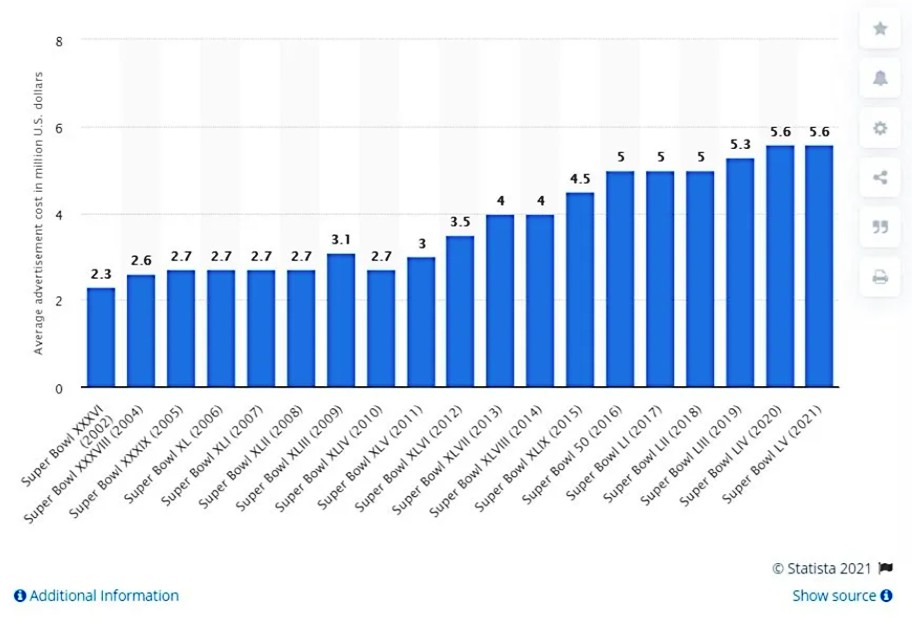
In 2021, Super Bowl advertising produced as much carbon dioxide as 100,000 Americans or around 2 million tonnes of CO2. This calculation is based on data from iSpot.tv, indicating that 56 advertisers and their 67 spots resulted in over 6.3 billion TV ad impressions, 26 million online views, and 64 billion social impressions.
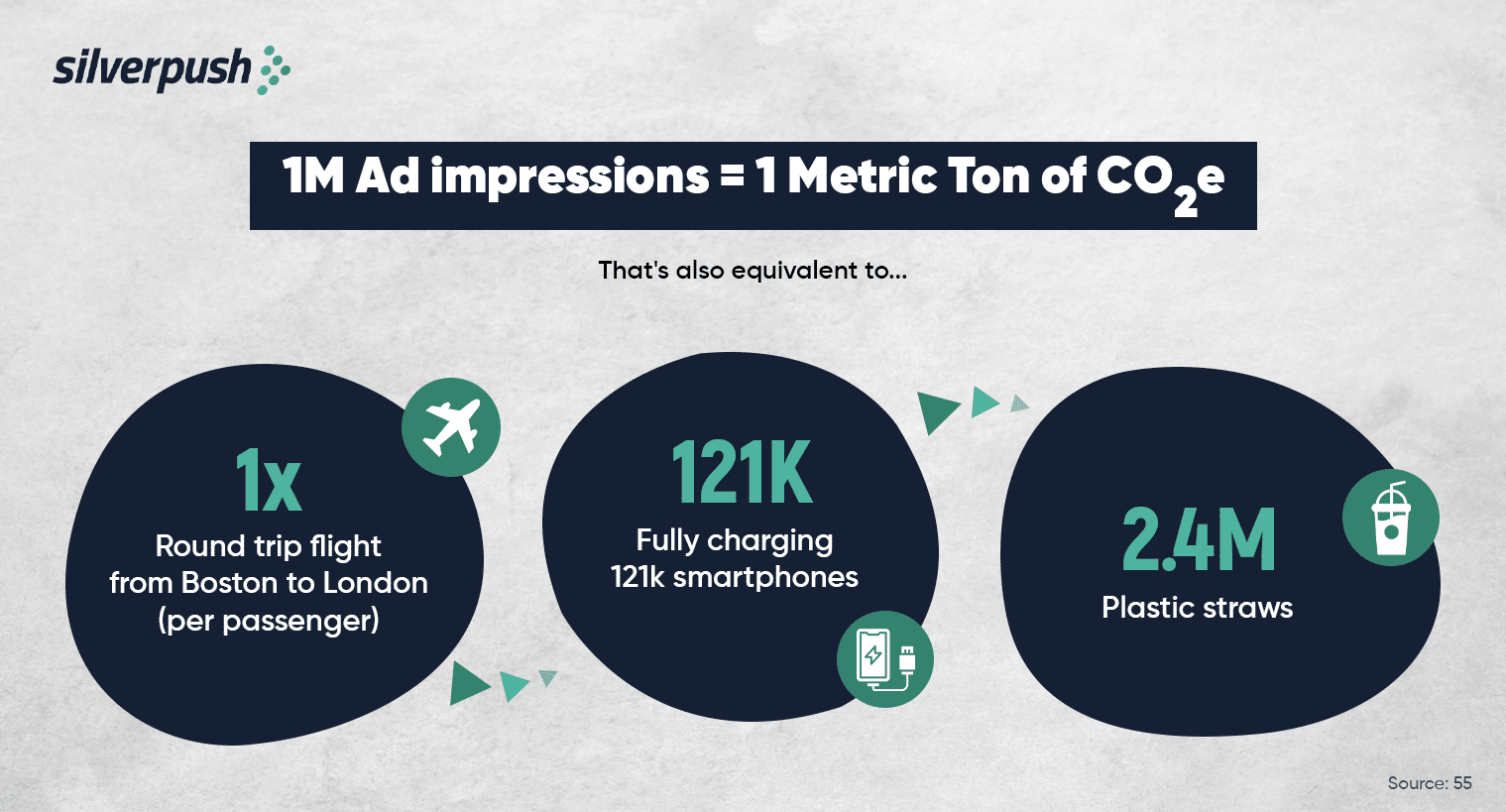
Some sources further noted that in the lead-up to the Super Bowl, there were a total of about 4 billion digital ad impressions. To put that in perspective, 1 million ad impressions is equal to 1 metric ton of CO2 or its equivalent. Using that data, the 4 billion ad impressions generated 4,000 metric tons of CO2e.
In 2022, the top 15 ads alone generated nearly 470 million views, illustrating the substantial long-tail effect. Last year, the Super Bowl event garnered over 115 million viewers, recording over 3 million increase compared to the previous year.
With all that said, the Super Bowl has been doing its best to make the sporting event “green” and sustainable.
NFL Leading the Way to Sustainability
In 2022, the NFL, the Los Angeles Super Bowl LVI Host Committee, and Verizon collaborated on greening efforts for Super Bowl LVI. They aimed to enhance air quality, establish community gardens, bolster food security, and restore a California kelp forest.
Last year, Super Bowl LVII, featuring the Eagles and Chiefs in Arizona, was one of the NFL’s most sustainable efforts yet. The football league has one of the greatest commitments to make the Super Bowl more sustainable.
The league created the program NFL Green to address the environmental impact of their major sporting events. The initiative leads community projects that restore ecosystems and habitats. These include activities such as tree planting, wildlife habitat restoration, and reforestation projects to plant thousands of trees.
In addition to ecosystem restoration, green energy plays a significant role in NFL Green’s efforts. Annually, the NFL procures Renewable Energy Certificates (RECs) matching the total energy consumption at its events. This strategy enables the NFL to offset the energy usage and greenhouse gas emissions associated with its major sporting events.
- RELATED: First NFL Team to Buy Carbon Credits
The NFL, in partnership with Arizonans, aims to achieve 92% waste diversion at the 2023 Super Bowl. Waste management has been a key focus, including recycling, composting, and minimizing landfill disposal.
Super Bowl and the Role of Carbon Credits
Earlier this year, the Union of European Football Associations (UEFA), the football governing body in Europe, established a climate fund to address the sport’s massive carbon footprint. The $7.6 million fund will address the UEFA EURO 2024 kicking off in Munich on June 14.
The American Super Bowl LVIII committees and the NFL Green implemented the “Green Initiative” at the Las Vegas Indian Center. The initiative aims to plant trees and create green spaces and seedling restoration projects. Highlighting the impact of these efforts, Susan Groh from NFL Green said:
“The Super Bowl is here and gone, but when we are able to implement these greening projects throughout the community, it leaves a lasting legacy and just an impact that lasts for years to come.”
Apart from implementing sustainable practices to reduce its substantial waste and greening projects, the Super Bowl stakeholders are also using carbon credits to offset a portion of their emissions. For instance, Entergy and the Super Bowl XLVII Host Committee purchased carbon offsets to address flight emissions.
The credits are from various offset projects including a landfill gas collection in Texas, a forest conservation initiative in California, and an effort to capture methane from livestock manure in Michigan. The offsets have been certified to deliver the promised carbon reductions by the Climate Action Reserve. NFL is also doing the same when Houston Texans bought carbon credits to offset their air travel emissions.
Each credit bought represents a tonne of carbon emission reduction from specific offset projects, which can be nature-based or technological.
While the Super Bowl shines with sportsmanship and spectacle, its environmental toll is a wake-up call. From celeb jets to advertisement carbon emissions, sustainability is key. NFL’s strides show promise, but climate action must score big.