

Three US companies – carbon solutions provider Rubicon Carbon, commodity trading firm Freepoint Commodities, and project developer Imperative Global – have teamed up to develop and fund a potential $500 million nature-based carbon offset projects that can create over 100 million carbon credits.
The trio joined forces to bring to the market large-scale nature-based carbon offset projects and create impactful results in the Global South.
A Trio for High-Quality Carbon Offset Projects
TPG Rise-backed Rubicon Carbon aims to help large companies meet their decarbonization targets and the growing demand for high-integrity carbon credits. The company sources and manages diversified carbon credit portfolios while bringing transparency and quality to voluntary carbon markets (VCMs).
Freepoint Commodities is a global commodities merchant with a voluntary carbon business delivering market solutions to VCM market players. Investing in high-quality carbon projects is one of the services that Freepoint provides.
Imperative Global seeks to advance carbon credit project development and the generation of high-quality credits by addressing issues at the source. It has expertise in carbon project execution, conservation projects, and carbon markets, optimizing these projects using advanced technology.
Their collaboration has the main goal of promoting nature-based carbon offset projects that can produce over 100 million credits.
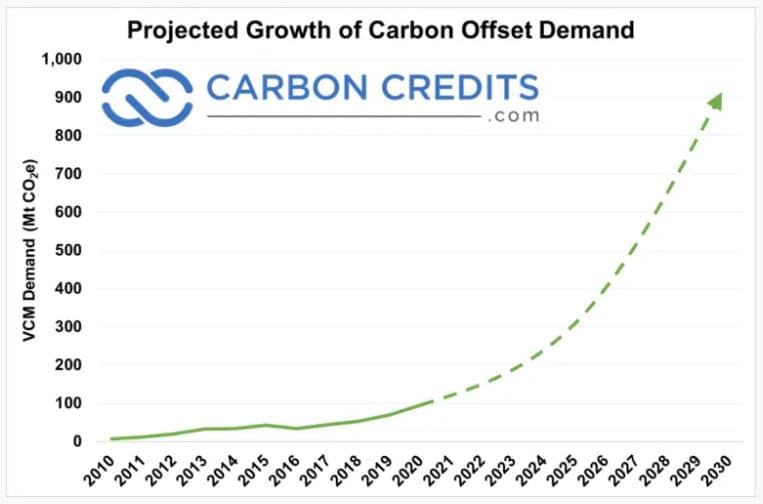
The VCM was valued at $2 billion in 2022 and market projections are bullish, surging to $250 billion by 2050. Demand for voluntary carbon credits, also known as carbon offsets, will grow exponentially as shown below.
 One of the biggest problems plaguing the market is the issue of quality. Nature-based carbon offset credits, in particular, have been criticized for being worthless.
The collaboration among the three companies aims to address this concern by driving quality within the VCM and providing capital at the scale necessary to fund large projects.
Generating 100M+ High-Integrity Carbon Credits
Rubicon Carbon has been focusing on working with project developers that implement high-integrity carbon projects. Partnering with Imperative reflects this commitment as their deal centers on promoting quality and setting new market standards.
Commenting on their collaboration, the Head of Rubicon Carbon Capital, Chris Brown said that it enables them to “help progress the VCM through a focus on integrity and quality”.
Freepoint Commodities shared the same viewpoint on their trio partnership. As the commodity trader seeks to expand its global voluntary carbon business, they’ll invest in high-integrity projects and developers.
Freepoint expressed intent “to support Imperative to be a market leader in the space”. They believe that doing so allows them to expand the suite of products and services they offer to customers.
Each dollar these companies invest in Imperative carbon projects aims to produce meaningful climate, biodiversity, and community benefits.
Imperative’s carbon project portfolio covers Latin America, Africa, and Asia, focusing on large-scale agroforestry, mangrove restoration, and native-species reforestation.
Highlighting the significance of their partnership with Rubicon and Freepoint, Imperative CEO Scobie Mackay remarked that:
“…we believe that we can deliver scale and address the issue of quality at the source – on the ground where project activities are occurring…This collaboration with Rubicon Carbon and Freepoint Commodities brings together institutional capital, specialized carbon know-how, and deep, large-scale projects expertise.”
Their strategic alliance seeks to create more than 100 million tons of carbon credits certified by Verra and Gold Standard. These credits won’t only reduce carbon emissions but also deliver substantial co-benefits and sustainable development goals.
By combining their expertise, resources, and commitment to quality and integrity, this collaborative effort seeks to address both the demand for reliable offsets and the critical need for authentic and effective nature-based carbon offset projects.