

In a groundbreaking move, India’s Finance Minister Nirmala Sitharaman has given utmost significance to critical minerals in the Union Budget for 2024-25. The Critical Minerals Mission aims to bolster India globally by ramping up domestic production of critical minerals for electric vehicles (EVs) and renewable energy technologies.
What is India’s Critical Mineral Mission?
Critical and rare earth elements (REE) are crucial for advancing clean energy and electric mobility, as the Economic Survey 2023-24 emphasized. The survey highlighted issues at mineral deposit sites and trade policies that are affecting India’s renewable energy and EV targets.
The government aims to launch this mission to eliminate these challenges and establish a smooth policy for domestic mineral exploration. The mission has outlined a comprehensive strategy that includes the recycling of lithium, copper, cobalt, and other REEs.
Furthermore, India will actively collaborate with REE-dominant nations like Australia and engage in initiatives like the Mineral Security Partnership (MSP). This will be a key component of the critical mineral mission. These partnerships are essential for securing overseas mineral resources and advancing India’s strategic objectives in exploration science.
Mrs. Sitharaman in her Budget speech, said,
“We will set up a Critical Mineral Mission for domestic production, recycling of critical minerals, and overseas acquisition of critical mineral assets. Its mandate will include technology development, a skilled workforce, an extended producer responsibility framework, and a suitable financing mechanism.”
She proposed that,
“25 critical minerals will be exempted from Basic Custom Duties (BCD). This will provide a major fillip to the processing and refining of such minerals and help secure their availability for these strategic and important sectors.”
How will the Budget 2024 Impact EVs and REEs?
Lithium, the key element for manufacturing batteries in EVs, just got a boost from the Budget 2024. The elimination of custom duty on lithium is set to drive down prices, making EV batteries more affordable in India. The same policy applies to ferrous scrap and nickel cathode while offering a concessional rate for copper scrap. These measures are aimed at fostering local manufacturing and recycling capabilities.
Currently, high lithium-ion battery costs are making EVs costlier. The Union Ministry of Mines reported that last year India imported over 2,000 tons of lithium, priced at Rs 700 crore. However, this waiver on customs duties, paired with declining global lithium prices, promises to reduce EV manufacturing costs. Additionally, the discovery of new lithium reserves in India could further slash prices, making EVs more accessible and affordable.
Pratik Kamdar, CEO & co-founder of EV batteries supplier Neuron Energy said,
“This pivotal move will substantially lower the production costs of battery cells, directly translating into more affordable electric vehicles (EVs) for consumers. By reducing manufacturing expenses, the overall cost of EV batteries will decrease, making electric vehicles a more economically viable option.”
Bhavish Aggarwal, Founder of Ola remarked,
“Exciting to see the Union Budget 2024-25 prioritizing DPI, critical minerals, and job creation. The focus on developing DPI applications in agriculture and other areas lays the data foundation for making India the AI hub of the world.”
He further added that the Critical Mineral Mission could be a game changer for India’s energy transition journey and would create ample job opportunities.
Why Mixed Response from Some EV Enthusiasts?
The EMPS (Electric Mobility Promotion Scheme) 2024 will end on July 31, 2024, and with this, the government needs to roll out a fresh long-term strategy to support the EV ecosystem. However, nothing has been clearly explained on the budget about the renewal of EMPS. Hence the response is mixed! EV makers expect that the new plan should focus on supply-side initiatives to boost domestic manufacturing and innovation.
Many startup founders and industry pandits have assessed the situation differently. They perceive that EV startups need robust support for R&D, easy capital access, and production-linked incentives. These measures will spur rapid innovation, scale operations, and increase contributions to India’s EV manufacturing. They believe that boosting India’s EV charging infrastructure is crucial to winning customer confidence. This demand is directly tied to ramping up the production of Indian EVs, including batteries and other components.
From media reports, we discovered that there’s strong anticipation for a reduction in GST rates on EV components and batteries from 18% to 5%. This tax cut would offset potential price hikes following the end of subsidies, keeping EVs affordable.
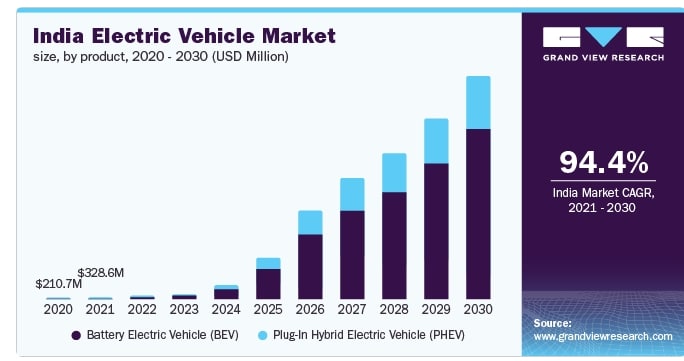 source: Grand View Research
After speculation and analysis, we can conclude that the current budget with its focus on critical minerals can position India as a global leader in clean mobility and innovation. We expect significant impacts on EV batteries, nuclear technology, AI, telecommunications, and advanced electronics. However, clear guidelines for EVs are still needed, which we hope to see in the coming months.
- FURTHER READING: Adani Reaches India’s First 10,000 MW Renewable Energy Capacity