


BHP is preparing a major expansion of its Australian copper business, planning to invest up to US$17.4 billion to double production in South Australia by 2040. The proposed investment could lift annual copper output from the region to approximately 650,000 tonnes, positioning the company to benefit from rising demand for the metal across electricity networks, renewable energy, electric vehicles (EVs), and artificial intelligence (AI) infrastructure.
The growth strategy brings together several mining and processing projects under BHP’s Copper South Australia (Copper SA) business. The company expects to increase regional production to around 500,000 tonnes annually by 2035, before reaching its longer-term target by 2040.
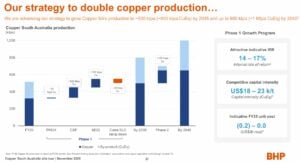
The proposed investment ranges from US$13.6 billion to US$17.4 billion. BHP expects to make final investment decisions on the overall growth program in stages, with major project decisions beginning in 2027.
The announcement comes as mining companies look to secure additional copper resources. Demand is increasing, but developing new mines has become more challenging because of declining ore grades, complex geology, permitting requirements, and infrastructure constraints.
BHP’s Copper South Australia Expansion Targets 650,000 Tonnes
The expansion will connect several existing operations and development projects, allowing BHP to increase production while improving mining and processing efficiency.
Its Copper SA portfolio includes four major assets:
- Olympic Dam: BHP’s flagship copper, gold and uranium operation and the foundation of its South Australian business.
- Carrapateena: An underground copper and gold mine acquired through BHP’s 2023 purchase of OZ Minerals.
- Prominent Hill: Another copper and gold operation acquired through the same transaction.
- Ankata: The new name for Oak Dam, a copper discovery made by BHP in 2018.
The company plans to develop these assets through a phased investment program.
The first phase aims to increase annual copper production to approximately 500,000 tonnes by 2035. It includes the Prominent Hill expansion, Carrapateena expansion, Olympic Dam mine and concentrator growth, and upgrades to the smelting and refining facilities.
The second phase will focus on Ankata and additional underground mining opportunities at Olympic Dam. Together, these developments are expected to deliver the longer-term production target.
BHP also expects the region to produce approximately 1 million tonnes of copper equivalent annually by 2040 when gold, uranium and silver are included. This would put the operation among the world’s largest mining complexes by combined metal output.
New Mining Technology Could Lower Production Costs
A major part of BHP’s strategy involves changing how it extracts and processes copper.
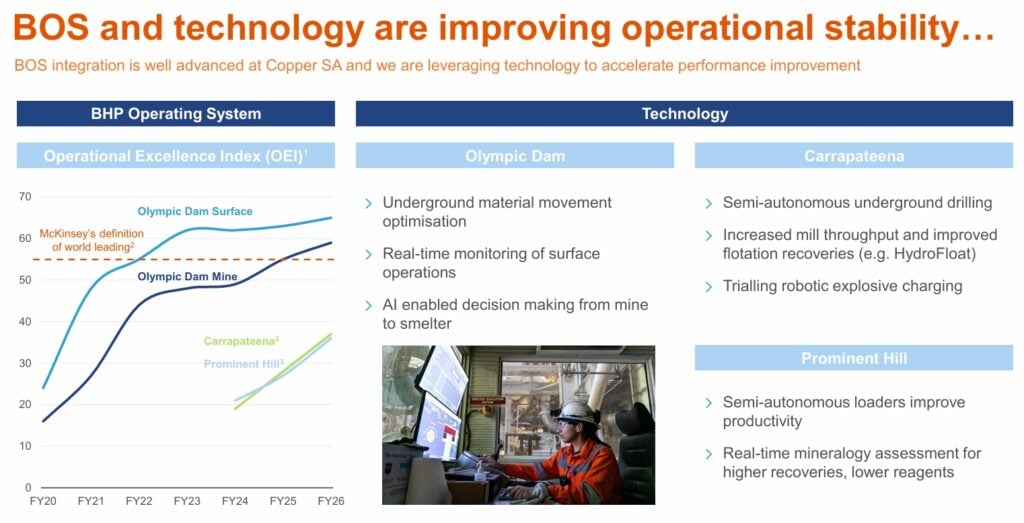
The company plans to introduce block caving at Carrapateena and Olympic Dam. This underground mining technique allows large sections of ore to break apart under gravity, making it possible to extract substantial volumes of minerals from deep deposits.
Block caving can reduce the cost of mining each tonne of copper compared with more selective underground mining methods. It can also improve productivity, extend mine life and create opportunities for greater automation.
At Carrapateena, BHP plans to develop a new block cave approximately 450 metres below its existing sub-level cave operation. The expansion is expected to increase mine production capacity from 6.4 million tonnes to 12 million tonnes of ore annually. First drawbell production is targeted for fiscal 2030.
Processing upgrades are equally important. BHP plans to introduce a two-stage smelting system at Olympic Dam to handle the complex mineral composition of its ore.
The proposed system includes a new primary flash-smelting furnace, a flash-converting furnace, additional acid-processing capacity and upgrades to the existing refinery.
These improvements are expected to increase processing flexibility, recover more value from mineral resources and reduce operating costs.
BHP estimates an indicative internal rate of return of 14% to 17% for its broader growth program. It also expects the first phase to be funded through Copper SA’s own cash flows, reducing its dependence on iron ore earnings.
Global Copper Demand Creates a Stronger Investment Case
BHP’s expansion comes as copper becomes increasingly important to the global economy.
The metal is essential for electricity transmission, power generation, electric vehicles, battery systems, and renewable energy installations. Its high electrical conductivity also makes it difficult to replace in many industrial applications.
Data centers are adding another source of demand. AI computing requires large amounts of electricity, while data center construction involves extensive electrical wiring, transformers, cooling systems, and power distribution infrastructure.
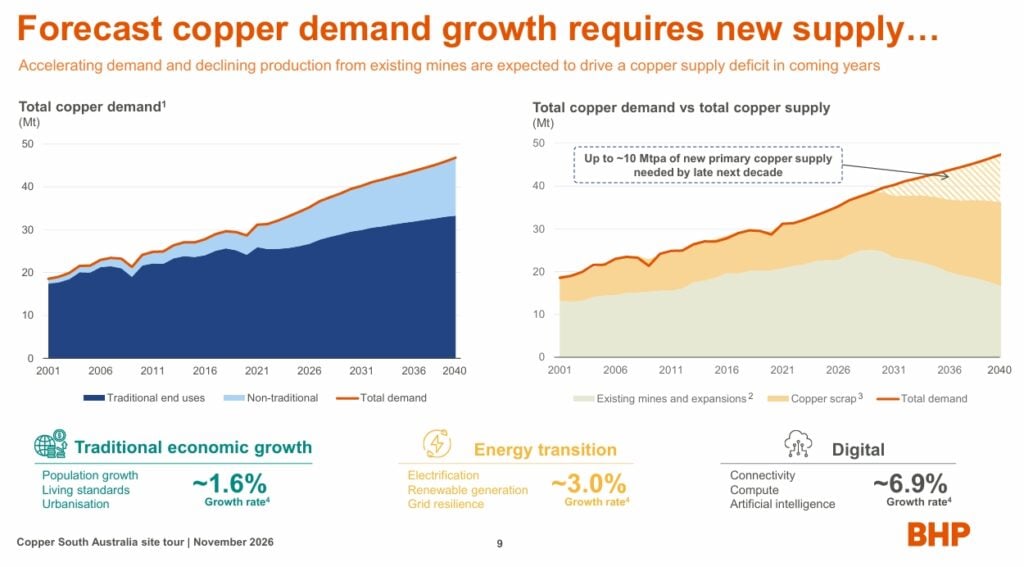
- BHP expects global copper demand to rise by about 30% by 2040, to more than 45 million tonnes annually. Electrification, digital infrastructure and AI-related investment are expected to support this growth.
The International Copper Study Group (ICSG) also expects global refined copper production and consumption to increase over the next two years.
- Its October 2026 market estimates put refined copper production at approximately 28.7 million tonnes in 2026 and 29.7 million tonnes in 2027. Refined copper usage is projected to reach 28.6 million tonnes and 29.3 million tonnes, respectively.
Although these estimates indicate a modest market surplus, they do not remove longer-term concerns about the availability of new mine supply. Developing major copper projects can take many years, while disruptions at existing operations can affect production.
The difference between near-term market balances and long-term supply requirements is important for investors. A temporary surplus does not necessarily mean the industry has enough new mining capacity to meet future demand.
Australia Strengthens Its Position in the Global Copper Market
Australia is also looking to increase its contribution to global copper supply.
According to the South Australian government’s 2025 mineral statistics, Australia produced approximately 750,000 tonnes of mined copper in 2025, representing around 3% of global production. The country ranked eighth among global copper producers.
South Australia has a particularly important role in this industry. It produced 328,323 tonnes of copper in 2025, generating approximately A$5.03 billion in production value.
The state also holds around 66% of Australia’s demonstrated economic copper resources, making it the country’s leading copper-producing region by resource potential.
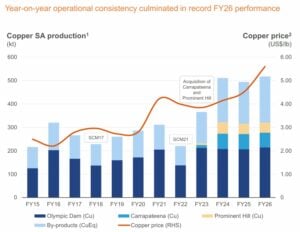
BHP’s expansion could significantly strengthen this position. Its FY2026 results showed that Copper SA produced 321,000 tonnes of copper, generating US$3.2 billion in underlying EBITDA. This was a 65% increase from the previous financial year, supported by stronger copper prices and lower unit costs.
The Australian government’s September 2026 Resources and Energy Quarterly also points to a positive longer-term outlook. Copper export earnings are projected to increase from A$14 billion in 2025-26 to A$19 billion in 2030-31, supported by higher prices and export volumes.
However, expanding production will require more than investment in mining equipment and processing plants. Water availability and reliable electricity infrastructure are important challenges for South Australia’s remote mining operations.
Water and Power Infrastructure Remain Critical
BHP’s Copper SA operations are located in an increasingly dry region, where water supply is a major consideration.
The company currently relies partly on water from the Great Artesian Basin. This has raised concerns among Traditional Owner communities, including the Arabana people, about the long-term management of groundwater resources.
To reduce this dependence, BHP is considering a seawater desalination facility at Cape Hardy on South Australia’s Spencer Gulf. The proposed plant could supply approximately 260 megalitres of water daily, although delivering it to the mining operations would require a pipeline extending hundreds of kilometres.
The Northern Water Project is another important part of the infrastructure plan. BHP expects to become a major long-term customer of this proposed multi-user water system, with first water targeted for fiscal 2032.
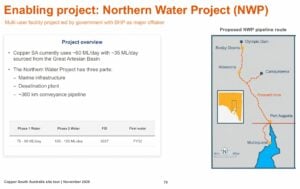
Power infrastructure will also need upgrades, including improvements to transmission capacity to support larger mining and processing operations.
Copper Growth Could Reshape BHP’s Long-Term Business
BHP’s South Australian expansion reflects a broader shift in its business priorities as copper becomes increasingly important to the global energy and technology industries.
The company has already demonstrated the financial contribution of its copper operations. In FY2026, copper generated more value for BHP than iron ore for the first time, highlighting the metal’s growing importance to its portfolio.
The proposed investment could strengthen that position further while supporting Australia’s ambitions to expand its critical minerals industry.
However, the production targets remain dependent on project approvals, infrastructure development, construction schedules and future investment decisions. The company will also need to manage water availability and the technical challenges associated with its complex ore deposits.
If successfully executed, the expansion could turn Copper South Australia into a much larger source of global copper supply just as demand from electrification, AI infrastructure and power networks continues to grow.