

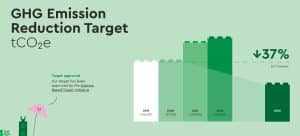
Lego, the world’s leading toy manufacturer, is taking significant steps to meet its net zero goals by mandating that its suppliers set near-term emissions reduction targets by 2026 under its new Supplier Sustainability Program. This initiative is crucial for Lego to stay on track with its commitment to reducing its carbon footprint by 37% by 2032 and achieving net zero by 2050.
Carsten Rasmussen, Lego’s Chief Operations Officer, emphasized the importance of sustainability in business operations and supplier selection. He stated,
“Sustainability is a license to operate and a requirement of how we do business, including how we select our suppliers. We have ideas and we have a pathway; we cannot do it alone.”
Lego’s Colorful Path to Net Zero
The toy industry produces an estimated 26 million metric tons of greenhouse gas (GHG) emissions annually. But the industry rarely makes public commitments regarding supplier emissions, making Lego stand out with this announcement.
The Danish toy maker’s initiative builds on a 2014 program aimed at measuring and mitigating the environmental impact of its close partners, involving 158 suppliers as of December’s sustainability progress report.
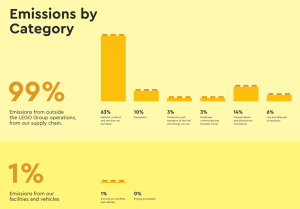
The Lego Group’s 2050 net zero emissions pledge includes Scope 1, 2, and 3 emissions. Notably, 99% of Lego’s emissions stem from Scope 3 activities, which include the entire supply chain.
Setting a long-term goal helps ensure the company achieves its climate targets, with the immediate priority of meeting its 2032 carbon reduction goals. The toy manufacturer employs various initiatives to reach those goals and has increased spending on climate actions by 60% in 2023 versus 2022.
Their major initiatives include the following and their sustainability 2023 progress:
Increasing capacity and production of renewable energy at sites:
- Reduced absolute emissions across manufacturing sites, stores, and offices.
- Increased production of renewable energy in factories and purchased renewable energy for factories, offices, and stores.
- Commenced construction of a new factory in Vietnam and broke ground on a new factory near Richmond, Virginia, USA, both with solar facilities to match total annual energy requirements.
- Increased solar capacity investments by adding 2.2 MWp, bringing peak capacity to 15.6 MWp across production sites in Denmark, the Czech Republic, Hungary, Mexico, and China (16% increase from 2022).
- Planning to build a solar park in Billund, Denmark, to cover energy requirements of offices and sites in the town, expected to be operational in 2027.
Taking CO2 emissions into account across all business decisions:
- Implemented shadow carbon pricing on key investments to encourage low-carbon initiatives.
- Ensured emissions related to new investments are considered before financial decisions.
- Established responsible travel guidelines to reduce employee travel, particularly international air travel, by 50% by 2032 compared to 2019.
Joining forces with suppliers to collectively reduce environmental impact:
- Continued collaboration with suppliers through the Engage-to-Reduce program (established in 2014).
- Engaged 158 suppliers in 2023, up from 138 in 2022, marking a 14.5% increase.
An Expensive Climate Commitment
Lego also plans to triple its investment in environmental sustainability over the next 3 years, spending over $1.4 billion.
This investment will support designing carbon-neutral factories and buildings, increasing renewable energy production and acquisition at its plants, offices, and stores, and incorporating carbon dioxide emissions into all corporate decisions.
This move places the company alongside industry rivals Hasbro and Mattel, who have made similar environmental pledges. In 2022, Hasbro set goals to reduce greenhouse gases by 40% by 2030 and achieve net zero emissions by 2050. Mattel committed to reducing plastic packaging by 25% per product by 2030.
One of the toy industry’s biggest challenges is plastic use; it uses nearly 1% of global plastic production.
Lego’s total footprint for 2022 was about 1.6 million metric tons, up from 1.5 million metric tons in 2021. Finding alternatives to plastic is a top priority for the company, though reducing plastics and cutting emissions don’t always align.
In September, Lego backed away from a commitment to make its bricks entirely from recycled plastic as it wouldn’t significantly reduce emissions.
To date, Lego has tested over 600 materials, including bio-polyethylene, used in botanical elements and Minifigure accessories. In 2023, 18% of the resin purchased for bricks was from renewable or recycled sources mixed with virgin materials.
From Playtime to Planet-Saving Actions
Additionally, Lego will invest in global carbon reduction initiatives, such as supporting carbon capture programs like that of Climeworks. In 2023, Lego entered an agreement with Climeworks, investing US$2.4 million in their carbon capture and storage services.
Climeworks specializes in removing historic and unavoidable CO2 emissions from the atmosphere through direct air capture and storage facilities. The process involves drawing air into large collector containers, capturing the CO2 on a filter, and then storing the collected CO2 deep underground in Iceland with Climeworks’ storage partner, Carbfix. This CO2 is eventually transformed into stone through an accelerated natural process.
This initiative reflects Lego’s commitment to addressing both current and historical carbon emissions, further enhancing its efforts to achieve net zero emissions by 2050.
By implementing these measures, Lego is taking a leadership role in sustainability within the toy industry, pushing for broader environmental responsibility and innovation among its suppliers and beyond.