


In late February 2026, OpenAI reached a deal that allows its artificial intelligence (AI) tools run inside the U.S. Department of Defense’s (DoD) classified computer systems. CEO Sam Altman said this deal includes safety limits on mass surveillance and use in weapons systems.
The announcement came shortly after the Trump administration ordered U.S. agencies to stop using rival AI company Anthropic’s technology.
This moment highlighted how AI is becoming linked with national security. It also showed how two leading AI models — OpenAI’s ChatGPT and Anthropic’s Claude AI — are now part of major technology debates. At the same time, their energy use and carbon footprints matter to people, organizations, and climate policy makers.
This article compares ChatGPT and Claude AI using data from credible research. It explains their environmental impact, why it matters, and how it connects to broader issues in technology and climate.
Why Every Query Counts: AI’s Hidden Carbon Cost
AI systems run on large computer networks called data centers. These centers use electricity and water. They also produce carbon dioxide (CO₂), a major contributor to climate change.
The size of the AI model and how often it is used affect its environmental costs. A single AI query may use only a small amount of energy. But billions of queries add up quickly. Data centers for AI are part of a fast‑growing electricity demand that could shape future carbon emissions patterns.
Because of this, comparing the environmental impact of different AI models helps users, developers, and policymakers understand sustainability trade‑offs.
How ChatGPT and Claude AI Use Energy
Energy Per Query
A single AI query is often measured in watt‑hours (Wh). This measures how much electricity is used.
Independent research shows:
- OpenAI’s GPT‑4o (ChatGPT) uses about 0.30 Wh per request, with around 0.13 grams of CO₂ emitted on a typical global electricity grid.
- Anthropic’s Claude 3 Opus AI uses significantly more, roughly 4.05 Wh per request, with about 1.80 grams of CO₂ per query in similar conditions.
- A lighter version of Claude, Claude 3 Haiku, uses around 0.22 Wh and 0.10 grams CO₂ per query, suggesting model choice matters for impact.
This comparison shows that different AI architectures and optimizations can lead to more than 10× differences in energy usage per interaction.
User Shifts: Claude Climbs as ChatGPT Falls
After news broke about OpenAI’s partnership with the U.S. Department of Defense, some users began leaving ChatGPT for alternatives. Data from app rankings shows that Anthropic’s Claude AI overtook ChatGPT as the #1 free app on the Apple U.S. App Store shortly after the dispute with the Pentagon became public.

Sensor Tower data showed that Claude climbed from outside the top 100 in late January to the top spot by early March. Daily sign-ups and free users increased sharply during this time.
Reports show that Claude’s free user base grew over 60% since January. Also, its paid subscriptions more than doubled this year, according to company statements about the surge.
At the same time, uninstalls of the ChatGPT app spiked. Some data showed that these rates surged after the Pentagon deal. Yet, OpenAI’s chatbot maintains a much larger overall user base, with reported weekly active users in the hundreds of millions.
These recent shifts represent a notable trend toward user migration and increased competition in the AI chatbot market.
Scaling Impact: Why Small Differences Multiply
A single AI query’s footprint may look small. For example, 0.30 Wh is roughly the energy needed to run a small LED light bulb for a few minutes. But the global scale of use changes the picture.
ChatGPT alone handles hundreds of millions to billions of queries every day. One estimate suggests more than 1 billion queries daily, leading to about 300 megawatt‑hours (MWh) of electricity consumption per day and over 260,000 kilograms of CO₂ emissions per month from ChatGPT use.
If models like Claude AI — which use more energy per query — are used widely, the total emissions scale up even faster. That means small differences in per‑query use can translate into large differences in total environmental output.
From Training to Inference: The Energy Life Cycle of AI
There are two main parts of AI’s life cycle:
-
Model Training
Training is a one‑time event for a given version of a model, but it must be repeated for updates.
Training a large AI model involves consuming large amounts of energy. Training generates billions of calculations and can emit hundreds of metric tons of CO₂.
For example, research on large language models estimates that training some early AI models resulted in over 500 metric tons of CO₂ equivalent because of the hardware and energy used.
-
Inference (Everyday Use)
Inference is when a model responds to user prompts. This ongoing use represents most of the daily energy footprint of AI systems. Here, the efficiency per query matters most.
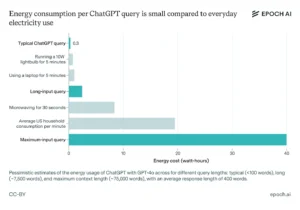
A more efficient model like GPT‑4o may use less energy per request than a less efficient model. Since ChatGPT already sees large volumes of queries, even small efficiency gains can reduce total emissions.
Water and Data Centers
AI data centers use water mainly for cooling. Hot servers generate heat and need water for cooling systems. Research indicates water use per query is usually very small, such as about 0.32 milliliters per average AI prompt.
However, at scale, this water use still matters, especially in regions where water is scarce. Not all companies publicly disclose the water footprints tied to their AI operations, making precise comparison challenging.
AI’s Role in Future Carbon Emissions
AI’s total environmental impact includes training, inference, and indirect effects from electricity production.

Data centers now account for a significant share of global electricity demand. Some estimates suggest that by 2030, data centers could use up to 3–4 % of global power. Most of this growth is tied to AI and cloud computing.
Globally, generative AI, including models like ChatGPT and Claude, could contribute millions of tons of CO₂ emissions annually by 2035 if current growth trends continue. This broad projection highlights why understanding per‑model efficiency matters for climate planning.
Comparing ChatGPT and Claude: Key Numbers
Here is a comparison at a glance based on third‑party research:
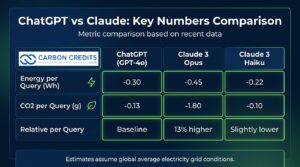
This table shows clear differences in per‑query environmental output between the two companies’ flagship models.
Understanding AI Emissions Limits
It is important to note that exact figures for model training and full system usage are often not publicly disclosed by AI companies. Independent research fills the gap using benchmarks and statistical methods.
Training emissions and energy use depend on many factors, such as the type of hardware used, the energy mix of the data center, and optimization choices. This study focused on inference energy use, not full life‑cycle emissions.
Greater transparency from AI companies would help both researchers and users better understand environmental impacts.
AI and Climate Policy: Why Efficiency Shapes Carbon Markets
Many climate strategies today focus on reducing emissions where possible. Measures include energy efficiency, shifting to renewable energy, and accounting for indirect emissions (scope 2 and 3).
AI technologies are part of this broader discussion for these reasons:
- They consume electricity at large scale.
- Their footprints depend on model design and data center energy sources.
- Differences between models show how design choices affect emissions.
For users and organizations, choosing more efficient models or using AI judiciously can reduce total carbon emissions. For policymakers, understanding AI’s footprint supports better regulation around digital emissions accounting.
Lessons from ChatGPT and Claude
AI models like ChatGPT and Claude AI do not have identical environmental footprints. Data suggests that, per query:
- ChatGPT’s GPT‑4o model operates with lower energy use and emissions than many versions of Claude AI.
- Claude has some versions with higher per‑query energy use, though variants exist with lower profiles.
These differences are significant because AI usage continues to grow rapidly. Even small gains in efficiency can make a substantial difference when scaled across millions or billions of queries.
For climate‑focused platforms, this comparison shows that digital technologies have measurable environmental effects. Understanding these effects helps shape carbon accounting, sustainability reporting, and climate policy decisions in a world where AI is increasingly widespread.