Coca-Cola vs PepsiCo 2025: Who’s Leading on Profits—and Planet Goals?

Coca-Cola reported strong profits, while PepsiCo faced higher costs and slower growth. But beyond earnings, their updates on carbon emissions, water use, and plastic waste show how both companies are trying to balance business goals with environmental action.

Let’s study and find out which beverage giant is making faster progress on revenue and, more importantly, sustainability.

Coca-Cola Q1 2025: Strong Profits, Even as Sales Dip

Coca-Cola sold 2% more drinks in the first quarter of 2025, thanks to strong demand in India, China, and Brazil. While overall revenue dropped 2% to $11.1 billion, mainly due to currency changes and the shifting of some bottling operations.

Coke’s core business stayed strong. Organic revenue (which removes the impact of currency changes and one-time events) grew 6%, helped by higher prices and a small rise in concentrate sales.

Big Jump in Profit and Margins

Profit rose 71% this quarter, thanks to solid sales, better cost control, and smart timing on marketing. Coca-Cola’s profit margin jumped to 32.9%, up from 18.9% last year. Adjusted margins (non-GAAP) were even better at 33.8%. Earnings per share rose 5% to $0.77, even after being hit by currency losses. Adjusted earnings came in at $0.73, up 1%.

Coke Zero and Sparkling Drinks Lead the Way

Coke Zero Sugar saw big success, with a 14% jump in sales. Sparkling drinks like Coca-Cola and Fanta grew by 2%. Water, tea, and juice drinks also saw slight increases. Overall, Coca-Cola gained more market share in ready-to-drink beverages around the world.

Mixed Results Across Regions

  • Europe, Middle East & Africa: Sales rose 3%, and profits held strong despite currency pressure.
  • Latin America: Sales were flat, but smart pricing helped boost profits.
  • North America: Sales dropped 3%, but profits grew thanks to higher prices.
  • Asia Pacific: Sales rose 6%, with strong growth across all drink types.
  • Bottling Operations: Volume fell 17% as Coca-Cola shifted bottling to partners. This lowered profits.

However, Coca-Cola’s free cash flow was down $5.5 billion. But this was mostly due to a large $6.1 billion payment related to its Fairlife deal. Without that, cash flow was still positive at $558 million.

Coca-Cola’s GHG Emissions in 2023: A Quick Look

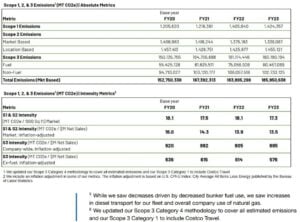
  • In 2023, Coca-Cola’s total manufacturing emissions were 5.62 million metric tons using the location-based method and 4.95 million metric tons using the market-based method.

Emissions directly from factories stayed the same at 1.61 million metric tons. Indirect emissions from electricity use increased slightly to 4.01 million metric tons (location-based) and 3.34 million metric tons (market-based).

However, carbon emissions per liter of product rose to 28.31 grams. Under CDP reporting, total emissions reached 5.62 million metric tons, with most coming from franchise operations.

Coca Cola emissions
Source: Coca-Cola

Improved Water Efficiency

Water management is a key part of Coca-Cola’s sustainability efforts. Since 2015, the company has consistently replaced more water than it uses in its drinks. In 2023, it stayed committed to this goal by aiming to replenish over 100% of the water used in its finished products globally.

  • Compared to 2022, Coca-Cola improved its water use efficiency in 2023. It used 1.78 liters of water per liter of product, slightly better than the 1.79 liters used the year before.

Meanwhile, total water withdrawal went up a bit, reaching 311,998 megaliters. Water consumption also increased to 194,853 megaliters.

Focus on Water-Stress Regions 

Importantly, 28% of the water was used in high water-stress areas signifies the need for efficient water management. On the positive side, wastewater discharge dropped to 117,124 megaliters, showing better control and treatment of wastewater.

Additionally, Coca-Cola expanded its focus on water in high-risk locations. Previously, the goal was to replenish 100% of the water used in 175 high-risk sites by 2030.

Now, the target encompasses all high-risk locations, i.e., more than 200 sites by 2035. This broader commitment reflects the company’s growing emphasis on supporting local ecosystems and communities where water resources are under stress.

PepsiCo Q1 2025: Mixed Performance in a Tough Market

PepsiCo released its Q1 2025 results on April 24, showing mixed performance due to slow demand and higher global costs. Still, international sales provided a boost.

Net revenue fell by 1.8% to $17.92 billion, but still came in above analyst estimates. Organic revenue grew by 1.2%, with strong international performance helping balance weaker North American sales.

pepsico earnings
Source: Pepsico

Profit Drops Amid Cost Pressures

Core earnings per share (EPS) dropped to $1.48, slightly below forecasts. Net income was $1.83 billion, down from $2.05 billion in Q1 2024. Rising supply chain costs and new tariffs impacted profitability.

North America Slows, International Gains

Pepsi Zero Sugar and Gatorade helped beverage sales in North America grow by 1%. However, food sales dropped, especially in Frito-Lay. International business saw strong demand in countries like India, Brazil, and Egypt.

PepsiCo now expects flat earnings growth for the rest of 2025 due to inflation and global uncertainty. Earlier, it had forecasted mid-single-digit growth.

This year, the company plans to focus on affordable products, expand globally, invest in new snacks and drinks, and cut costs to manage inflation.

PepsiCo’s 2023 ESG Progress: Big Wins in Farming, Emissions, Water, and Packaging

In 2023, PepsiCo made strong progress on its environmental goals. The company focused on farming, clean energy, water savings, and cutting plastic waste. While it faced some challenges, it stayed on track toward its long-term targets.

Boosting Regenerative Farming

PepsiCo doubled its regenerative farming land. It grew from 900,000 acres in 2022 to 1.8 million acres in 2023. The company also beat its water-use goal. It improved water efficiency by 22% — far above its 15% target.

In 2023, 58% of key ingredients came from sustainable sources. Since 2021, PepsiCo has supported over 57,000 farmers and workers. It offered training and programs to help women and build local economies.

PepsiCo also met its water protection goals in high-risk areas two years early. Now, it will focus on broader water efforts instead of tracking this specific goal.

Cutting Emissions and Using Clean Energy

PepsiCo plans to hit net-zero emissions by 2040. It also aims to cut Scope 1 and 2 emissions by 75% and Scope 3 emissions by 40% by 2030 (from 2015 levels).

  • In 2023, total GHG emissions (Scopes 1, 2, and 3) were ~58 million metric tons. It dropped 4% from 2015 and 5% from 2022.

Direct emissions (from PepsiCo’s operations) fell by 33%. Scope 3 emissions (from suppliers and others) dropped only 1%.

To help lower emissions, PepsiCo added more electric vehicles. These EVs covered over 3 million zero-emission miles in 2023. The company also used more renewable biogas from food waste, like potato peels.

pepsico emission
Source: PepsiCo

Saving and Replenishing Water

Water remains a top focus for PepsiCo. In 2023, it improved water-use efficiency by 25% at high-risk sites. This means it achieved its target 2 years early.

The company gave back about 69% of the water it used in water-stressed areas. This added up to over 12 billion liters. Also, the number of PepsiCo plants meeting top water standards rose from 8 to 27 in just one year.

  • In Spain, PepsiCo restored 70 million liters of water near its Alvalle plant by replacing invasive plants with native trees.

Reducing Plastic and Promoting Reuse

PepsiCo continued to cut plastic waste. In 2023, 10% of its drinks were sold in reusable packages. It also became the first brand in North America to replace plastic rings on multipacks with paper-based ones.

The company used 10% recycled plastic in its packaging. Its 2030 goal is 50%. Over 30 countries now sell PepsiCo drinks in 100% recycled PET bottles (except caps and labels).

PepsiCo cut virgin plastic use per serving by 1% in 2020. Overall, virgin plastic use was 6% higher than in 2020 — a smaller increase than the 11% in 2022.

  • By the end of 2023, 89% of PepsiCo’s packaging was designed to be recyclable, compostable, biodegradable, or reusable (RCBR).
  • It now expects 98% to be RCBR by 2025, and 92% of it will likely be recycled in real life.

That falls short of the 100% goal, but the company is pushing forward with new ideas and partnerships.

Coca-Cola Vs PepsiCo: Who’s Winning The Sustainability Game? 

pepsico coca cola

In summary, PepsiCo’s reported emissions are much higher than Coca-Cola’s manufacturing-only figures due to broader reporting boundaries. Both companies have made progress versus their 2015 baselines, but PepsiCo achieved a year-over-year reduction in 2023, while Coca-Cola’s manufacturing emissions rose slightly.

Eni Picks Saipem for $590M Carbon Capture Project in UK’s Liverpool Bay

Italian company Saipem has won a major contract from Eni to help build a new carbon capture and storage (CCS) project off the coast of northern England. The contract is worth about €520 million ($590 million) and is part of the HyNet industrial cluster. It is a major effort to cut emissions in one of the UK’s most carbon-heavy regions and support the country’s net-zero goal.

The Liverpool Bay CCS project will capture carbon dioxide (CO2) from industries across North West England and North Wales. The captured CO2 will then be transported through a network of pipelines and stored deep underground in old gas fields under the Irish Sea. These fields, such as Hamilton, Hamilton North, and Lennox, are owned by Eni.

The project is possible to complete in about three years and will play an important role in helping the UK meet its net-zero emissions goals. It could also create over 1,000 local jobs during the construction period, giving the economy a boost.

What Saipem Will Build: Connecting the Carbon Dots

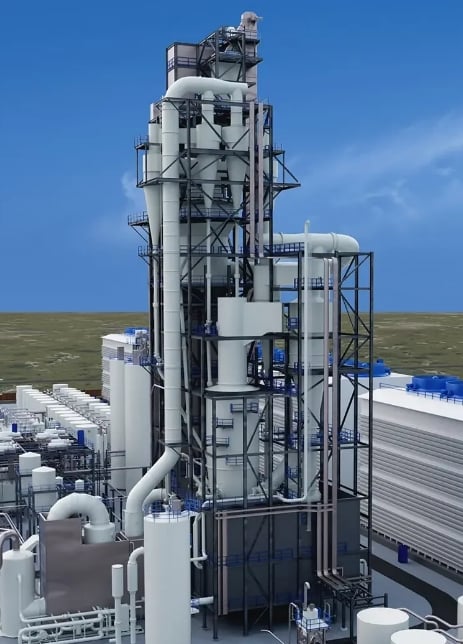
As part of the project, Saipem will be responsible for the engineering, procurement, construction, and commissioning support of a new CO2 compression station at Point of Ayr in North Wales.

This new facility will replace an old gas processing plant. Instead of handling natural gas, the new station will compress CO2 and send it to storage sites offshore. It will connect with both the project’s onshore and offshore parts, ensuring that the captured carbon can be transported safely and permanently stored underground.

In addition to the new compression station, other work includes:

  • Retrofitting existing offshore platforms to handle CO2 instead of natural gas
  • Repurposing 149 kilometers (about 93 miles) of existing pipelines
  • Building 35 kilometers (about 22 miles) of new pipelines to link factories and other carbon sources to the network

These efforts will ensure that CO2 captured from factories, power plants, and other industrial sites can be securely stored and kept out of the atmosphere.

Zeroing In on the UK’s Net Zero Goals

The UK government has made carbon capture and storage a key part of its plan to fight climate change. It will spend £22 billion over 25 years on carbon capture and storage (CCS) to help reach its net-zero goal by 2050.

UK net zero roadmap
Source: IEA

CCS captures carbon from heavy industries and stores it underground. But rising costs mean only 3 of the 8 planned projects will go ahead. These include the East Coast Cluster, led by BP and Equinor, and HyNet in western England and Wales.

  • Together, they aim to remove about 3 million tons of CO₂ per year—much less than the 20 to 30 million tons first planned.

Critics say this could keep the UK tied to natural gas for years and slow down the shift to clean energy like wind and solar. The National Audit Office warns about delays, rising costs, and past CCS failures. CCS could help reduce industrial emissions. However, experts say more investment in renewables and energy efficiency is needed for a truly green future.

The government approved the HyNet project in October 2024.

Companies, like Heidelberg Materials, which makes cement, are ready to send their CO2 for storage. Other partners include Viridor, Ineos, Fulcrum Bioenergy, and Progressive Energy.

The Liverpool Bay CCS project aims to cut emissions from tough-to-clean industries, such as cement manufacturing and waste-to-energy plants. The project captures and stores CO2. This helps stop millions of tons of greenhouse gases from entering the atmosphere each year.

Liverpool Bay will store up to 4.5 million tonnes of CO2 each year in its first phase and increase that to 10 million tonnes annually after 2030. This effort directly supports the UK’s goal to store 20 to 30 million tonnes of CO₂ per year by 2030.

Eni Liverpool Bay CCS project
Source: Liverpool Bay T&S

Eni recently got funding from the UK’s Department for Energy Security and Net Zero (DESNZ). This support lets them proceed with construction.

In addition, Eni has received three carbon storage licenses from the North Sea Transition Authority (NSTA). These licenses cover the development of a storage system capable of holding 109 million tons of CO2 over the next 25 years.

This project is a major piece of the UK’s broader effort to reach net-zero emissions by 2050.

Saipem’s Growing CCS Business

For Saipem, the Liverpool Bay contract is another big win in the growing field of carbon capture and storage. The company reported a total backlog of €32.7 billion ($37.2 billion) at the end of March 2025, with CCS projects playing an increasing role.

Saipem said that the Liverpool Bay project shows how energy companies can reuse existing oil and gas infrastructure to support the energy transition. By converting old pipelines and platforms to handle CO2, the industry can cut costs and speed up the move toward cleaner energy.

In addition to the Liverpool Bay project, Eni is working on another CCS initiative in the Bacton Thames area in the southern North Sea. This project, called the Bacton Thames Net-Zero Initiative, aims to capture CO2 from industries around Bacton and the Thames Estuary. It could even accept CO2 from factories in the European Union, expanding its impact beyond the UK.

Turning the Tide in Liverpool Bay

The Liverpool Bay CCS project shows how old fossil fuel infrastructure can be given a new life in the clean energy era. Pipelines and platforms will now help fight climate change. They will safely store carbon underground instead of producing and transporting natural gas.

Construction on the new compression station at Point of Ayr and upgrades to the wider pipeline network will ramp up soon. If things go as planned, the Liverpool Bay CCS system may start capturing and storing CO2 by the end of the decade. This could significantly boost the UK’s climate efforts.

The region is leading by turning carbon-heavy industries into cleaner ones. This shows how industrial hubs worldwide can help meet global climate goals.

Netherlands Invests $726 Million in Aramis CCS as Shell and Total Shift Strategies

The Dutch government has committed $726 million (639 million euros) to the Aramis carbon capture and storage (CCS) project, the largest of its kind in the Netherlands. This major investment comes after energy companies Shell and TotalEnergies decided to reduce their financial support for part of the project.

Shell and TotalEnergies had originally planned to help fund the construction of a large pipeline system. This pipeline would connect factories and industrial areas to underground storage sites in the North Sea.

However, both companies have now chosen to focus only on developing the carbon storage sites and offering carbon storage services. They pulled out of investing in the pipeline infrastructure.

Without government help, Aramis’s future was uncertain. In response, the government stepped in to cover the risk and keep the project moving forward. Climate Minister Sophie Hermans said that the decision would help ensure that the country could still meet its climate goals, saying:

“This takes away a large part of the risk in the project.”

How Aramis Will Trap Carbon and Cut Emissions

The Aramis project is designed to capture carbon dioxide (CO₂) from industries and transport it to underground storage locations. These sites are in empty gas fields deep under the North Sea. Once stored, the CO₂ will stay underground permanently, preventing it from entering the atmosphere and contributing to climate change.

Aramis CCS project Netherlands
Source: Aramis

Aramis plans to transport up to 22 million tonnes of CO₂ every year. The system will be open-access, meaning many different industrial companies can use it. The goal is for construction to finish by 2030, after a final investment decision in 2026.

The pipeline is a central part of the Netherlands’ plan to reduce its carbon emissions. The country wants to cut emissions by 55% by 2030 compared to 1990 levels

Netherlands greenhouse gas emissions
Source: European Parliament

Although emissions were 37% lower than 1990 levels as of 2024, government experts warn that current policies are not strong enough to meet the 2030 target. Projects like Aramis are seen as essential to closing that gap.

By capturing and storing carbon from hard-to-decarbonize sectors like cement, chemicals, and steel, Aramis will help industries reduce their impact without shutting down operations.

Shell and TotalEnergies Shift Gears: What It Means

Shell and TotalEnergies’ decision to back away from the pipeline part of Aramis reflects a larger shift happening among European energy companies. In recent years, many companies have set ambitious climate goals and promised large investments in renewable energy

However, competition from American oil and gas companies, who stayed focused on fossil fuels, has made it harder for European firms to keep up financially.

Now, some European energy giants are slowing down their clean energy plans to focus again on their core oil and gas businesses. Shell, for example, announced in 2023 that it would focus more on delivering value to shareholders and less on expanding renewable energy investments.
Despite reducing their funding, Shell and TotalEnergies are still involved in Aramis. They will work with Gasunie and Energie Beheer Nederland (EBN) to develop two offshore CO₂ storage sites. They also plan to offer carbon storage and transport services once the system is built.

With Shell and TotalEnergies pulling back on pipeline investment, state-owned EBN and gas grid operator Gasunie will take greater control of the Aramis infrastructure. They will jointly own and operate the pipeline system as a 50:50 partnership.

Building a Carbon Capture Superhighway

Aramis is not the only CCS project underway in the Netherlands. Several other infrastructure projects are linked to it, helping to build a broader carbon capture network.

One of these projects is CO₂next, a new terminal being built by Gasunie, Vopak, Shell, and TotalEnergies. Located in Rotterdam’s Maasvlakte area, the terminal will allow ships to bring in or ship out liquid CO₂. The CO₂next terminal will connect to the Aramis pipeline system, making it easier for industries not directly connected to the pipeline to use CCS services.

Another related project is the planned expansion of the Porthos compression station. This station will help compress CO₂ so that it can be safely pushed into storage sites under the sea.

In addition to these projects, the Dutch government announced a new €8 billion ($8.6 billion) package to support renewable energy, electric vehicles, and other sustainable technologies. Industries will also receive compensation to help deal with high energy prices, which can make the transition to cleaner energy harder.

Why CCS Matters More Than Ever

Carbon capture and storage is becoming an important tool in the global fight against climate change. Some industries, like cement and steel, are very hard to decarbonize.

Even with new technologies, they are likely to continue producing some emissions for years to come. CCS offers a way to deal with these emissions by capturing them before they enter the atmosphere.

According to the International Energy Agency (IEA), reaching net-zero emissions by 2050 will require capturing more than 7.6 billion tonnes of CO₂ globally each year. Right now, global CCS capacity is much smaller — only about 50 million tonnes per year — so major expansion is needed.

As of 2024, the following is the global CCS project trend per McKenzie’s data.

CCUS global projects 2024 by region

Several European countries are investing heavily in CCS. Norway’s Longship project and the United Kingdom’s East Coast Cluster are examples of large CCS hubs being developed. The Netherlands hopes that by investing early, it can become a leader in carbon capture services for Europe.

By supporting Aramis, the Dutch government is not just working toward national climate goals. It is also protecting its industrial economy and creating new business opportunities for the future.

If it succeeds, the Aramis project could guide other countries. They can learn how to balance economic growth with climate action. It also boosts Europe’s efforts to use CCS technology. 

As the energy transition continues, partnerships between governments and businesses will be crucial. The Netherlands’ bold move to back the Aramis CCS project shows a clear commitment to finding practical solutions to the climate crisis — even as market dynamics shift and corporate strategies evolve.

France Launches High-Integrity Carbon Credit Charter to Boost its Net Zero Progress

At one of Europe’s biggest climate events, ChangeNOW 2025, France made a major move toward building a stronger, more credible carbon market. On April 24, 2025, French Minister for Ecological Transition, Biodiversity, Forests, the Sea, and Fisheries, Agnès Pannier-Runacher, unveiled a new Charter for Paris-aligned and High-Integrity Use of Carbon Credits.

This launch marks an important step to further push the progress happening since the launch of the 2015 Paris Agreement.

The session also brought together some of the most influential voices in climate action like Simon Stiell, Executive Secretary of the UNFCCC; and Dr. Osama Faqeeha, Saudi Arabia’s Deputy Minister of Environment and President of COP16 under the UN Convention to Combat Desertification.

They stressed that urgent, real-world action like credible climate solutions is needed to move closer to global net-zero goals.

France’s Emissions Drop but Natural Carbon Sinks Also Shrink

France accounted for 12.4% of the EU’s total greenhouse gas (GHG) emissions. Overall, France’s total emissions dropped by 31.2% between 2005 and 2023. However, not all trends were positive. During the same period, France’s carbon sink, comprising mainly forests and land that absorb CO2, shrank by more than half.

While emissions from sectors covered by the EU’s Emissions Trading System (ETS) fell by an impressive 52.3%, emissions from sectors outside ETS (under effort-sharing rules) dropped by only 24.1%.

France now needs to reduce its emissions by around 5% every year from 2022 to 2030 to meet the EU’s new climate target of a 55% net emissions cut.  And more significantly it must also rebuild its carbon sink.

France has set an ambitious goal of cutting its GHG emissions by 50% compared to 1990 levels by 2030. In 2005, France’s emissions stood at about 566 million tonnes of CO2 equivalent (MtCO2e). By 2023, these emissions were 24.1% lower than in 2005.

  • In 2023, per capita emissions were 5.7 tonnes of CO2 equivalent — a 37% decrease from 2005.
  • The carbon intensity of France’s economy also improved, dropping by 43% between 2005 and 2023.

fraNCE EMISSIONS

How the Carbon Credit Charter Supports Real Net Zero Progress

The new Carbon-Credit Charter calls on companies to use carbon credits responsibly, focusing on transparency and real climate action. Seventeen international companies, including Schneider Electric, have already signed the pledge.

At its core, the Charter commits businesses to three main principles:

  • Prioritize Their Own Emission Reductions: Companies must first work on cutting their own emissions across all three scopes (Scope 1, 2, and 3) and publish a time-bound climate transition plan.
  • Use Carbon Credits Only as a Complement: Carbon credits should never replace efforts to reduce emissions. Instead, they can help address any remaining emissions on the way to achieving net-zero goals.
  • Clear and Separate Reporting: Companies must clearly report their gross emissions and disclose separately any use of carbon credits.

These principles closely follow the Voluntary Carbon Markets Integrity Initiative (VCMI)’s international best practice guidelines, including their Claims Code of Practice and the upcoming Scope 3 Action Code of Practice.

Building Momentum from COP29

The Charter’s launch comes at a time of rising international momentum. In November 2024, during the COP29 UN Climate Conference, a global consensus was reached on the long-awaited standards for carbon credits under Article 6.4 of the Paris Agreement.

These standards introduced clear rules for validating, verifying, and issuing high-quality carbon credits, setting a stronger foundation for international carbon markets.

Importantly, the new French Charter requires companies to align their carbon credit purchases with:

  • The Article 6.4 Mechanism Standards
  • The Integrity Council for the Voluntary Carbon Market’s (ICVCM) Core Carbon Principles

This dual focus ensures both supply-side (quality of carbon credits) and demand-side (how companies use credits) integrity.

Why This Matters Now

Commenting on the launch, Lydia Sheldrake, VCMI’s Director of Policy and Partnerships, praised France’s leadership. She said,

“The French government has shown international leadership by convening a group of high-ambition businesses to commit to using carbon credits with confidence and credibility.”

Sheldrake stressed that high-integrity carbon markets can drive immediate progress toward global climate goals. However, she also emphasized that real change will need strong mandates and clear market demand signals—areas where the French government is stepping up.

VCMI helps companies invest in voluntary carbon markets confidently and responsibly. According to Sheldrake, today’s announcement proves that VCMI’s guidance is now central to helping governments and businesses engage with carbon markets properly.

France Gives a Clear Signal to Global Carbon Markets

By introducing this Charter, France is sending a clear message: carbon credits are not a free pass. Companies must first reduce their actual emissions and only use carbon credits for the unavoidable emissions on their net-zero journey.

Furthermore, the signatories have pledged to ensure their credits come from reliable sources, either through the Article 6.4 mechanism or ICVCM-approved standards. This will help remove low-quality or questionable credits from the system, strengthening the credibility of the entire carbon market.

To summarize, the pledge offers:

  • A clear blueprint for businesses and governments worldwide on how to participate in carbon markets without undermining climate goals.
  • A hope that voluntary carbon markets will become an even more powerful force in the fight against climate change.

carbon market

Still, success depends on wide adoption. Other countries and more companies must follow this example, committing to credible carbon credit use and putting real effort into emission cuts. All this all, this latest annoucement from France shows that real, practical steps are being taken to strengthen climate action.

Global Clean Energy Growth Surpasses Demand: Is Net-Zero 2050 Closer Than Ever?

According to BloombergNEF’s New Energy Outlook 2025, global energy-related CO₂ emissions likely peaked last year because of record growth in clean energy. They predict a a structural decline in emissions might now begin.

Let’s explore how new energy trends and policies are shaping a cleaner future.

Global Clean Energy Growth Outpaces Demand

BloombergNEF’s updated Economic Transition Scenario (ETS) shows a major shift. For the first time, clean energy additions outpaced the growth in energy demand. This could lead to a 9% drop in global energy emissions by 2030, deepening to 13% by 2035 and 22% by 2050 compared to the 2024 peak.

Solar, wind, and hydropower are driving three-quarters of the emission cuts. The rest comes from transportation electrification, fuel switching, and better energy efficiency. While clean energy demand is booming, fossil fuel demand is starting a slow but steady decline, expected to continue over the next 25 years.

carbon emission

Big Players: U.S., China, and Europe Behind the Change

Major economies like the United States, China, and Europe are leading the way. Countries under the Paris Agreement are preparing new climate targets for 2035, due by early 2025.

BloombergNEF notes that Australia, the EU, and South Korea would need to slash emissions by around 70% relative to earlier baselines to stay on track for a 1.5°C limit. Meanwhile, India can still grow its emissions by 27% and remain aligned with global goals.

Early movers include Brazil and the UK, both submitting 2035 targets that match net-zero ambitions. Japan’s targets fall somewhere between BloombergNEF’s base and net-zero scenarios.

Furthermore, emissions are expected to rise in Vietnam and Indonesia, while Africa and the Middle East may see emissions plateau rather than sharply decline.

bllombergNEF emissions report

US Energy Transition Progress Amid Challenges

In the United States, energy-related emissions are forecasted to fall by 16% by 2035 and 29% by 2050 compared to 2024. Power sector emissions alone could decline by 22% by 2035.

However, sectors like road transportation are complicating the outlook. Rising travel and slower-than-expected EV adoption are pushing transport emissions higher. Meanwhile, oil refining and natural gas-fired electricity are expanding in some regions.

The clean energy buildout remains strong. US wind capacity is expected to double to 321 gigawatts by 2035, and solar could triple to 692 gigawatts.

clean energy emissions
Source: BloombergNEF

Additionally, battery storage will grow from 29GW to 175GW. Even so, wind forecasts were cut by 15% due to higher costs and project delays, while solar and battery forecasts rose by 15% and 28%. This was the outcome of lower costs and policy incentives from the Inflation Reduction Act.

There are risks ahead. New tariffs on imported solar panels and batteries could slow adoption, potentially cutting future battery installations by 27% and solar by 7% by 2050 if policies are not carefully managed.

Data Centers Driving Massive New Demand

One of the newest challenges is the exploding electricity demand from data centers, fueled by AI, cloud computing, and crypto mining. Global electricity needs are projected to rise 75% by 2050 from 2022 levels.

By 2035, data centers could consume 1,200 terawatt-hours (TWh) of electricity annually, rising to 3,700 TWh by 2050, which will be nearly 9% of total global electricity demand. And meeting this surge will require around 362GW of new power capacity by 2035.

Although most of this will come from renewables, fossil fuels could still supply about 64% of data center power by 2035 unless policies shift significantly.

Renewables and EVs Shaping the Future

Despite challenges like higher interest rates and rising costs, renewables and electric vehicles (EVs) are thriving. BloombergNEF projects that renewables will supply 67% of global electricity by 2050, up from 29% today. In contrast, fossil fuels’ share will shrink from 58% to just 25%.

Solar and wind alone will make up two-thirds of global electricity generation by 2050. In the transportation sector, annual EV sales are set to jump from 17.2 million in 2024 to 42 million by 2030.

  • By 2050, two-thirds of the global passenger vehicle fleet will be electric, cutting oil demand for road transport by about 40%.

Fossil Fuels: Slow Decline Begins

Fossil fuels are not disappearing overnight but are clearly losing ground, even though the Trump government has a strong inclination towards them.

Oil demand is expected to peak around 2032 at 104 million barrels per day, before declining to 88 million barrels per day by 2050. Aviation and petrochemical sectors will drive most of the remaining oil consumption.

More significantly, coal use is forecasted to fall rapidly as it loses out to cheaper and cleaner alternatives. From now until 2035, global coal consumption drops by 25%. More precisely, it can decline by about 2% in 2025, mainly due to the drastic phasing out in China

Gas demand will stay relatively steady through 2050 but will eventually start falling as renewables expand.

fossil fuel demand

This research shows that the surge in clean energy installations during 2024 may have triggered the first real, long-term decline in global emissions. Technologies like solar, wind, EVs, and improved energy efficiency are reshaping industries and creating real hope for a low-carbon future.

Challenges such as soaring data center demands, uneven sector transitions, and political uncertainty remain. However, with strong momentum behind clean energy and supportive policies, achieving net-zero emissions by 2050 is increasingly within reach. The green transition isn’t just coming, but it’s already here.

Electra Raises $186 Million in Temasek-led Round to Advance Green Steel Production

Electra, a clean iron startup based in Boulder, Colorado, has announced it raised $186 million in its latest Series B funding round. This new investment will help the company get closer to using its clean iron production technology. It is a key step to cut carbon emissions in the steel industry.

Sandeep Nijhawan, Electra CEO and co-founder, explained how important this funding is, saying:

“Electra’s technology can significantly reduce the steel industry’s carbon footprint, and we are thrilled to have the support of such a diverse group of investors who share our vision of reinventing ironmaking from the ground up. There is a growing demand for our clean iron and this funding puts us on the fast track to commercial-scale production.”

Who is Supporting Green Steel Production?

Founded in 2020, Electra’s goal is to change the way iron is made. Instead of using coal and extreme heat, which are common in traditional ironmaking, Electra uses electricity and renewable energy. This makes the process greener and helps reduce carbon emissions worldwide.

Capricorn Investment Group and Temasek Holdings led the Series B round. They are both key investors in sustainable technologies. Other participants included:

  • Breakthrough Energy Ventures,
  • Builders Vision,
  • Lowercarbon Capital,
  • Collaborative Fund,
  • S2G Investments, and
  • Earth Venture Capital.

With this round, Electra’s total funding reaches $214 million. The money will go toward building a demonstration plant and preparing for large-scale production by the end of the decade.

Several big companies from mining, steel, and consumer sectors also joined these financial investors in the round. These include BHP Ventures, Rio Tinto, Roy Hill, Nucor, Yamato Kogyo, Interfer Edelstahl Group, and Toyota Tsusho Corporation. Their involvement shows growing interest from the industry in Electra’s clean iron technology.

These strategic investors are not just providing funds—they are also future users of Electra’s product. Their participation shows they believe in the company’s ability to impact the global steel supply chain.

Turning Rust into Gold: How Electra’s Iron-Making Tech Works

Electra’s patented process uses a low-temperature method to extract iron from ore. The company skips coal-fired blast furnaces. Instead, it dissolves iron ore in an acidic solution and then removes waste materials.

electra green steel clean iron production
Source: Electra

Finally, it uses electricity to deposit pure iron onto metal sheets. This technique creates 99% pure iron and does not release large amounts of carbon dioxide.

Because the process uses electricity instead of fossil fuels, it can run on renewable energy sources like solar or wind. This makes it flexible and better for the environment. It also allows the use of lower-grade iron ore, including material that would usually be discarded as waste. This means fewer natural resources are wasted, and the need for high-purity ore is reduced.

The ability to remove co-products such as silica and alumina further improves the quality of the iron while protecting critical minerals. The technology is modular, meaning it can be scaled up or down to fit different production needs.

Tackling the Industry’s Biggest Carbon Problem

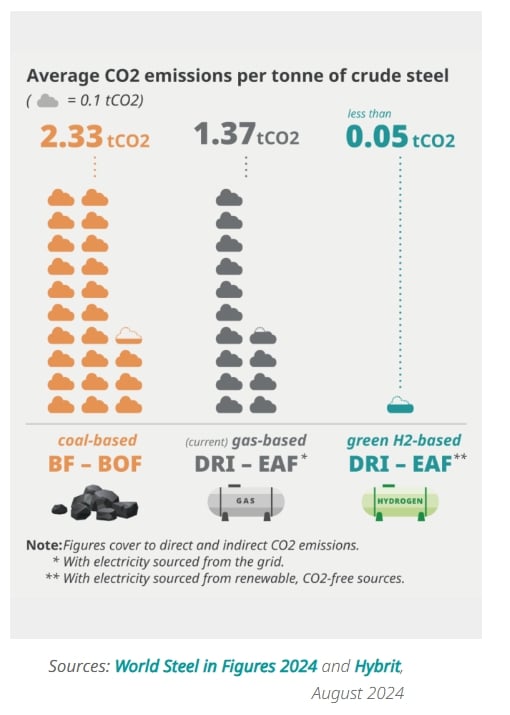
Steel production is responsible for about 7-9% of global carbon dioxide emissions. A large part of this comes from the traditional way iron is made. The industry emits about 3.7 billion tonnes of CO2 in 2024.

steel industry carbon emissions net zero
Source: World Economic Forum

By offering a cleaner alternative, Electra is helping the steel industry meet growing climate goals.

One area where this shift is especially important is in the automotive sector. Car manufacturers are looking for ways to lower the carbon footprint of their vehicles, including the materials used to build them. Steel is a major component in vehicles, and clean iron is key to making low-carbon steel.

Noah Hanners, executive vice president for sheet products at Nucor, one of the largest U.S. steelmakers, explained how Electra fits into this trend.

“We’re seeing a shift in the automotive sector toward increased use of steel made via EAF [electric arc furnace] technology, driven by OEMs’ [original equipment manufacturers] focus on lowering the embedded carbon footprint of their vehicles…”

Nucor, which aims to reach net-zero steelmaking by 2050, sees Electra’s product as a valuable feedstock for its EAF operations. More steelmakers are using electric arc furnaces to cut reliance on coal-based methods. As a result, demand for sustainable iron is likely to increase.

According to the International Energy Agency, the steel industry can cut carbon emissions toward net zero via these means:

net zero methods for steel production

From Prototype to Production

The $186 million in new funding will be used to build Electra’s demonstration plant in Colorado, which is set to begin construction later this year. This plant will help the company make clean iron on a bigger scale. It will also let them test the product with partners and collect data for future development.

The demonstration plant is a key step toward the company’s goal of opening a full-scale commercial facility by the end of the decade. Once complete, Electra’s clean iron could be used in a wide range of industries, from construction to transportation to consumer electronics.

The company has signed Memoranda of Understanding with big customers like ZF Group and Interfer Edelstahl Group. This shows there is a market demand for its clean iron. These agreements include steel and battery uses, showing a strong interest in low-carbon materials.

Clean Iron’s Role in a Net-Zero World

Electra’s latest funding round marks an important milestone for the clean materials industry. As countries and companies continue to look for ways to reduce emissions, technologies like Electra’s could play a major role in reshaping global supply chains.

By replacing coal and high heat with renewable electricity and chemistry, Electra offers a cleaner, smarter way to make iron. With strong support from investors and industry leaders, the company is well-positioned to help decarbonize one of the world’s most emitting industries.

P&G Doubles Down on Financial Growth with Strong Q1 Results and Net-Zero Goals

Procter & Gamble (P&G), one of the world’s largest consumer goods companies, has released its financial results for the 3rd quarter of fiscal year 2025 (January to March). Alongside solid performance across key business segments, the company is also making steady progress on its climate and net-zero goals. 

Let’s take a closer look at how the company performed financially and environmentally.  

P&G Reports Strong Financial Results

Procter & Gamble reported net sales of $19.8 billion, which reflects a 2% decrease compared to the same period last year. This growth was driven mainly by higher pricing across product categories, even though global volume remained flat.

Organic sales, which remove the effects of currency fluctuations and acquisitions, drop 1%. P&G’s Chairman, President, and CEO, Jon Moeller, said the results show the company’s “continued commitment to balanced growth and value creation.”

The company reaffirmed its guidance for the full fiscal year 2025. It expects organic sales growth of 4% to 5%. Core earnings per share should grow by 2% to 4%.

The company’s Health Care and Fabric & Home Care segments saw the largest gains. Health Care organic sales remained flat, and Fabric & Home Care rose 5%. However, sales in Beauty and Grooming were flat or down due to weaker demand in some global markets.

P&G returned a total of $3.8 billion to shareholders, comprising $2.4 billion in dividends and $1.4 billion in share repurchases.

For the full fiscal year 2025, P&G anticipates distributing approximately $10 billion in dividends and executing $6 to $7 billion in share buybacks, demonstrating its ongoing commitment to delivering value to shareholders.

P&G Q3 2025 financial results
Source: Chart from uk.investing.com

P&G’s Climate Commitment: Net Zero by 2040

While P&G is known for products like Tide, Pampers, and Gillette, the company is also working to become a sustainability leader. One of its biggest climate goals is to reach net-zero greenhouse gas emissions across operations and supply chains by 2040.

P&G net zero roadmap
Source: P&G

P&G made a Climate Transition Action Plan. It aims to cut emissions from factories, logistics, raw materials, and product use. These areas make up the majority of the company’s carbon footprint.

P&G uses a “science-based” approach that matches the Paris Agreement, which aims to limit global warming to 1.5°C.

  • The company plans to cut its emissions by at least 65% by 2030. Then, it will neutralize the remaining emissions with reliable carbon removal methods by 2040.

The plan includes both short-term and long-term actions for P&G to reach net zero. By 2030, the company aims to:

  • Cut Scope 1 and 2 emissions (from its own operations) by 65% versus 2010 levels
  • Reduce Scope 3 emissions (from its supply chain and product use) by 40% per unit of production
  • Power all global plants with 100% renewable electricity
P&G carbon GHG emissions
Source: P&G * Estimated from fiscal year 2024 finished product production volumes and average weights. ** Total GHG emissions = Scope 1 + Scope 2. Scope 2 emissions calculated using a market-based method. *** Market-based Scope 2 GHG emissions. Note: Location-based Scope 2 emissions in 2024 were 2,228 metric tons (x1,000). ****P&G reports biogenic emissions separately from Scope 1 emissions. This includes biogenic CO2 from the use of biogas and biomethane delivered via the natural gas pipeline where 3rd party certified energy attribute certificates are provided by the supplier.

The company has already reached an important milestone: over 97% of the electricity used in its manufacturing plants now comes from renewable sources. In the U.S., all plants are already using 100% renewable electricity.

Cutting Emissions Across Products and Supply Chains

Most of P&G’s emissions—over 85%—come from what happens outside its own factories. This includes the carbon footprint from suppliers, packaging, shipping, and especially how people use and dispose of its products.

P&G scope 3 emissions
Source: P&G

P&G is working with suppliers to cut emissions toward net-zero goal. They are using low-carbon materials and more recycled content. They also aim to boost energy efficiency. For example, P&G has started using green hydrogen and bio-based materials in some of its products.

The company also launched a “50L Home Coalition,” working with other partners to redesign household products that reduce water and energy use. For instance, Tide cold-water detergents help save electricity by reducing the need for heated water.

P&G also created a Product Emissions Roadmap, which outlines steps to reduce product-related emissions over time. Some of these steps include:

  • Redesigning packaging to use less plastic and more recycled content
  • Shifting to compact product formats (like pods or bars) to lower shipping emissions
  • Improving formulas so products work better in cold water or with shorter wash cycles

These changes aim to reduce environmental impact. They won’t affect product performance or customer satisfaction.

Beyond Carbon Reduction: Investing in Carbon Removal and Innovation

Even with major efforts to reduce emissions, P&G knows that some emissions are hard to eliminate to achieve net zero. That’s why the company also plans to invest in carbon removal solutions to balance out what it can’t cut.

P&G is exploring new technologies like direct air capture (DAC) and natural carbon sinks (such as forests and soils) to remove CO₂ from the atmosphere. The company is also taking part in industry groups and pilot projects to test these solutions at scale.

In 2023, P&G formed the P&G Climate Unlock Program that helps smaller suppliers reduce emissions and track progress. This creates a ripple effect throughout its supply chain.

The company is also supporting research into sustainable product design, low-emission logistics, and climate-resilient manufacturing. P&G says these investments will help them “decarbonize not just our operations, but the entire value chain.”

Tracking Progress and Staying Transparent

To make sure its climate goals are credible, P&G reports its progress publicly every year. It uses third-party auditing. It also aligns with global frameworks like the Science-Based Targets initiative (SBTi) and the Task Force on Climate-related Financial Disclosures (TCFD).

In its latest sustainability report, P&G shared that it has already reduced Scope 1 and 2 emissions by 60% since 2010. The company made good progress in cutting supply chain emissions. It plans to share more detailed Scope 3 breakdowns in future reports.

CEO Jon Moeller says that:

“Caring for our consumers and our planet is core to all of us at P&G…There is no action too small, and no vision too big, as we all work together to preserve our shared home for generations to come.”

Balancing Business Growth with Climate Action

Procter & Gamble’s Q1 2025 results show strong business performance, with steady growth in sales and profit. But behind the numbers, the company is also making major moves toward climate leadership.

By aiming for net zero by 2040 and reducing emissions across its supply chain, products, and operations, P&G hopes to lead the way in sustainable business practices. The company uses science, technology, and partnerships to achieve its climate goals.

As pressure mounts for companies to deliver on their environmental promises, P&G is working to prove that a cleaner, greener future is also good for business.

U.S. Solar and Energy Storage Set for Major Growth in 2025

Disseminated on behalf of SolarBank Corporation.

According to EIA’s latest Preliminary Monthly Electric Generator Inventory report, the U.S. power grid is expected to add 63 gigawatts (GW) of new utility-scale electric-generating capacity in 2025.

Most of this growth will come from solar power and energy storage, showing strong momentum for clean energy, even as fossil fuels remain part of the mix.

Solar Shines Brightest

Solar energy is growing quickly across the United States. Nearly 49 GW of solar power is in line to connect to the electric grid. That’s enough to power more than 35 million homes for a year.

Texas is leading the solar race, with more than 12 GW of planned solar capacity. Other large amounts are planned in the Midcontinent Independent System Operator (MISO) region with 8 GW, and the PJM Interconnection area with over 6 GW.

The growth of solar is being pushed by several things:

    • Falling prices of solar panels
    • Government tax credits and incentives
    • Demand for clean electricity from businesses and households

According to the Solar Energy Industries Association (SEIA), the U.S. solar market grew by 51% in 2023, and similar strong growth is expected in 2025. By 2034, the High Case scenario shows a 17% increase in solar deployment. 

US solar forecast to 2034

Batteries or Energy Storage Take the Grid to the Next Level

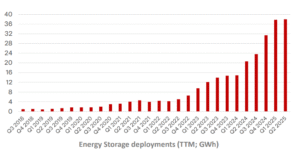
Energy storage systems, mostly large batteries, are important because they help store solar and wind power for use when the sun isn’t shining or the wind isn’t blowing. In 2025, over 31 GW of new storage capacity is expected to be built.

California and Texas are the leaders in battery storage. The California Independent System Operator (CAISO) is set to add about 6 GW of storage next year, while Texas plans to add nearly 12 GW.

Storage growth is important because it makes renewable energy more reliable. Batteries can help keep the grid stable and reduce blackouts.

Wind Picks Up, But Slower

Wind energy is still expanding, though not as fast as solar. More than 2 GW of new wind capacity is expected in Texas alone in 2025, and around 2 GW more across the rest of the country.

Offshore wind projects have faced delays due to high costs and supply chain problems, but some are moving ahead. For example, the Vineyard Wind project off the coast of Massachusetts began delivering power to the grid in early 2024 and plans to expand.

Fossil Fuels: Still in the Field

While renewable energy is growing fast, fossil fuels like natural gas and coal are still part of the energy system. In 2025, the U.S. plans to add 6.4 GW of new natural gas capacity. At the same time, 4.6 GW of older gas plants are expected to retire, resulting in a net gain of 1.8 GW.

Coal power continues to decline. About 6.2 GW of coal-fired power plants are scheduled to shut down in 2025. This follows a long-term trend, as more utilities move away from coal due to high costs and pollution concerns.

Still, some recent government actions could slow coal’s decline. In April 2025, President Trump signed orders calling coal a “critical mineral” and pushed for its use in powering data centers. His administration declared a “national energy emergency” and said the grid was becoming less reliable without coal and gas.

Even so, experts say coal is unlikely to see a big comeback. Most utility companies are not planning to build new coal plants, as they worry about being left with stranded assets—plants that cost more to operate than they earn.

Natural Gas Eyes a Bigger Role

As electricity demand rises, especially from electric vehicles and data centers, natural gas could play a larger role in some parts of the country.

Still, challenges remain for natural gas. High capital costs, slow permitting, and supply chain delays could limit how fast new plants are built.

Grid Growth by Region

Each part of the U.S. energy grid has its own plans for new projects in 2025. These include the following:

  • ERCOT (Texas): 27 GW of new capacity, with only 574 MW of retirements. Major growth in solar and batteries.
  • PJM (Mid-Atlantic and Midwest): 7 GW of new projects, mostly solar. About 3 GW of fossil fuel plants will retire.
  • CAISO (California): 10 GW of new capacity, including 6 GW of storage.
  • MISO (Midwest): 11 GW of new capacity, mostly solar. Coal retirements are expected.
  • ISO New England: About 2 GW of new power, mostly solar and storage.
  • NYISO (New York): 1.4 GW of new capacity, with gas retirements.
  • SPP (Southwest Power Pool): 6 GW of new capacity, mainly from solar and gas.
  • Non-ISO/RTO areas (Southeast and Western U.S.): 33 GW of new capacity, including 17 GW of solar and 11 GW of storage.

Toward a Cleaner Grid

Overall, the U.S. is set to add nearly 86 GW of new net power capacity in 2025. Most of this will come from solar and storage. These technologies are key to cutting emissions and meeting climate goals. And one company that stands out in this field is SolarBank Corporation (Nasdaq: SUUN) (Cboe CA: SUNN) (FSE: GY2). 

SolarBank is a leading independent renewable energy developer focused on distributed and community solar projects in Canada and the U.S. The company specializes in solar, battery storage, and EV charging solutions for utilities, municipalities, commercial clients, and homeowners.

Notably, SolarBank completed a $41 million USD deal with Honeywell for three New York-based solar projects and began work on a 1.4 MW rooftop project for Fiera Real Estate in Alberta. Major community solar initiatives include the Geddes, Greenville, and Nassau projects in New York, set to power thousands of homes. In Nova Scotia, SolarBank is developing up to 31 MW of solar capacity with TriMac Engineering, targeting 4,000 households.

SolarBank projects
Source: SolarBank

Looking ahead, SolarBank is advancing projects in New York, Pennsylvania, and Nova Scotia, including agrivoltaic systems that combine solar power with farming. These efforts highlight the company’s role in accelerating the clean energy transition through innovative, community-based solar solutions.

However, fossil fuels are still needed to meet rising demand and ensure grid reliability. Policymakers and energy companies face tough choices as they try to balance clean energy growth with keeping the lights on.

Even with political shifts, experts say the energy transition is moving forward. Market forces, customer demand, and lower costs for renewables are driving long-term change.

As more projects get built in 2025, the U.S. will come closer to a cleaner energy system—one that can power homes, businesses, and vehicles while cutting carbon pollution.

This report contains forward-looking information. Please refer to the SolarBank press release entitled “SolarBank Announces 2024 Highlights” for details of the information, risks and assumptions.


Disclosure: Owners, members, directors, and employees of carboncredits.com have/may have stock or option positions in any of the companies mentioned: None.

Additional disclosure: This communication serves the sole purpose of adding value to the research process and is for information only. Please do your own due diligence. Every investment in securities mentioned in publications of carboncredits.com involves risks that could lead to a total loss of the invested capital.

Please read our Full RISKS and DISCLOSURE here.

From Sea to Sky: MOL & Climeworks Launch Maritime Carbon Removal First

Climeworks, a Swiss company known for its carbon removal technology, announced a major partnership with Mitsui O.S.K. Lines (MOL), one of the world’s largest shipping companies. This is Climeworks’ first collaboration with a shipping company and its first agreement with a Japanese partner.

As part of the deal, Climeworks will remove 13,400 tons of carbon dioxide (CO₂) from the air on behalf of MOL by 2030.

This agreement supports MOL’s goal of reaching net-zero greenhouse gas emissions by 2050. MOL is already using clean energy, improving energy efficiency, and testing new technologies. But because shipping is one of the hardest industries to decarbonize, carbon removal is seen as a necessary tool to meet climate goals.

Christoph Gebald, co-founder and Co-CEO of Climeworks, said,

“Shipping is a hard-to-abate sector where residual emissions are likely to remain even with ambitious mitigation measures. Carbon removal solutions will be necessary to address those emissions and reach full climate targets.”

How Climeworks’ Direct Air Capture Technology Works

Climeworks uses a method called Direct Air Capture (DAC) to remove CO₂ directly from the atmosphere. Special machines with large fans pull in air, which passes through filters that trap CO₂.

When the filters are full, they are heated to release the CO₂ gas. This gas is then either stored underground, where it turns into rock over time, or reused in other processes. This approach removes CO₂ permanently and allows it to be measured, verified, and tracked.

Climeworks DAC technology
Source: Climeworks

Climeworks opened its largest DAC facility, called Mammoth, in Iceland in 2024. This plant can capture up to 36,000 tons of CO₂ per year. It builds on Climeworks’ Orca project. This is part of their plan to remove multi-megaton CO₂ by the 2030s and reach gigaton levels by 2050.

Hard-to-Abate Emissions and the Role of Carbon Removal

Shipping contributes about 3% of global greenhouse gas emissions. The chart below shows the industry’s emissions since 2012 by vessel type. Unlike cars or buildings, which can switch to electric or renewable energy solutions more easily, cargo ships are harder to decarbonize.

shipping emissions 2023
Source: UNCTAD

Even with low-carbon fuels and better designs, some emissions will remain. That’s why companies like MOL are turning to carbon removal.

Through this agreement, MOL is taking early action to address the challenge. It plans to remove 2.2 million tons of CO₂ by 2030. The partnership with Climeworks marks an important first step in reaching this goal.

MOL’s Commitment to Net-Zero Emissions

MOL has set a clear goal to achieve net-zero GHG emissions by 2050, as outlined in its “MOL Group Environmental Vision 2.2.” This roadmap outlines clear goals and milestones. They will help the company reduce emissions in its operations. ​

MOL net zero emissions roadmap 2050
Source: MOL

To reach this goal, MOL is implementing various strategies, including:​

  • Adopting Clean Energy. MOL is investing in alternative fuels, such as e-methane and bio-methanol, to power its vessels. These cleaner energy sources are part of the company’s plan to reduce reliance on traditional fossil fuels. ​

  • Energy-Saving Technologies. The company is enhancing ship designs and operations to improve energy efficiency. This includes utilizing wind power for vessel propulsion and other innovative technologies to lower fuel consumption.

  • Carbon Removal Initiatives. MOL has partnered with Climeworks to remove CO₂ from the atmosphere using DAC technology. This collaboration aims to offset emissions that are difficult to eliminate through other means.

Hisashi Umemura, Senior Executive Officer of MOL, explained,

“At Mitsui O.S.K. Lines, we’re committed to navigating toward a net-zero future. Contributing the expansion of high-integrity carbon removal credits, driven by Climeworks’ state-of-the-art Direct Air Capture technology, empowers us to address emissions that are hard to eliminate through conventional methods. This is not just an investment in carbon removal but an investment in the future of sustainable shipping.”

Japan’s Role in the Carbon Removal Market

Japan is playing a bigger role in the carbon removal industry. In 2024, it became the first country to allow international, durable carbon removal credits in its national emissions trading system. This made it easier for companies like MOL to invest in projects like Climeworks’.

MOL is not only Climeworks’ first shipping client but also its first customer from Japan. This shows how both are working together to push the boundaries of climate solutions.

The Growing Market for Direct Air Capture

The DAC market is growing quickly as more governments and companies take action to fight climate change. In 2023, experts valued the global DAC market at about $62 million.

DAC market outlook
Source: MarketsandMarkets
  • By 2030, they expect it to reach around $1.7 billion, with a strong annual growth rate of 60.9%, according to MarketsandMarkets.
Governments around the world are setting net-zero emission targets, which drives up demand for DAC. Many companies also see value in DAC to support synthetic fuels and meet climate goals.
North America leads the DAC market, thanks to major investments in new DAC technologies. Europe follows closely, with strong policies and big climate ambitions helping the market grow.
With these trends in place, the DAC market looks ready to keep growing fast. As more groups choose carbon removal, DAC will play a bigger role in global efforts to limit climate change.

A Bigger Vision for Global Impact

Alongside the offtake agreement to remove 13,400 tons of CO₂, MOL and Climeworks also signed a Memorandum of Understanding. This means MOL might invest in future Climeworks projects. These investments would help Climeworks build more DAC plants worldwide, increasing their ability to remove CO₂ on a large scale.

This partnership goes beyond reducing emissions in shipping. It shows how companies can take the lead in fighting climate change. By working with Climeworks, MOL is also helping to create demand for high-quality carbon removal solutions. These early actions could make it easier and more affordable for other industries to follow.

More initiatives like this can help carbon removal technologies grow to become a key part in decarbonizing the shipping industry and be a global strategy to fight climate change.

Alphabet Smashes Q1 2025 Expectations with Strong Growth But Emissions Are Rising

Alphabet, Google’s parent company, kicked off 2025 with a solid earnings report. Despite global economic concerns and trade tensions, the company beat analyst expectations across the board. Its core businesses—Search, YouTube, and Cloud continued to grow, showing strong momentum and revenue. However, with a massive upgrade in AI infrastructure, emissions have risen. Can Google still meet its net-zero target?

Alphabet’s Revenue Jumps Amid Economic Uncertainty

Alphabet reported $90.2 billion in revenue for the first quarter. That’s a 12% increase from $80.5 billion in Q1 2024. Analysts had expected $89.2 billion. Net income came in at $34.54 billion, up 46% from $23.66 billion a year ago.

Earnings per share (EPS) hit $2.81, far above the expected $2.01. Operating income rose 20% to $30.6 billion. Plus, the company’s operating margin expanded to 34%, which is higher than last year.

CEO Sundar Pichai, confirmed by saying,

“We’re pleased with our strong Q1 results, which reflect healthy growth and momentum across the business. Underpinning this growth is our unique full-stack approach to AI. This quarter was super exciting as we rolled out Gemini 2.5, our most intelligent AI model, which is achieving breakthroughs in performance and is an extraordinary foundation for our future innovation. Search saw continued strong growth, boosted by the engagement we’re seeing with features like AI Overviews, which now has 1.5 billion users per month. Driven by YouTube and Google One, we surpassed 270 million paid subscriptions. And Cloud grew rapidly with significant demand for our solutions.”

Google Search, YouTube, and Cloud Drive Growth

Google Search brought in $50.7 billion in revenue. YouTube ads earned $8.93 billion, up from $8.09 billion a year earlier. Google Services, which includes Search, YouTube, subscriptions, and device sales, generated $77.3 billion—a 10% increase from last year.

Meanwhile, Google Cloud stood out. The cloud business earned $12.3 billion, growing 28% from $9.57 billion in Q1 2024. This growth was fueled by demand for Google Cloud Platform, AI infrastructure, and generative AI tools.

Alphabet earnings
Source: Alphabet

Shareholders Win Big

Alphabet didn’t just report big profits, it also rewarded investors. The board approved a massive $70 billion stock buyback plan. In addition, the company raised its quarterly dividend by 5% to $0.21 per share.

Right after the earnings release, Alphabet’s stock jumped 5% in after-hours trading. Shares hit $169, the highest level in four weeks.

AI Still the Focus Despite Trade Tensions

Even with rising costs and trade tensions between the U.S. and China, Alphabet is staying aggressive. The company confirmed it will stick to its $75 billion capital spending plan for 2025. A large portion of that will support AI infrastructure and data centers.

Analysts have raised concerns about Big Tech pulling back on data center projects. But Alphabet and its peers, like Meta and Amazon, remain committed, giving AI investment a top priority.

For now, Alphabet shows strong growth for the rest of the year.

Google’s Emissions Are Rising, Not Falling

Google aims to hit net-zero emissions across its operations and supply chain by 2030. The company is leaning on two major strategies: cutting emissions in all possible areas and removing the remaining emissions through carbon removal.

In 2023, Google’s total greenhouse gas (GHG) emissions hit 14.3 million metric tons of CO₂ equivalent. That’s a 13% jump from 2022. While the growth slowed compared to past years, the trend still moved in the wrong direction. Most of the rise came from higher energy use at data centers and emissions from its supply chain.

Scope Emissions

  • Scope 1 (direct) emissions: 79,400 tCO₂e (1% of total)
  • Scope 2 (indirect from electricity): 3.4 million tCO₂e (24%)
  • Scope 3 (supply chain and other indirect emissions): 10.8 million tCO₂e (75%)
alphabet google emissions
Source: Google

Although Google has made progress, its emissions increased in 2023, highlighting the challenge of scaling digital services while reducing carbon emissions. Especially with the unpredictable energy demands of artificial intelligence (AI).

Google’s Roadmap to a Net-Zero Future

Google aims to cut its emissions by 50% by 2030 using 2019 as the baseline. However, after updating how it measures emissions, the company now reports a 48% rise from 2019.

google alphabet
Source: Alphabet

Renewable Energy

Google has run on 100% renewable energy for seven years straight. But under current standards, this hasn’t cut its market-based Scope 2 emissions. Its new goal is to run all operations on 24/7 carbon-free energy (CFE) by 2030. In 2023, it hit 64% CFE globally.

google renewable energy Alphabet
Source: Alphabet

Energy Efficient Data Centers

Google’s data centers are 1.8 times more energy efficient than typical enterprise setups. In 2023, its average Power Usage Effectiveness (PUE) was 1.10, well below the industry average of 1.58.

Another example is its AI hardware, TPU v4 chips, which are 2.7 times more efficient than their predecessors.

Using AI to Slash Emissions

Furthermore, it is developing tools to reduce the energy needed to train AI models by up to 100 times. They can slash emissions by as much as 1,000 times.

Their Gemini 1.5 Pro model delivers performance similar to Gemini 1.0 Ultra but with far less computing power. Google is also guiding software developers through its “Go Green Software” initiative to shrink their environmental impact.

Practical examples of AI in action include:

  • Fuel-efficient navigation, cutting 2.9 million metric tons of emissions since 2021.
  • Flood forecasting tools are used in over 80 countries.
  • The Green Light initiative is to optimize traffic signals.

Google is also building AI-powered systems to predict extreme heat, detect cool roofs, and track methane leaks. These tools show how AI can play a key role in solving environmental problems.

Betting Big on Carbon Removal Credits

Google knows how important it is to remove residual emissions to hit its net-zero target. That’s where carbon removal and high-quality carbon removal credits are immensely useful.

  • In 2022, it pledged $200 million to Frontier, an initiative to boost carbon removal technologies by committing to buy future credits.
  • Signed deals with Charm Industrial, Lithos Carbon, and CarbonCapture through Frontier. These deals represent about 62,500 metric tons of carbon removal credits to be delivered by 2030.
  • Joined a U.S. Department of Energy program to match carbon removal purchases, aiming to lock in at least $35 million worth of credits within a year.

Nature-Based Solutions

Furthermore, Google has also invested in nature-based removals. To support carbon credit markets, it gave more than $7 million in grants to organizations like The Gold Standard and ICVCM.

google alphabet
Source: Alphabet

Google’s large-scale commitments are:

  • Purchased 200,000 tons of removal credits from Terradot, which uses enhanced rock weathering.
  • Bought 50,000 tons from Brazilian startup Mombak, which is focused on reforestation in the Amazon.
  • A partnership with Holocene to capture 100,000 tons of CO₂ by 2032.

These investments reflect its transition from short-term carbon neutrality and focusing on long-term carbon removal solutions.

Google’s environmental efforts show its huge strides in clean energy and AI-driven efficiency. Yet emissions are still rising. As 2030 approaches, the big question is, can Google truly deliver on its net-zero promise while expanding its tech empire? Only time will tell.