


Xpansiv, a leading infrastructure provider for global energy transition markets, has announced the launch of its CBL GEO® CORSIA first compliance phase (GEO CP1) standardized spot contract on April 29, 2025. This contract will help the international aviation sector meet carbon offsetting needs. It supports the Carbon Offsetting and Reduction Scheme for International Aviation (CORSIA).
The new contract will trade on Xpansiv’s CBL spot exchange. It will also be available through partner exchanges. These include the Aviation Carbon Exchange (ACE), which CBL runs with the International Air Transport Association (IATA). The Johannesburg Stock Exchange’s JSE Ventures Carbon Market will also offer it.
This expansion is a big step in blending voluntary and compliance carbon markets. Airlines are now entering the first compliance phase of CORSIA.
The Growing Need for Carbon Credits in Aviation
The aviation industry is responsible for a significant share of global greenhouse gas emissions. Carbon credits are becoming more essential for airlines aiming to cut emissions. This is because alternative technologies, like sustainable aviation fuel (SAF), are still costly and not fully developed.
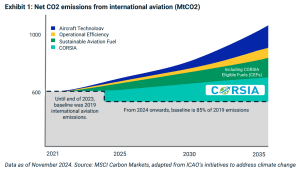
Under CORSIA, airlines must offset emissions above 2019 levels. They do this by buying carbon credits from approved projects that reduce or remove greenhouse gases.
The demand for high-quality carbon credits will likely rise. This increase comes as more airlines and industries join compliance markets. ICAO recently projected that 100-150 million tons of CORSIA Eligible Emissions Units (EEUs) will be required during the first compliance phase.
Xpansiv’s new GEO CP1 contract aligns with this growing demand, as remarked by John Melby, Xpansiv CEO:
“The transition into the compliance phase of CORSIA is a watershed moment for the rapidly converging voluntary and compliance carbon markets. Our new GEO CP1 contract has been carefully designed based on an extensive market consultation, which revealed a clear consensus to launch the contract only when deliverable supply was available and sufficient clarity around the ICAO framework was achieved. Those conditions have now been met.”
Standardized Trading and Market Transparency
One of the key features of the GEO CP1 contract is its alignment with CORSIA EEU eligibility criteria. When launched, EEUs from this contract will be sourced from top environmental credit registries. These include:
- ART TREES,
- ACR,
- Climate Action Reserve,
- Gold Standard, and
- Verra.
When more registries get CORSIA approval, their credits can be used in the contract, too.
Xpansiv is using its strong market infrastructure to boost transparency and efficiency in trading. A unique sub-account structure developed for IATA’s recent EEU procurement events will also be available for GEO CP1 participants. This setup allows traders to trade the contract without needing main accounts for each credit standard. It makes access to CORSIA-compliant credits easier.

Market Growth and the Role of Carbon Credits
The launch of the GEO CP1 contract comes at a time when the carbon market is experiencing rapid growth. In 2023, global carbon market revenues reached a record $104 billion.

Companies in aviation, energy, and manufacturing are turning to carbon credits. They use these credits to meet sustainability goals and follow regulations.
Regulatory frameworks like the EU’s Carbon Border Adjustment Mechanism (CBAM) are boosting the demand for verified carbon offsets. Also, consumer demand and investor interest in sustainability have pushed companies to join carbon markets. As a result, investment firms and financial institutions are integrating carbon offset projects into their portfolios.
Even with this growth, the carbon market has struggled with price swings and unclear regulations. In 2024, carbon credit prices dropped due to shifts in global climate policies.
The global average carbon price stood at $32 per ton of CO₂, falling short of the estimated $50 per ton needed by 2030 to achieve Paris Agreement targets. Localized markets like California’s cap-and-trade system saw carbon prices hit $42 per metric ton in 2024. They are expected to rise to $46 per ton in 2025.
Xpansiv’s Performance in the Carbon Market
Xpansiv has seen significant growth in its trading volumes, particularly on its CBL platform. In November 2024, trading volumes almost doubled. This surge was fueled by Nature-Based Global Emission Offsets (N-GEOs). More than 600,000 tons were traded at prices between $0.30 and $4.10 per metric ton.
By mid-December 2024, over 2 million tons of carbon credits were traded on the platform. This made up 16% of all transactions for the year.
In January 2025, Xpansiv’s CBL spot exchange made headlines. It recorded over $27 million in Renewable Energy Certificate (REC) transactions. This amounted to a total of 251,758 MWh.
These market trends show the increasing reliance on Xpansiv’s infrastructure for carbon trading and emissions management.
The Future of Carbon Markets and CORSIA Compliance
Looking ahead, Xpansiv is well-positioned to support the expansion of carbon markets. As companies and governments push for net-zero goals, the need for quality carbon credits will grow. Standardized trading tools like the GEO CP1 contract boost the trust and ease of access in carbon markets.
Government policies will also play a crucial role in shaping the future of carbon markets. Initiatives like carbon pricing, cap-and-trade, and carbon taxes will likely affect credit demand. Also, new tech like blockchain for credit tracking will boost market transparency. This helps stop problems like double counting.
Xpansiv’s latest GEO CP1 contract marks a significant step forward in providing aviation stakeholders with the resources needed to comply with CORSIA while supporting global sustainability efforts.