


Contrary to the instant fun it provides, the gaming industry has been slow to acknowledge that developing and playing video games uses a lot of energy and generates emissions responsible for climate change. A researcher revealed the gaming industry’s carbon footprint, standing at over 81 million tonnes of emissions in 2022.
Dr. Benjamin Abraham, a digital games researcher and founder of AfterClimate, closely evaluates how the gaming industry tackles climate change. He publishes an annual progress report on the industry’s net zero ambitions in his ‘Net Zero Snapshot 2023’.
The Gaming Industry’s Carbon Footprint
Abraham estimates that the $180+ billion video game industry consumes energy and produces carbon emissions comparable to the global film industry.
His conservative estimates revealed that the gaming industry’s carbon footprint stands at 81 million tonnes of CO2, but it doesn’t specifically break down how much is emitted by video gaming alone. The estimation shows how much video games and the big tech companies emitted last year, which is even larger than what many small countries emit.
The data included 35+ global games and tech companies, with around $1.2 trillion in revenues in 2022. Tencent, Microsoft, Apple, Sony, and Google account for the majority of the total emissions.
 Taking those 5 big tech companies out of the equation, the other companies reported >7 million tonnes in 2022. Including the absolute minimum of the total emissions of companies that didn’t disclose data, the researcher estimated >14 million tonnes of CO2.
Thus, video game companies alone were responsible for these carbon emissions, about 14 Mt CO2. That amount is about the same as what the country of Estonia emitted in 2021.
The analysis didn’t even account for other sources of emissions, particularly falling under Scope 3 emissions. These include activities outside the video game companies’ or developers’ control, such as manufacturing consoles and computer hardware, powering servers, and flying developers or executives for meetings and conferences.
One of the most notable findings in Abraham’s 2023 report is that the gaming industry’s carbon emissions were up globally. Out of the 34 largest game companies, only 3 were able to reduce their carbon footprint in 2022.
- Tencent – 13.73% down
- Apple – 11% down
- Nintendo – 2.95% down
What Video Game Companies Are Missing Out
The report also highlighted a more secretive issue in the industry – most companies aren’t diligent at disclosing Scope 3 emissions. “Use of sold products” emissions, which fall under Category 11 of the GHG Protocol, is specifically missing. That includes energy from the use of a gaming device, such as Xbox or PlayStation, or a computer or smartphone.
Gamers generate Scope 3 emissions, which account for about 10-90% of the total Scope 3. Let’s take the example of Ubisoft, one of the world’s largest game studios. Of the company’s total annual CO2 emissions, only as much as 10% is from their direct operations. The remaining footprint breaks down to 10-15% for game distribution, 40% for game device production, and 40% for gamers.
Microsoft estimates that the average gamer using a high-performance gaming device emits 72 kilograms of CO2 per year. In the United States, gamers emit 24 million tons of CO2 each year, data according to Project Drawdown. Globally, 3+ billion people, or 40% of the world’s population, are playing video games.
For other companies, Scope 3 is most often not included in disclosures as they’re not mandatory, only optional, for now.
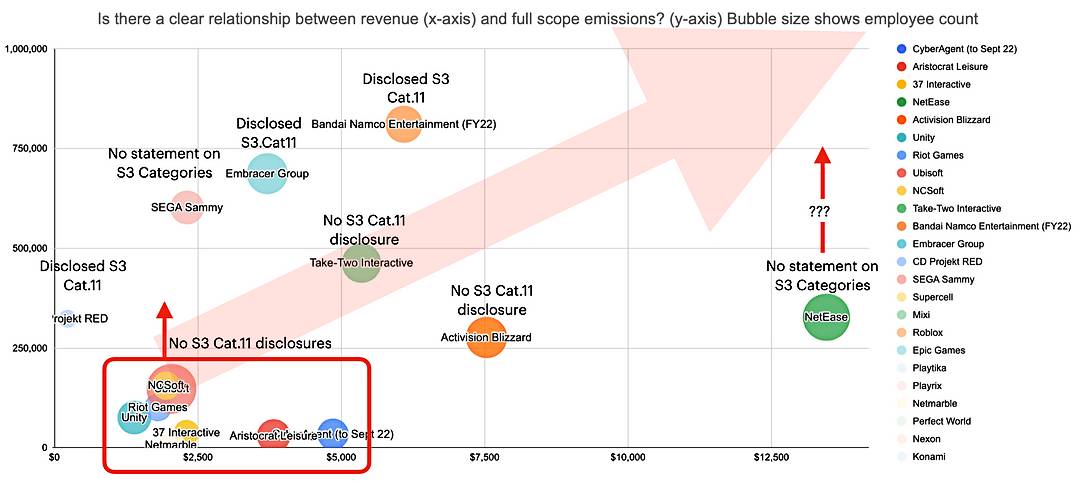
The 2023 snapshot suggests that video game companies are still not up to the standards of disclosing their emissions data as shown above. However, there has been a significant shift in the industry’s approach to the climate crisis in the recent years.
What Sustainable Game Leaders Are Doing
Reports show a growing number of video game developers who take into account the climate impact of their games. Indie video game developers, in particular, are taking the matter into their own hands. They advocate for a more sustainable game development that reduces their impact on the planet.
For instance, indie game developers like Hannah Nicklin of Die Gute Fabrik studio, are proactively accounting for their carbon footprint. By doing so, the developer is providing the gaming community some ways to tackle their carbon footprint, which is crucial to bringing the industry to net zero, Dr. Abraham said. He particularly noted that:
“As more and more businesses start to do this, it starts to have this amplification effect on the whole industry where we just set this expectation that, yes, we’re going to pay attention to our emissions.”
Nicklin’s indie gaming studio emitted only about 47 tonnes of CO2 per year per employee. This figure represents only 0.000058% of the total emissions of the largest game companies worldwide.
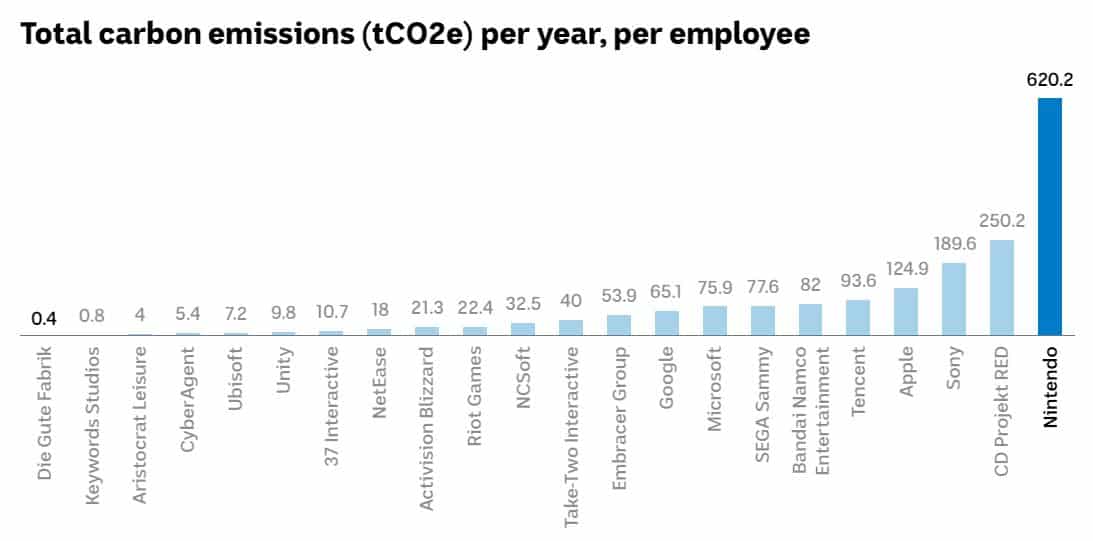
Each of those big companies have set their own net zero emissions targets, employing different strategies. Some are opting for offsetting or buying clean energy credits to negate their fossil fuel consumption. Microsoft and Apple, in particular, are investing significantly in carbon removals to offset their emissions.
But they’re also proactively innovating how they can reduce their gaming emissions directly.
For example, Microsoft developed the Xbox Developer Sustainability Toolkit that guides developers to clean up the game’s performance and look for areas for energy savings. Decreasing resolution and frames-per-second in pause screens or menus could save up up to 55% of energy use.
Other gaming companies like Nintendo and Sony had also expressed intent to reduce their carbon emissions. But their sustainability and net zero pledges lack specific strategies on how they’re going to address video game related footprint.
Despite the gaming industry’s significant carbon emissions, recent initiatives by independent developers and major companies signal a promising shift towards more sustainable practices. This development underscores the need for greater transparency and concerted action to address the industry’s environmental impact.