

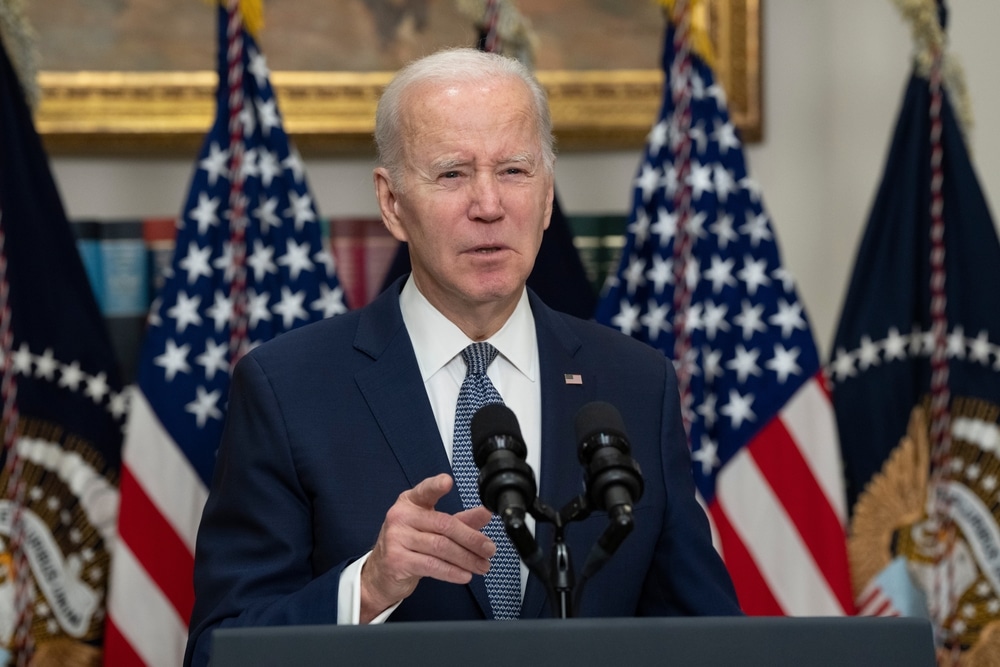
The Biden-Harris Administration has unveiled the President’s Budget for Fiscal Year 2025, marking a continuation of the administration’s efforts to advance economic growth, address inflation concerns, and bolster key social programs. Notably, the budget outlines a substantial increase of almost $27 billion for climate programs across various US agencies. It also includes funding for international climate finance initiatives.
One significant aspect of the budget is the Department of Energy’s (DOE) allocation, which sees historic investments aimed at laying the groundwork for a clean and equitable energy economy. These investments are intended to support the United States in achieving its goal of reaching net zero emissions by 2050.
Secretary of Energy Jennifer Granholm emphasized the administration’s aim to create an inclusive clean energy economy that benefits all communities. She remarked that:
“President Biden’s budget request reflects his commitment to building a clean energy future that is made in America, powered by American workers.”
The document outlines how the 2025 budget would address climate crisis through clean energy innovation, resilience, and resource protection. Here are the key budget items and highlights to take note.
Lowering Energy Costs in Rural Areas
The budget aims to build upon the President’s Inflation Reduction Act, aiming to reduce energy expenses for households, expand clean energy initiatives, overhaul rural power production, and generate numerous well-paying jobs across rural America.
Funding is allocated for loan guarantees for renewable energy systems and energy efficiency enhancements for farmers and small rural enterprises. It also includes support for rural electric loans to promote additional clean energy projects, energy storage, and transmission initiatives.
Investing in Clean Air and Health
The proposed budget allocates $1.5 billion for the Environmental Protection Agency’s Office of Air and Radiation. The goal is to continue the development of national programs, policies, and regulations focused on controlling air pollution and radiation exposure.
Additionally, $8.2 billion is earmarked for the DOE to address legacy waste and contamination in communities. There’s also funding for toxic substances control enforcement by the EPA. These investments are aligned with the Justice40 Initiative, aimed at benefiting disadvantaged communities.
Creating Jobs with Clean Energy Infrastructure
A significant portion of the budget, amounting to $1.6 billion, is designated for the Department of Energy to support clean energy workforce and infrastructure projects nationwide. This includes the following initiatives:
- Weatherizing and retrofitting homes for low-income individuals ($385M),
- Manufacturing clean energy components domestically ($113M),
- Transitioning Tribal homes and institutions to renewable energy ($95M), and
- Bolstering the resilience of the grid to integrate clean energy sources ($102M).
These efforts would create employment opportunities while advancing the administration’s climate goals.
Building Clean Energy Innovation Pipeline
The budget further allocates $8.5 billion to DOE for advancing clean energy innovations, targeting areas like offshore wind, industrial heat, sustainable aviation fuel, and grid infrastructure. Over $325 million supports research on sustainable critical minerals and materials essential for clean energy technologies.
Additionally, $76 million funds methane leak detection technologies, and $150 million supports advanced nuclear reactor demonstrations with high-assay, low-enriched uranium (HALEU). It also provides $30 million to accelerate commercial demonstration projects via national laboratories.
Enhancing Climate Resilience
The budget proposes an investment of $23 billion in climate adaptation and resilience efforts across the federal government. The focus is on mitigating the impact of extreme weather events fueled by climate change.
Funding will support initiatives to assist the wildland firefighting workforce, aid farmers, ranchers, and forestland owners in adapting to climate change while conserving natural resources, and advance climate resilience strategies nationwide.
Expanding American Climate Corps (ACC)
Last year, the Administration unveiled the ACC, aiming to mobilize a diverse cohort of over 20,000 workers dedicated to advancing clean energy, conservation, and climate resilience efforts. Now, in 2024, the first cohort of ACC members would embark on their service.
The budget includes mandatory funding to expand the ACC, aiming to mobilize additional 50,000 ACC members annually by 2031. The ACC aims to train and engage a diverse workforce in projects addressing climate change across communities in the country.
Strengthening Global Climate Leadership
Apart from domestic investments, the budget seeks to fulfill President Biden’s commitment of $11 billion for international climate finance. It also supports a $3 billion contribution through mandatory funding to finance the Green Climate Fund, building on previous international climate finance efforts undertaken during the administration.
These initiatives underscore the Biden administration’s commitment to addressing climate change through comprehensive domestic and international strategies. Collectively, they aim to drive sustainable economic growth while mitigating the impacts of climate change on communities and ecosystems.