

The European Union (EU) and China have made headlines with their latest joint climate statement ahead of COP30. While the agreement emphasizes clean energy and green technology, it stops short of committing to reducing coal use—a decision that has left many environmental groups concerned. Still, the partnership reflects a shift in global climate diplomacy, especially with U.S. leadership appearing uncertain.
Let’s break down the statement, its implications, and the key challenges ahead.
Clean Tech, Not Coal Cuts: What the Climate Statement Promised
At the EU-China Summit in Beijing on July 24, 2025, leaders from both sides released a joint press statement. The focus was on reinforcing their partnership in addressing climate change while promoting clean technologies like solar, hydropower, electric vehicles (EVs), and battery storage. The statement marked the 10th anniversary of the Paris Agreement and the 50th year of diplomatic relations between the two powers.
Key commitments include:
- Supporting the UNFCCC and the Paris Agreement as the backbone of global climate cooperation.
- Turning climate targets into real-world outcomes through systematic policies.
- Submit updated 2035 climate goals (NDCs) before COP30, covering all sectors and greenhouse gases.
- Expanding global renewable energy access and sharing green technologies, especially with developing countries.
- Boosting adaptation support to help nations respond to climate threats.
- Collaborating on areas like methane reduction, carbon markets, and low-carbon technology.
Yet, coal was left unaddressed. Despite growing pressure from environmental advocates, the statement made no mention of cutting coal use, a major source of global emissions.

A United Push for Renewable Energy
The EU and China’s climate focus now leans heavily toward clean technology development and cooperation. This includes:
- Solar panel production and installation.
- Scaling up EV adoption with better batteries and charging infrastructure.
- Building large-scale battery storage systems for better grid reliability.
These technologies could significantly lower emissions and make clean energy more affordable and accessible worldwide. Both China and the EU have strong manufacturing bases, positioning them as global leaders in the green tech race.
Their cooperation could be especially useful for developing countries struggling with the high costs of clean energy. If done right, this tech-sharing strategy could support global decarbonization and improve climate equity.
China’s Medog Dam: Climate Win or Ecological Fallout?
One of the most ambitious pieces in China’s green energy puzzle is the Medog Dam project in Tibet. With an estimated cost of $137 billion, the dam will become the largest hydropower station in the world. Once completed, it will generate around 300 billion kilowatt-hours (kWh) of electricity annually, which could replace energy from hundreds of coal plants.
This scale of clean power is a major boost to China’s goal of reaching carbon neutrality by 2060.
However, the project has drawn criticism for its environmental and geopolitical risks:
- Built in a fragile ecosystem, near the Yarlung Tsangpo Grand Canyon, the dam could harm biodiversity, impact river flows, and disrupt agriculture downstream.
- Local communities face displacement, raising humanitarian concerns.
- The dam’s location near the India-China border adds fuel to regional tensions, especially over shared water resources.
Environmental experts have also raised alarms about the lack of transparency around impact studies. While the project promises millions of tons of emissions savings, its ecological footprint could offset the climate gains if not managed responsibly.
Carbon markets and clean-tech exports offer hope for climate progress. But without firm commitments to end coal dependency and without stronger oversight of mega-projects, the climate gains may fall short. This balancing act between energy security and environmental integrity is one of the key challenges that the EU and China must address moving forward.
Is China Exporting Clean? And at What Cost?
China is stepping up its global presence as a major exporter of clean technologies. Today, it leads the world in the production of solar panels, electric vehicles (EVs), and batteries.
As per reports,
- This surge in clean-tech exports is expected to reduce global emissions by as much as 2.5 billion tons by 2030—equivalent to removing 500 million cars from the world’s roads.
- It saved 4Gt as the cumulative lifetime savings from just 2024 exports.
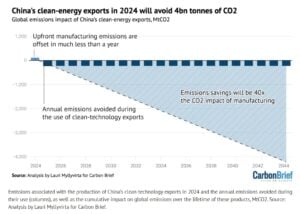
This boom is doing two things simultaneously. It supports climate action globally by offering countries affordable green alternatives, and it boosts China’s economy and expands its geopolitical influence, especially in emerging and developing markets.
However, there’s one more side of the leaf which isn’t so green. The environmental costs of producing these technologies can be significant. Mining and manufacturing components like lithium and rare earth elements often lead to high emissions.
If these upstream processes are not cleaned up, China could end up exporting “dirty green” solutions that undermine the broader climate goals. Life-cycle emissions, i.e., from raw material extraction to final product delivery, must be included when evaluating the real impact of these exports.
Thus, China needs to decarbonize its supply chains and ensure the climate benefits of its clean-tech exports are genuine and lasting.
Impact of EU-China Collaboration on Carbon Markets
One of the most promising outcomes of the EU-China climate statement is the potential impact on international carbon markets. As more countries introduce emissions caps, the demand for carbon credits is expected to surge. Analysts estimate that the carbon market could grow to $100 billion by 2030.
This creates a major opportunity. Companies involved in verifiable clean projects could benefit by generating and trading carbon credits. In turn, these credits can support global decarbonization, especially in hard-to-abate sectors. A stronger and well-functioning carbon trading system could accelerate the pace of emissions reductions worldwide.
However, carbon markets are only effective if they are transparent and based on actual, verified reductions in emissions. Strict rules and enforcement are necessary to prevent greenwashing and to ensure the system does not simply shift emissions from one place to another.
Without trust, data accuracy, and mutual accountability, the effectiveness of carbon markets will remain limited. Both the EU and China must ensure that any expansion of the carbon credit system is built on strong governance and integrity.