

Walmart’s Scope 1 & 2 Emissions Drop Despite Business Expansion
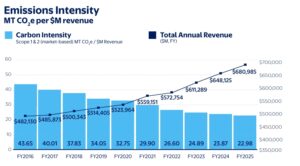
Since FY2016, emissions intensity has dropped 47.4%, showcasing how Walmart’s energy efficiency and renewable sourcing efforts are helping decouple emissions from business growth.
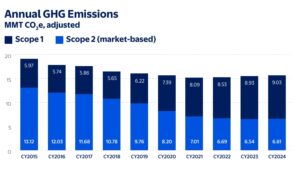
In 2024, the retail giant’s operational emissions (Scope 1 & 2) totaled 15.65 million metric tons of CO₂ equivalent, marking an 18.1% reduction from the 2015 baseline.
Even with a 1.1% year-over-year increase in absolute emissions driven by transportation growth and energy challenges in Mexico and Central America, Walmart’s emissions intensity fell by 3.7%, meaning the company’s carbon footprint per dollar of revenue is shrinking.
Renewable Energy Goals
Walmart’s renewable energy goals are clear:
- 50% renewable electricity by 2025
- 100% renewable electricity by 2035
In 2024, 48.5% of global electricity demand was supplied by renewable sources, with 30.6% secured through renewable energy contracts. While regulatory hurdles and market dynamics in certain regions may delay progress, Walmart continues to invest in renewable energy capacity and policy advocacy to accelerate the transition.
These efforts are crucial for cutting Scope 2 emissions, which account for 42.3% of Walmart’s total operational footprint.
Addressing Scope 3 Emissions
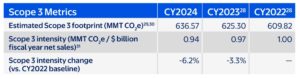
Walmart’s indirect emissions stem from upstream suppliers and downstream customer activities, covering everything from manufacturing processes to product disposal. These Scope 3 emissions account for approximately 90% of Walmart’s carbon footprint.
Efforts to tackle Scope 3 emissions include:
- Collaborating with suppliers to implement renewable energy and efficiency programs
- Encouraging sustainable packaging designs and material reuse
- Advocating for policy changes that support clean energy and emissions tracking
- Enabling customers to reduce emissions through energy-efficient products
By improving transparency and offering tools for reduction, Walmart is fostering a more sustainable supply chain.
Refrigerants and Stationary Fuels
On-site refrigerants remain a significant challenge, representing 32.9% of Walmart’s total operational emissions and 57% of its Scope 1 emissions.
Walmart’s rollout of lower global warming potential (GWP) refrigerant systems has resulted in a 2.4% reduction in refrigerant emissions in 2024, supported by:
- Preventive maintenance across all U.S. stores
- Advanced technician training and in-house expertise
- AI-powered leak detection and predictive maintenance tools
- Refrigerant reuse programs and banking initiatives
Stationary fuel usage, including heating and backup power, contributed 10.4% of total operational emissions, with a 4.9% increase in 2024. Walmart’s efforts to upgrade aging infrastructure to more efficient systems are ongoing but constrained by supply, technology maturity, and cost.
Transportation Emissions Grew 7% in 2024, But Innovation Drives Decarbonization
Transportation-related emissions accounted for 24.9% of Walmart’s Scope 1 emissions and 14.4% of total operational emissions. Despite a 7% increase in 2024 and nearly 20% growth over two years, Walmart is piloting solutions to reduce its transport carbon footprint, including:
- Heavy-duty battery EVs and hydrogen fuel cell forklifts
- Electric yard trucks are achieving 75% emissions reductions per hour compared to diesel units
- Renewable diesel and hydrogen-powered equipment development
While industry-ready solutions for heavy-duty trucking are years away, Walmart’s investments position it as a leader in sustainable transport innovation.
Project Gigaton Helps Walmart’s Suppliers Cut 1.19 Billion Metric Tons of CO₂ Since 2017
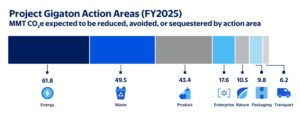
Walmart’s Project Gigaton has been a cornerstone of its Scope 3 emissions strategy, engaging more than 5,900 global suppliers to reduce emissions across energy use, waste, packaging, nature, transportation, and product design.
Since its launch in 2017, Walmart’s supply chain initiatives have:
- Avoided or sequestered 1.19 billion metric tons of CO₂ equivalent
- Surpassed its goal of cutting 1 billion metric tons by 2030 six years ahead of schedule
- Supported innovations aligned with science-based targets through partnerships with organizations like WWF and CDP
Project Gigaton focuses on actionable, measurable projects that help suppliers decarbonize while improving resilience and efficiency.
Walmart’s waste management strategy is designed to close the loop and promote reuse across its operations. By the end of 2023, Walmart achieved an 83.5% global waste diversion rate, a step toward its 90% zero-waste target by 2025.
Key initiatives include:
- Food waste recycling programs that turn organic waste into nutrient-rich compost, animal feed, and renewable energy
- Packaging innovations that aim for 100% recyclable, reusable, or compostable private brand packaging by 2025
- Reducing problematic plastics and promoting sustainable materials
These efforts support Walmart’s climate goals by reducing methane emissions from landfills and lowering the carbon intensity of packaging materials.
Walmart’s Climate Strategy Supports a Net-Zero Future
Walmart’s climate roadmap is ambitious but realistic. The company made strong progress. It cut Scope 1 and 2 emissions by 18.1% since 2015. It also helped suppliers reduce 1.19 billion metric tons of CO₂. This shows that large-scale collaboration can speed up environmental action.

Challenges remain, especially in transport and energy supply, but Walmart’s commitment to innovation, renewable energy, and circular solutions places it on track to meet interim targets and achieve net-zero emissions by 2040.
With measurable goals, industry partnerships, and transparent reporting, Walmart’s climate strategy stands as a blueprint for how corporations can scale sustainability while delivering value to customers, communities, and the planet.
- FURTHER READING: Walmart Looks at Innovative Carbon Capture to Turn CO2 Into Clothes