

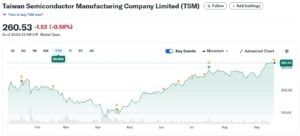
Taiwan Semiconductor Manufacturing Company (TSMC) continues to set new benchmarks in both market performance and environmental responsibility. Recently, the company’s stock (TSM) hit a record-high closing price of NT$1,280, pushing Taiwan’s main stock index to an all-time peak.
Investors responded positively, betting on U.S. Federal Reserve rate cuts and rising demand for artificial intelligence (AI) technologies. But behind the market excitement lies a deeper story. TSMC’s leadership in semiconductor manufacturing and its bold climate action strategy are driving long-term value for shareholders and the planet.
Why Investors Are Bullish on TSMC (TSM Stock)
In the second quarter of 2025, the fab giant expanded its global foundry market share to 38%, up from 31% a year earlier. This jump signals how effectively the company is capturing opportunities in advanced chipmaking.
Counterpoint Research reports that TSMC accounted for nearly three-quarters of the revenue growth in the fast-growing “foundry 2.0” market. This segment, which focuses on next-generation semiconductor production, grew by 19% year-over-year.
The company’s rapid 3nm process ramp-up, along with high utilization of its 4nm and 5nm nodes for AI-related chips, positions it at the forefront of innovation.
Furthermore, MediaTek’s announcement that its next flagship chip will use TSMC’s 2nm process underscores the company’s industry leadership. Investors recognize that TSMC’s advanced technologies are critical to powering AI, 5G, and cloud computing.
AI-Driven Growth Fuels Future Prospects
The much-hyped semiconductor demand is soaring as companies deploy AI chips in data centers, autonomous vehicles, and edge devices. As per reports, its flagship CoWoS (Chip-on-Wafer-on-Substrate) packaging capacity is expected to reach between 65,000 and 75,000 wafers per month by the end of 2025, with further expansion to about 100,000 units by 2026.
This capacity expansion gives TSMC a competitive edge, ensuring it remains the supplier of choice for high-performance AI chips.
The entire supply chain benefits from this growth. Additionally, Advanced Semiconductor Engineering (ASE), a key player in outsourced assembly and test services, saw an 11% increase in revenue. Thus, rising demand for sophisticated packaging solutions confirms that AI-driven expansion is reshaping the industry.
TSMC’s Strong Financials Support Long-Term Investment Confidence
Investors are drawn to TSMC’s resilience. In August 2025, the company’s revenue hit NT$335.77 billion—up 3.9% from the previous month and 33.8% from August 2024. Year-to-date revenue through August reached NT$2,431.98 billion, marking a 37.1% increase compared to 2024.
This growth reinforces TSMC’s reputation as a stable, high-performing investment. The company’s diverse client base, advanced manufacturing capabilities, and strategic expansion into AI markets strengthen its long-term outlook.

Climate Action: A Competitive Edge for Investors
While growth captures headlines, TSMC’s commitment to sustainability builds deeper trust with investors and stakeholders. The semiconductor industry is energy-intensive, and responsible climate action is now a key differentiator.
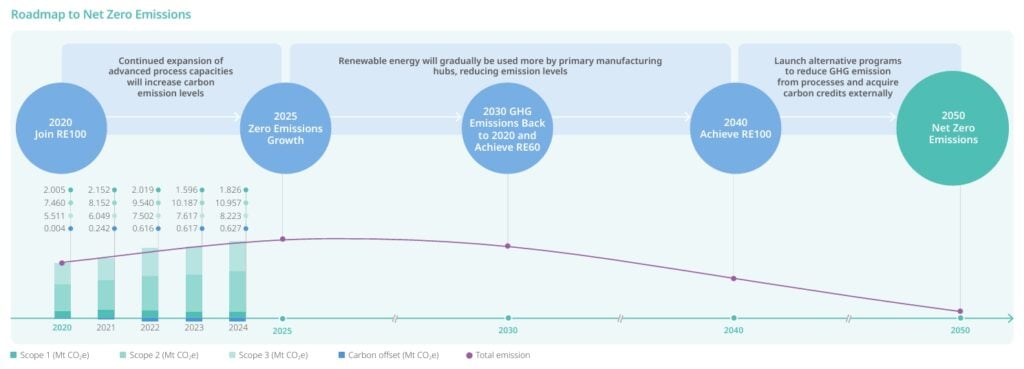
- In 2024, TSMC’s total greenhouse gas emissions reached 21 million metric tons of CO₂ equivalent.
- Electricity usage (Scope 2) caused 52% of TSMC’s emissions, while its supply chain (Scope 3) contributed 39%, and direct processes (Scope 1) accounted for 9%.
Emissions increased by 8% compared to the previous year, and emissions per product unit rose by 19%. While the company missed its reduction targets, it swiftly accelerated its efforts to improve energy efficiency and reduce its carbon footprint.
Key Climate Initiatives Driving Impact
Last year, the company installed or upgraded more than 3,400 scrubbers at manufacturing sites, cutting 390,000 metric tons of direct emissions.
It added nine new green factories certified by LEED Gold or higher, bringing its total to 51 eco-certified facilities. These buildings use energy-saving designs and materials that enhance operational efficiency.
Recognizing that reducing supply chain emissions is essential, TSMC introduced its “Supply Chain Carbon Reduction Action Strategy.” This framework focuses on performance tracking, supplier support, motivation incentives, and collaborative innovation, encouraging suppliers to adopt low-carbon practices.
Renewable Energy Drives TSMC’s Climate Action
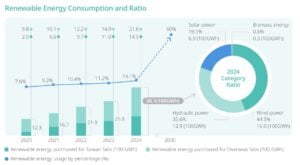
Renewable energy leads TSMC’s climate roadmap. In 2024, its Taiwan fabs used 1,450 GWh of renewable power. Meanwhile, its global offices ran entirely on renewable electricity, and all CO₂ emissions from overseas sites were fully offset. As a result, TSMC has achieved net-zero electricity-related emissions for seven straight years.
Looking ahead, the company aims to source 40% of its electricity from renewables by 2030. It also fast-tracked its goal to reach 100% renewable energy by 2040—ten years earlier than planned.
Through initiatives like roof-mounted solar panels and maximizing renewable installations, TSMC boosted its renewable energy use to 3,610 GWh in 2024. By year’s end, it secured 4.4 GW of renewable energy contracts, cutting an estimated 5.23 million metric tons of CO₂ emissions annually.
Bringing Bees Back: How TSMC’s Green Efforts Revived Local Ecosystems
The company’s environmental initiatives have restored ecosystems around its manufacturing sites, resulting in unexpected benefits for biodiversity. After reintroducing plant species suitable for pollinators, bees naturally returned to areas near TSMC’s fabs.
Recent reports say that the company partnered with local beekeepers and Taiwan’s Tunghai University to produce “Ji Mi,” a branded honey cultivated in and around its factories. The project not only supports pollinators but also creates new community livelihoods.