


The semiconductor industry powers artificial intelligence, cloud computing, and modern data centers. Yet, it is also one of the most energy-hungry and resource-heavy industries. When Nvidia announced a $5 billion investment in Intel, with plans to co-develop chips that combine Nvidia’s AI technology with Intel’s CPU architecture, many see this as a big business move.
Adding to the spotlight, Nvidia also signed a $100 billion deal with OpenAI to supply advanced AI hardware for the next generation of AI models. However, these moves raise an important question: can such deals help reduce carbon emissions and improve sustainable computing?
The High Cost of Silicon: Why ESG Matters
Environmental, social, and governance (ESG) issues now play a major role in how technology companies are judged. Making chips requires huge amounts of water, energy, and chemicals.
Once built, the chips power data centers and AI systems that consume even more electricity. This makes sustainability a challenge for both chip production and chip use.
Both Intel and Nvidia have set ambitious climate goals. Intel has pledged to reach net-zero greenhouse gas emissions for Scope 1 and Scope 2 operations by 2040. The company further aims for net-zero upstream Scope 3 emissions by 2050. It also targets net-positive water use and zero waste to landfills by 2030.

Nvidia, which outsources chip production, promises to lower emissions in its products. It also wants suppliers to set science-based climate goals.
By the end of fiscal 2025, Nvidia used 100% renewable electricity in all its offices and data centers. This move cut its Scope 2 emissions to zero. In fiscal 2024, the company emitted 3,692,423 metric tons of CO₂ equivalent. This total includes emissions from Scopes 1, 2, and 3, showing its environmental impact.

Nvidia surpassed its supplier engagement goal. It worked with partners covering over 80% of Scope 3 Category 1 emissions, up from the initial target of 67%.
By joining forces with Intel, Nvidia gains access not only to its production capacity but also to its sustainability practices. Intel aims for cleaner supply chains and greener manufacturing. This effort could lower the impact of new joint chips.
- RELATED: Intel Stock Surges 9.8% on $2B SoftBank Deal: Can Its Net-Zero Push Power the Future of Chips?
Nvidia is “fabless” and usually relies on partners like Taiwan Semiconductor Manufacturing Company (TSMC). This partnership gives Nvidia more control over how chips are made, packaged, and delivered.
The recent OpenAI deal further emphasizes Nvidia’s role in high-powered AI while keeping sustainability in mind. The company will provide energy-efficient chips for OpenAI’s large AI tasks. This shows the importance of balancing AI development and reducing carbon emissions.
Power-Hungry AI: Cutting Emissions per Computation
The environmental impact of chips is not limited to their production. In fact, much of the emissions tied to semiconductors come from how they are used in practice. Large-scale AI training, for example, requires massive computing power and electricity.
As demand for AI continues to surge, the energy needs of data centers are climbing quickly. The International Energy Agency predicts that global data center electricity demand may double by 2030. This raises concerns about the carbon footprint of AI-driven growth.

Here, the Nvidia-Intel partnership could play a vital role. Intel has set a target to improve the energy efficiency of its processors by 10 times by 2030. Nvidia is also focusing on efficiency. They aim to cut emissions for each computation. This includes lowering carbon dioxide equivalent per petaflop of processing power.
The OpenAI deal adds another layer. Nvidia will supply AI chips to power massive models while aiming to maintain energy efficiency. This ensures that even as AI workloads grow dramatically, emissions per computation can stay lower than older technologies.
“Compute infrastructure will be the basis for the economy of the future,” said Sam Altman, cofounder and CEO of OpenAI. “We will utilise what we’re building with Nvidia to both create new AI breakthroughs and empower people and businesses with them at scale.”
- RELEVANT: NVIDIA Stock (NVDA) Surges: Driving AI Mobility and Cloud Growth with OpenAI and Oracle Partnerships
Nvidia and OpenAI: The $100 Billion AI Hardware Deal
Under its $100 billion deal with OpenAI, Nvidia will provide AI hardware for the next generation of large AI models. This agreement names Nvidia as the main supplier of specialized GPUs and AI chips for OpenAI’s large computing tasks.
The deal includes support for AI training infrastructure. It also covers software optimization and ongoing maintenance of data center operations.
Nvidia’s fine print states it will provide advanced GPUs over the years. This way, OpenAI can grow its AI systems smoothly and without delays. OpenAI will also commit to using Nvidia’s energy-efficient chips and adopt best practices to limit energy use per computation. Both companies will closely track power use and emissions. They will link efficiency gains to contract milestones.
The companies will work together to build advanced AI supercomputing systems, starting with the Nvidia Vera Rubin platform in the second half of 2026. They plan to roll out 10 gigawatts of computing power, creating one of the largest AI infrastructures ever.
This partnership emphasizes two points:
-
AI demand is growing at an unprecedented speed, and
-
There is increasing pressure to meet that demand while minimizing carbon emissions.
Nvidia is using high-performance, energy-efficient hardware to support OpenAI’s bold AI projects. This helps keep energy use and emissions low. The deal further boosts Nvidia’s role in driving sustainable AI growth. It aligns with its ESG and supply-chain efforts.
Following this announcement, Nvidia’s stock experienced a significant uptick. Shares surged over 4%, making it a top performer on major indices including the Dow, Nasdaq, and S&P 500. This surge reflects investor optimism about Nvidia’s strengthened position in the AI infrastructure market.

The Fine Print: Supply Chains and Scope 3 Hurdles
Even with progress, the semiconductor industry faces significant challenges in reducing its environmental footprint. Making advanced chips requires temperatures over 1,000°C. It also requires special chemicals and rare materials such as gallium, cobalt, and indium.
Modern fabs use a lot of energy. For example, one Intel fab can use up to 150 million kWh of electricity each year. This results in about 50,000 metric tons of CO₂ emissions annually.
Globally, semiconductor manufacturing produces over 400 million metric tons of CO₂ each year. This is about 1% of all global emissions. With demand for AI chips and cloud services growing, efficiency gains risk being offset.
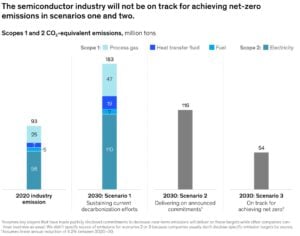
McKinsey & Company’s analysis suggests that the industry must reduce Scope 1 and 2 emissions by at least 4.2% annually from 2020 levels to align with a 1.5°C trajectory by 2030. However, even with full implementation of current decarbonization measures, emissions could reach 89 million tons of CO₂e by 2030, falling short of the 54 million tons needed for net-zero by 2050.
Supply chains are an even bigger hurdle. Scope 3 emissions cover raw material extraction, supplier manufacturing, packaging, and logistics. They can account for 70–80% of a chipmaker’s total carbon footprint.
Nvidia has already engaged suppliers covering over 80% of Scope 3 Category 1 emissions, exceeding its initial 67% target. Yet, emissions from mining, wafer fabrication by foundries, transportation, and overseas assembly are still significant. For example, shipping a single ton of semiconductor wafers internationally can add up to 20 metric tons of CO₂.
Energy sourcing is also critical. Chips remain high-emission if produced or operated in regions reliant on fossil fuels. Training a large AI model, such as OpenAI’s GPT-4 or the future GPT-5, can use up to 1,000 MWh of electricity. This process may emit hundreds of metric tons of CO₂, depending on the energy source. It does not even include the energy for using the AI model.
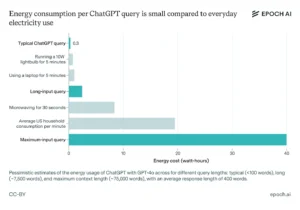
A coal-powered data center with an efficient chip generates 17 kg of CO₂ per teraflop. In contrast, renewable-powered setups only produce 4–5 kg per teraflop. The Nvidia–OpenAI deal focuses on providing GPUs and AI hardware.
This new tech aims to boost energy efficiency. It could cut emissions per computation by 30–50% compared to older hardware. This shows that while chip-level efficiency is essential, a full lifecycle approach is necessary.
Emissions reduction relies on several factors. It depends on processor design, energy sources for manufacturing, supplier practices, and how data centers operate. Without cleaner grids and good supply chain management, much of the carbon-saving potential from new chips and AI workloads may be wasted.
Beyond Business: A Climate Play in Disguise
These partnerships show that top chipmakers now see sustainability as part of growth. Investors, customers, and regulators are increasingly focused on the carbon footprint of technology. Linking climate goals to high-profile deals shows that Nvidia and Intel view emissions reduction as a strategic priority.
The Nvidia-Intel partnership and Nvidia’s OpenAI deal could shape the chip industry’s climate impact. Intel’s clean manufacturing record and Nvidia’s efficient AI hardware can help reduce emissions in production and use.
Still, the results will depend on whether efficiency matches demand and if energy sources move to renewables. For now, these collaborations highlight how innovation and sustainability can go hand in hand.