

The LEGO Group announced a new investment of DKK 18 million, or about $2.8 million, into carbon dioxide removal (CDR) projects. This funding adds to an earlier DKK 19 million, or about $2.6 million, commitment made in February 2025. These two amounts are separate. They support different groups of projects under LEGO’s expanding carbon removal portfolio.
LEGO has now invested about DKK 54 million, or $8–8.5 million, in carbon removal initiatives across eight projects. The company says these investments help it reach its goal of net-zero greenhouse gas emissions by 2050.
The toymaker emphasizes that it prioritizes cutting emissions within its own operations and supply chain first. It views carbon removal as a complementary tool for emissions that are difficult to eliminate.
Annette Stube, Chief Sustainability Officer at the LEGO Group, said:
“This purchase highlights our commitment to testing a broad range of credible pathways for nature and tech-based carbon removal. As the programme expands, it is helping to strengthen our understanding of different approaches and inform future decision-making on how carbon removal may complement our wider climate goals. While reducing emissions in our own operations remains our priority, this programme allows us to work with expert partners and contribute to solutions that may help scale effective climate action over time.”
Climate Experts Driving LEGO’s Carbon Removal
LEGO works with two specialist partners: Climate Impact Partners and ClimeFi.
Climate Impact Partners helps design and deliver nature-based carbon removal projects. ClimeFi focuses on engineered and technology-based removal solutions. These partnerships allow LEGO to support a mix of short-term and long-term carbon storage pathways.
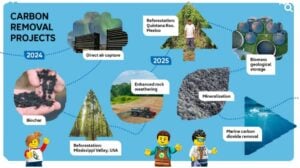
The 2025 investment supports four projects, including biochar, enhanced rock weathering, and reforestation. The 2026 investment supports four additional projects. Together, they form a diversified carbon removal portfolio.
Nature-Based Carbon Removal: Forest Restoration in Mexico
One of the four new projects funded by the 2026 investment is a big reforestation effort in Quintana Roo State, Mexico. This project:
- Restores more than 14,000 hectares of degraded tropical forests.
- Includes native tree planting, species recovery, fire prevention, and community forest management.
- Allocates over 20% of the budget to local job creation and income generation.
- Bringing biodiversity benefits and supporting ecosystems for native wildlife.
This initiative is delivered through Climate Impact Partners in collaboration with Canopia Carbon. It adds to LEGO’s earlier help for reforestation in the Lower Mississippi Alluvial Valley (USA). These forest projects remove carbon dioxide from the atmosphere as trees grow and store it in biomass and soil.
Nature-based removal projects often provide co-benefits. These include biodiversity protection, watershed improvements, and community income. However, they can face risks such as fire or land-use change. Long-term monitoring and strong governance are, therefore, critical.
Engineered Carbon Removal Technologies: From Biomass to Marine CDR
The other three 2026 projects involve emerging CDR technologies managed by ClimeFi:
- Biomass Geological Storage: Uses slurry injection to store carbon-rich organic waste deep underground.
- Mineralization: Transforms CO₂ into manufactured limestone using reactive waste materials that can serve as building inputs.
- Marine Carbon Dioxide Removal: Enhances wastewater alkalinity to remove CO₂ and store it durably in ocean water.
LEGO invests in various pathways to gain hands-on experience with new solutions. These approaches have different durability profiles. This means they store CO₂ for different lengths of time and may also scale in various ways.
Engineered carbon removal often offers higher durability than many nature-based solutions. In some cases, storage can last hundreds to thousands of years. However, these technologies are still developing and can be expensive in the early stages.
LEGO chooses to try various pathways to understand costs, scalability, durability, and verification standards in the carbon removal market. It also aligns with its net-zero goals.
Net-Zero in Motion: LEGO’s Dual Approach to Emissions
The LEGO Group has committed to a net-zero greenhouse gas emissions target by 2050. This target covers its full value chain, including Scope 1, 2, and 3 emissions. LEGO’s near-term targets are validated by the Science Based Targets initiative (SBTi).
The toymaker has committed to reducing absolute Scope 1 and Scope 2 emissions by 37% by 2032 from a 2019 baseline. It also aims to reduce absolute Scope 3 emissions by 37% within the same timeframe. These targets align with limiting global warming to 1.5°C.
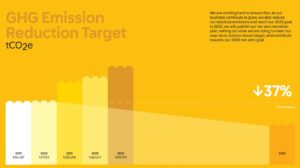
LEGO’s FY2024 Sustainability Statement says the company’s greenhouse gas emissions were around 1.7 million tonnes of CO₂ equivalent (tCO₂e).
While the statement does not yet include a full breakdown of emissions for that year, the most recent publicly disclosed data (for 2023) show that LEGO’s total emissions were about 1.82 million tCO₂ equivalent. In that year:
- Scope 1 (direct emissions) were approximately 23,403 tCO₂e.
- Scope 2 (purchased energy) was very low — effectively 1 tCO₂e when using market‑based accounting due to renewable energy matching.
- Scope 3 (value chain emissions) accounted for about 1.80 million tCO₂e, representing roughly 99 % of total emissions.
The dominance of Scope 3 is consistent with LEGO’s industry profile:
Most emissions arise from materials, manufacturing by suppliers, transport, and end‑of‑life impacts, rather than from the company’s own direct operations. Scope 1 and 2 emissions accounted for roughly 1% of total emissions.
LEGO says it uses 100% renewable electricity for its operations. This comes from on-site solar panels and renewable energy certificates. The company first matched 100% of its electricity use with renewable energy generation in 2017.
In 2024, LEGO also reported progress in sustainable materials purchasing, which indirectly contributes to reduced emissions. About 47 % of the materials purchased to make LEGO elements were certified via mass balance principles. This translates to an estimated average of 33 % renewable sources in raw materials.
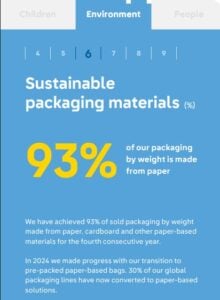
Half of all purchased materials were produced with sustainable sources. The same goes for its packaging materials, where 93% were from paper.
LEGO recognises that carbon removal projects are not a substitute for reducing emissions. They see CDR as a helpful tool. It targets emissions that are tough to fully eliminate.
Investing in both nature-based and technology-based removals allows the company to:
- Understand emerging solutions.
- Gain practical insight into quality, cost, and permanence.
- Build relationships with expert partners.
- Support broader climate goals beyond its own footprint.
LEGO’s climate disclosures stress that the company prioritizes operational cuts first. The company engages suppliers. It uses low-carbon materials and boosts energy efficiency. It also expands renewable energy in its value chain.
The company uses its CDR portfolio to guide future decisions, which helps scale effective climate action while focusing on reducing emissions. Their main goal is to achieve net zero by 2050.
Carbon Removal in Corporate Net-Zero Strategies
Carbon dioxide removal is becoming more important in corporate climate strategies. McKinsey & Company says that by mid-century, the world may need billions of tons of carbon removal each year to reach net-zero.
McKinsey estimates that the CDR market could grow to between $40 billion and $80 billion per year by 2030. By 2050, the market could reach $300 billion to $1.2 trillion annually if scaled to climate targets.

Many climate models show that even aggressive emission cuts may leave 10% to 20% of emissions hard to eliminate. Carbon removal can help address these residual emissions.
Corporate demand plays a key role in building supply. Early buyers send price and volume signals that support project financing. Frontier and other groups have promised to spend hundreds of millions on future carbon removal credits. Members include major technology and consulting firms such as Google, McKinsey, and H&M Group.
Despite growth, current global carbon removal capacity remains far below what climate science suggests is needed. High-quality projects require strong measurement, reporting, and verification systems. Standards continue to evolve across voluntary carbon marke.
Learning and Leading: LEGO’s Early-Mover Advantage in CDR
LEGO’s total DKK 54 million commitment represents a learning strategy as much as a climate contribution. The company gains experience in evaluating project quality, permanence, and social impact. It also builds relationships in a fast-developing sector.
The company’s approach reflects a broader shift among multinational firms. Many now test different removal methods while continuing to reduce direct emissions. This dual strategy helps companies prepare for future regulatory frameworks and stakeholder expectations.
As the global carbon removal market expands, early investments like these help improve project standards, scale innovation, and attract more capital. The sector still faces cost and scalability challenges. But corporate participation provides one pathway to accelerate development.
LEGO’s CDR investments show a steady expansion of the company’s carbon removal portfolio. They also reveal how major consumer brands are integrating carbon removal into long-term climate strategies while continuing to prioritize emissions reduction.