

China is preparing one of the biggest artificial intelligence (AI) infrastructure programs ever announced. According to reports, Beijing is developing a plan to invest about 2 trillion yuan ($295 billion) over the next five years to build a nationwide network of AI-focused data centers.
The initiative aims to strengthen China’s position in the global AI race and challenge U.S. leadership in advanced computing. Yet, the plan is about more than data centers.
China aims to link its computing infrastructure with its power system, transport networks, and industrial strategy. Bloomberg reports that including power-grid integration could raise total investment to over 5 trillion yuan ($740 billion).
For climate and energy markets, an important question arises: Can China support a huge AI expansion and still move toward cleaner energy?
Beijing’s Blueprint for a Nationwide AI Superhighway
Unlike the United States, where AI investment is led mainly by private companies, China is taking a state-driven approach.
Bloomberg reports that major government agencies, like the National Development and Reform Commission (NDRC), are creating a plan for connected computing hubs nationwide. State-owned telecommunications giants China Mobile and China Telecom are expected to operate much of the infrastructure.
The project forms part of China’s broader “Six Networks” infrastructure program, which covers critical systems such as electricity, water, transportation, and digital connectivity.
The goal is to connect scattered computing facilities into a unified national network by 2028. This would build a digital backbone. It would support AI training, cloud computing, robotics, advanced manufacturing, and smart-city applications.
Investors expect to fund the project largely through sovereign debt, including ultra-long-term government bonds, strategic industry funds, bank loans, and private capital.
The investment reflects China’s growing confidence in the sector. According to NDRC estimates, the country’s AI industry could exceed 10 trillion yuan ($1.4 trillion) by 2030.
The AI Race Is Becoming an Energy Race
Building data centers is only part of the challenge. Powering them may be even harder.
AI systems require enormous amounts of electricity. Training large language models, running cloud services, and supporting AI applications consume far more power than traditional computing workloads.
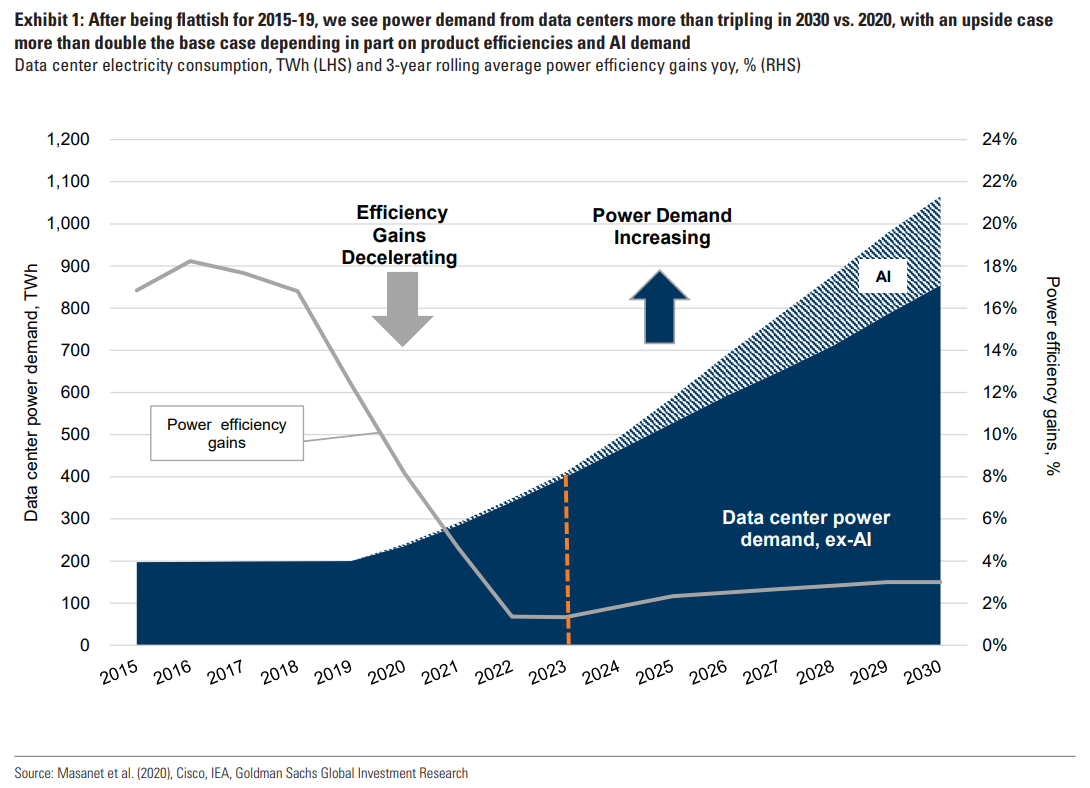
Goldman Sachs Research estimates that global data-center electricity demand could rise by over 160% by 2030 compared with 2023 levels. Other studies suggest AI could become one of the fastest-growing sources of electricity demand this decade.
Many regions are already struggling to keep up.
Utilities in parts of the U.S. and Europe have reported delays. They can’t connect new data centers because local grids don’t have enough capacity. In some cases, projects face waiting periods of several years before receiving grid access.
China faces similar challenges. However, it enters the AI boom with one major advantage: a massive buildout of power infrastructure that has been underway for years.
That helps explain why China’s AI strategy includes plans to integrate computing facilities with the national power grid. Policymakers appear to recognize that future AI leadership may depend as much on electricity supply as on computing power.
China Already Leads the World in Renewable Energy
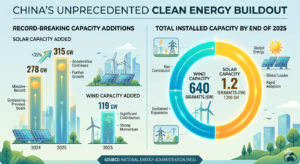
China’s clean energy buildout is unprecedented. According to the National Energy Administration,
- The country added a record 278 gigawatts (GW) of solar capacity in 2024. That growth accelerated further in 2025, when China added another 315 GW of solar power and 119 GW of wind power.
- By the end of 2025, China had installed approximately 1.2 terawatts (TW) of solar capacity and about 640 GW of wind capacity.
Together, those figures make China the world’s largest renewable energy market by a wide margin. The scale is difficult to overstate.
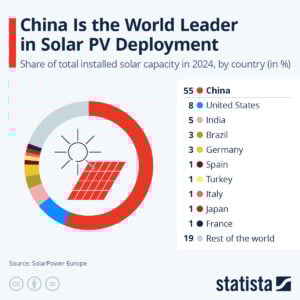
China now installs more renewable energy capacity each year than many countries have in their entire power systems. In several major clean energy categories, the country accounts for more solar PV deployment than the rest of the world combined.
This expansion matters for AI.
Renewable electricity is increasingly becoming the lowest-cost source of power for new industrial projects and data centers. Several Chinese firms are already exploring renewable-powered computing facilities to reduce operating costs and emissions.
However, renewable energy alone cannot solve every challenge. AI data centers require electricity around the clock, regardless of weather conditions. This is where nuclear power becomes important.
China’s Nuclear Expansion Adds a Powerful Edge
China is also building nuclear power faster than almost any other country. The country has over 30 nuclear reactors being built, according to the International Atomic Energy Agency. This is the biggest nuclear construction project in the world.
- The country runs over 50 reactors and aims to boost nuclear capacity to about 200 GW by 2040. That’s nearly four times what it is now.
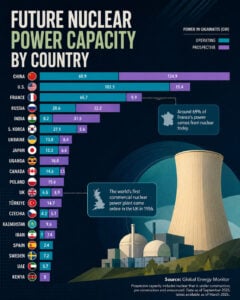
Nuclear energy provides a key benefit for AI infrastructure: reliable electricity 24 hours a day with virtually no direct carbon emissions.
Around the world, technology companies are increasingly turning to nuclear power to support AI growth. Amazon, Microsoft, and Google have all announced plans to invest in advanced nuclear energy and small modular reactor technologies (SMRs).
China is pursuing a different model. It is growing nuclear power through national planning and state support, not corporate deals.
Overall, renewable energy and nuclear power can help China meet its growing electricity needs. This mix can also limit emissions from its expanding digital economy.
Huawei and Domestic Technology Are Central to the Plan
The proposal is also designed to strengthen China’s technology independence. Bloomberg reports that at least 80% of the project’s technology will come from local suppliers. Huawei Technologies will lead this effort, providing key AI processors.
The policy follows earlier directives requiring state-funded data center projects to use locally produced AI chips. The strategy is now more crucial. U.S. export controls limit China’s access to advanced processors from NVIDIA and AMD.
Huawei has boosted production of its Ascend 910C AI chip. Many analysts see it as a top domestic alternative in China. This means the project is not simply a data center expansion plan.
It is also an industrial strategy designed to strengthen domestic computing, telecommunications, semiconductor production, and energy infrastructure simultaneously.
What It Means for Climate and Economic Growth
China remains the world’s largest greenhouse gas emitter, and coal still plays a major role in its power system.
At the same time, China is investing more in renewable energy and nuclear power than any other country. The country has pledged to reach peak carbon emissions before 2030 and achieve carbon neutrality before 2060.
The AI buildout could become an important test of those goals.
If China powers hundreds of billions in new computing with mostly renewable and nuclear energy, it will prove that digital growth and low-carbon electricity can thrive together.
The proposed $295 billion investment highlights a broader reality. The global AI race is no longer just about software, chips, or algorithms. It is increasingly about energy.
China enters that race with the world’s largest renewable energy buildout and one of the fastest-growing nuclear programs. Those energy investments may prove just as important as the data centers themselves in determining who leads the next phase of AI development.