

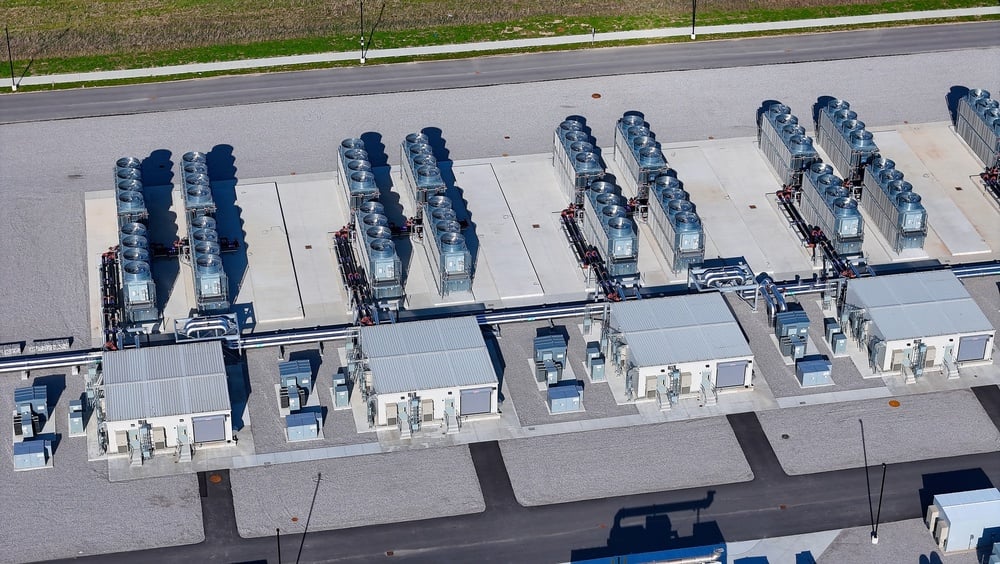
Artificial intelligence (AI) is driving new growth in the global battery industry. For years, electric vehicles (EVs) fueled battery demand. Now, AI data centers are the next multi-billion-dollar opportunity.
The fast growth of generative AI has led to a rush in building AI data centers in the U.S., Europe, and Asia. These centers require significant electricity to train and operate large AI models such as ChatGPT, Gemini, etc. As electricity demand rises, battery makers are exploring a new market beyond electric vehicles (EVs).
This shift shows a bigger change in the battery industry. As per reports, China’s leading battery makers CATL, Panasonic, BYD, Sungrow, Hithium, Sunwoda, and Envision Energy are racing to create advanced energy storage for AI systems.
The Next Battery Boom Is Being Built for AI
Traditional data centers mainly store data and run cloud services. AI data centers are quite different. These facilities train and run large AI models. They need thousands of high-performance graphics processing units (GPUs) working at the same time. They use much more electricity than regular data centers.
Their power demand has three key traits.
- First, power density is much higher. A traditional server rack needs around 5-8 kilowatts (kW). In contrast, AI server racks often require 30-100 kW, and some advanced systems need even more.
- Second, energy consumption is enormous. A single hyperscale AI data center can use as much electricity yearly as a medium-sized city.
- Third, electricity demand changes almost instantly. When training AI models, power usage can spike sharply within seconds. When workloads slow, demand drops just as quickly. These fluctuations pose significant challenges for power grids.
Challenges in Traditional Backup Systems
Most conventional data centers rely on two backup systems.
- First, an uninterruptible power supply (UPS) keeps servers running briefly during outages.
- Second, diesel generators provide electricity during longer power interruptions.
However, these systems were not designed for the rapid power swings caused by AI workloads. AI data centers need batteries that respond almost instantly, delivering large amounts of electricity within milliseconds while maintaining stable voltage.
The Solution: AIDC Battery Storage
This demand has sparked a need for a new generation of high-power battery cells and advanced energy storage systems for continuous, high-intensity operation.
According to the International Energy Agency (IEA), global data center electricity consumption is expected to hit 485 terawatt-hours (TWh) by 2025 and could nearly double by 2030. AI will drive much of this growth.
Other forecasts show even steeper increases. Goldman Sachs estimates that global data center electricity use may rise by over 220% by 2030. This could hit about 1,350 terawatt-hours each year.
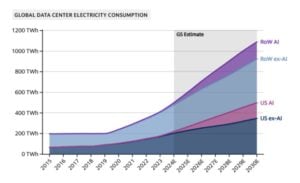
Thus, as AI expands, reliable energy storage is becoming as crucial as computing power. Many experts believe AI data center batteries could be the next big growth driver for the global energy storage market.
Panasonic Bets Big on AI Infrastructure
At its Investors Day in Tokyo, Panasonic announced a 350 billion yen ($2.4 billion) investment to expand its battery business. The company aims to strengthen its supply chain in Japan and North America while ramping up production of battery systems for AI data centers and continuing its EV battery business.
Panasonic plans to add dedicated production lines at its battery plant in De Soto, Kansas, complete additional battery module factories in Mexico, and significantly boost battery cell production in Japan by fiscal year 2029.
- The Kansas battery factory is expected to produce 32 gigawatt-hours (GWh) of batteries each year.
- The facility will create about 4,000 new jobs and cover roughly 4.7 million square feet, making it one of the world’s largest battery manufacturing plants.
Part of this expansion involves converting an automotive battery production line in Osaka to make lithium-ion batteries and supercapacitors for industrial applications.
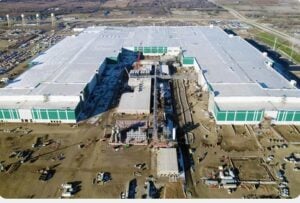
Panasonic’s Kankas Facility
A Complete Power Solution for AI Facilities
Instead of focusing solely on EV batteries, it also aims to provide complete power solutions for AI facilities.
Its future portfolio includes advanced Capacitor Backup Units (CBUs) that stabilize voltage during power spikes, battery backup systems for high-voltage direct current (HVDC) data center architecture, and high-power lithium-ion battery cells that can deliver rapid bursts of electricity.
The company’s strategy reflects how AI infrastructure is shifting battery demand from transportation to essential digital infrastructure.
- Meanwhile, Panasonic’s Sparks, Nevada, facility produces approximately 5.7 million battery cells daily, or nearly 70 cells every second.
Interestingly, Panasonic’s AI strategy follows its exit from the U.S. residential solar and home energy storage business in 2025. Now, the company is focusing on higher-growth industrial markets like electric vehicles and AI data centers.
CATL Calls AIDC Energy Storage Its Next Growth Engine
Among Chinese firms, CATL has the clearest strategy. Chairman Robin Zeng noted that energy is the foundation of artificial intelligence.
Every AI-generated token requires electricity, making reliable energy infrastructure as vital as advanced chips and servers. Zeng pointed out that limited energy supply is becoming a major constraint on AI development.
Rather than enter chip manufacturing, CATL plans to focus on its strengths—batteries, energy storage, and integrated energy management systems. In short, it aims to be a full-service energy provider for AI data centers.
- To meet these needs, CATL has introduced a 300Ah-plus sodium-ion battery built on the same platform as its lithium systems.
- The battery reportedly offers over 15,000 charge cycles, around 97% efficiency, and supports energy storage times from two to eight hours.
Moreover, the battery giant now sees AI infrastructure as a long-term business that might rival or exceed the growth of its traditional EV battery sector.
Building an Entire AI Energy Ecosystem
Since 2025, the company has invested in AI software firm Damao Technology, high-voltage direct current specialist Zhongheng Electric, and plans to become the largest shareholder of data center operator 21Vianet.
These investments create an integrated model that covers battery production, power management, electricity distribution, and AI data center operations. So, instead of just selling battery cells, it is now engaging across the entire energy value chain.
Chinese Battery Giants See an Even Bigger Opportunity
Other than Panasonic and CATL, China’s leading battery manufacturers are aggressively entering AI energy storage. To name a few, Sungrow, Hithium Energy Storage, Sunwoda, Envision Energy, and others are heavily investing in batteries tailored for AI infrastructure.
These batteries focus on rapid discharge capability, long lifespan, and safety under continuous heavy workloads.
They operate at a massive scale, benefit from integrated supply chains, and continually reduce manufacturing costs through innovation. These strengths give them an edge as AI data centers become one of the fastest-growing battery markets.
The Bottom Line: A Multi-Billion-Dollar Battery Market
While EVs are still important, AI data centers are now a big source of battery demand. Unlike EVs, these centers need batteries that deliver quick power, handle constant load changes, and support crucial digital infrastructure around the clock.
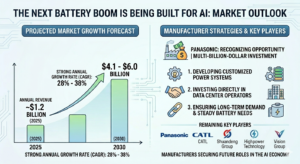
- The market for AI data center energy storage is set for rapid growth over the next decade. Annual revenue is expected to rise from about $1.2 billion in 2025 to $4.1-$6.0 billion by 2030, representing a strong annual growth rate of 28% to 38%.
Panasonic’s multi-billion-dollar investment is a classic example that shows how traditional battery makers recognize this opportunity.
Additionally, firms like Shuangdeng Group, Ampace, Highpower Technology, and Vision Group are creating customized power systems. They are investing directly in data center operators to ensure long-term demand. This strategy provides a steady flow of future battery needs and allows manufacturers to play a bigger role in the growing AI economy.
As governments and tech companies invest billions in AI, energy storage is becoming essential. It’s more than just backup; it’s a key asset. Companies that provide reliable, high-performance batteries for AI data centers could lead the global battery market.