


Walmart (NYSE: WMT) has taken a major step toward cleaner energy by signing its first-ever nuclear power purchase agreement (PPA) with Constellation Energy. The long-term deal will provide emissions-free electricity from Constellation’s Dresden Clean Energy Center in Illinois and help support Walmart’s climate goals while strengthening local energy infrastructure.
- The agreement covers about 176 megawatts (MW) of wholesale electricity supply, including 30 MW of additional generation capacity from planned efficiency upgrades at the nuclear facility.
Under the agreement, the retail giant will purchase electricity, environmental attributes, and capacity through two separate 15-year contracts starting in 2029 and 2030.
Walmart stock (WMT stock) moved slightly higher after the company announced its first nuclear energy deal with Constellation Energy. The stock rose about 1.9%, trading near $120, as investors reacted positively to Walmart’s plan to secure reliable, carbon-free electricity for its future operations.
Dresden Plant Expansion Supports Walmart Growth in Illinois
The agreement will help fund power uprates at the Dresden Clean Energy Center. These upgrades improve the efficiency of existing nuclear reactors and increase electricity output without building a new facility.
The additional power generated through these improvements will support Walmart’s new high-tech perishable distribution center currently under development in Belvidere, Illinois.
Together, the nuclear energy agreement and the distribution center investment are expected to create jobs, strengthen local communities, and support Walmart’s growing supply chain operations across the region.
Constellation announced in late 2025 that Dresden received renewed operating licenses, allowing the facility to continue operating through 2049 and 2051. The plant currently supports more than 1,100 jobs and provides reliable carbon-free electricity across Illinois.
Walmart Faces Challenges on Its Road to Net Zero
Walmart has set ambitious climate goals. The company aims to reduce its Scope 1 and Scope 2 greenhouse gas emissions by 65% by 2030 compared to 2015 levels. It also plans to achieve net-zero operational emissions by 2040.
However, it acknowledged in 2024 that reaching its interim climate targets may be difficult. The company cited challenges such as limited availability of low-carbon refrigeration technologies, transportation solutions, and clean energy infrastructure.
Scope 1 emissions come from sources Walmart directly controls, including transportation fleets, refrigeration systems, and fuel use in facilities. Scope 2 emissions result from purchased electricity used to power stores, distribution centers, and offices.
Despite these challenges, the company continues to make progress.
- In 2024, the company reduced its emissions intensity by 3.7% compared to the previous year.
- Since 2015, Walmart’s total Scope 1 and Scope 2 emissions have fallen by 18.1%, while emissions intensity has dropped by 47.4%.
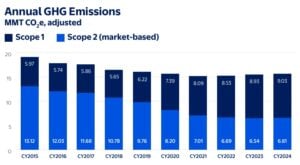
The company noted that emissions increased slightly in some areas because of business growth. Higher transportation activity in the U.S. and expansion across Mexico and Central America contributed to increased emissions. Renewable energy production in some regions also declined because of drought and extreme heat conditions.
Building a More Resilient Power Mix
Alongside nuclear energy, Walmart continues to invest heavily in renewable power.
- It aims to source 50% of its electricity from renewable energy by 2025 and reach 100% renewable electricity across its operations by 2035.
In 2024, renewable sources supplied 48.5% of Walmart’s global electricity needs. About 30.6% of its electricity came through renewable energy contracts, including long-term agreements tied to wind and solar projects.
It has also announced plans to help enable up to 10 gigawatts (GW) of new clean energy projects between 2024 and 2030.
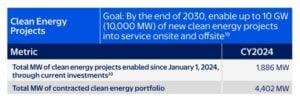
These investments are expected to support grid reliability while helping the company secure affordable, low-carbon power.
The new nuclear agreement complements Walmart’s broader clean energy strategy by adding a dependable source of emissions-free electricity to its growing energy portfolio.
Constellation Bolsters Its Position as America’s Nuclear Leader
Constellation Energy is the largest nuclear power operator in the United States. It operates about 55 gigawatts (GW) of generating capacity across nuclear, natural gas, hydro, wind, solar, and geothermal facilities.
Its fleet produces enough electricity to power roughly 27 million homes and delivers nearly 10% of the nation’s clean energy. The company also serves around 2.5 million customer accounts, including about 80% of Fortune 100 companies.
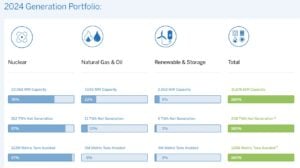
As companies work to reduce emissions and meet climate targets, nuclear energy is becoming an increasingly attractive option. Unlike wind and solar power, nuclear plants provide around-the-clock electricity, making them a reliable source of carbon-free energy.
US Nuclear Generating Capacity
The United States remains the world’s largest producer of nuclear energy. EIA data shows that, in 2025, the country had about 97 GW of operating nuclear capacity, generating roughly 785 terawatt-hours (TWh) of electricity annually.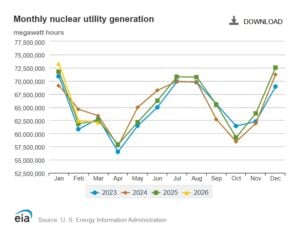
Nuclear power supplies around 18% of U.S. electricity and nearly half of the nation’s carbon-free power, making it a critical part of the country’s clean energy transition.
The deal also reflects a broader shift in the U.S. energy market. Rising electricity demand from data centers, advanced manufacturing, and electrification is increasing the need for stable, low-carbon power sources.
Illinois is an important market for both companies. Constellation’s generating assets play a key role in the state’s electricity supply, while Walmart operates approximately 175 stores and clubs and employs more than 55,000 associates across Illinois.
As demand for reliable clean power rises, Walmart’s partnership with Constellation could serve as a model for other large corporations seeking to balance growth, energy security, and emissions reductions.