

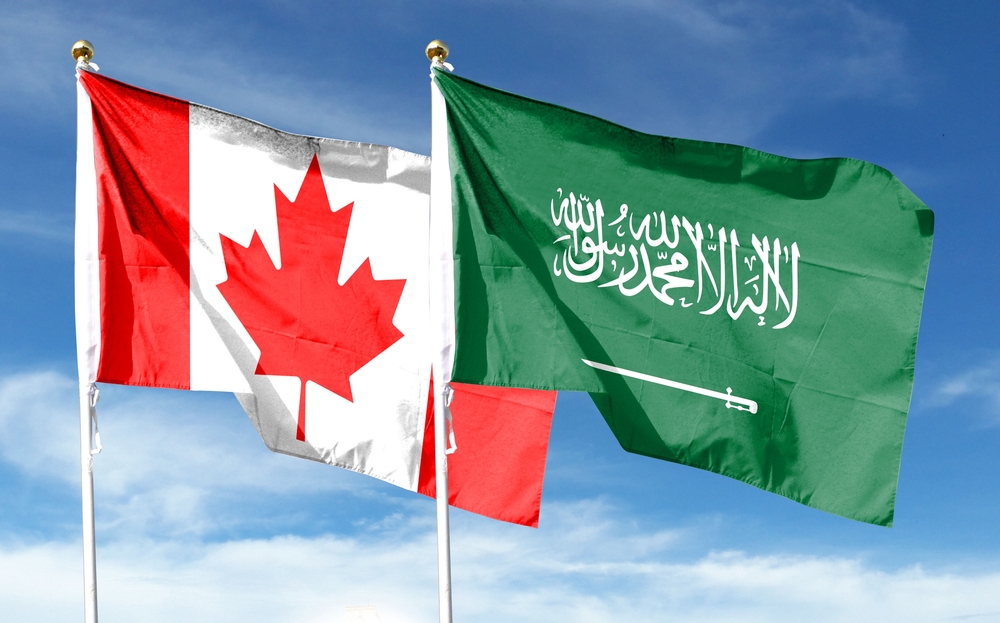
Canada and Saudi Arabia have entered a new phase in their bilateral relationship, signing more than C$1 billion (US$730 million) worth of commercial agreements and launching new partnerships in clean energy, mining, artificial intelligence (AI), infrastructure, and investment.
The announcements came during Prime Minister Mark Carney’s official visit to Saudi Arabia—the first by a Canadian prime minister in 26 years—as both countries seek to diversify their economies and strengthen cooperation in industries driving the global energy transition.
The visit produced new government agreements on energy and AI, alongside 13 commercial deals involving Canadian and Saudi companies. Together, these initiatives could create fresh opportunities for Canadian firms while supporting Saudi Arabia’s ambitious Vision 2030 economic transformation.
Mark Carney noted:
“Canada and Saudi Arabia have both embarked on ambitious new missions to transform their economies. To that end, we are harnessing each other’s strengths across minerals and mining, technology, energy, and commerce. Canada has what the world wants. We are cultivating a dense web of new connections to diversify our trade, create new opportunities for our workers and businesses, and deliver greater security and prosperity for all Canadians.”
A New Chapter in Canada-Saudi Relations
Meeting in Jeddah, Prime Minister Carney and Crown Prince Mohammed bin Salman agreed to deepen cooperation across trade, investment, defence, education, science, and technology.
One of the key outcomes was the signing of a memorandum of understanding (MOU) establishing the Canada–Saudi Arabia Coordination Council, a new platform that will oversee bilateral cooperation across strategic sectors.
The visit also reflected Canada’s broader effort to diversify exports beyond the United States while attracting new foreign investment. Carney has repeatedly emphasized the need to build stronger partnerships with fast-growing economies as global trade patterns shift.
Energy Cooperation Expands Beyond Oil
Clean energy emerged as one of the biggest winners from the visit. Canada and Saudi Arabia signed a new energy MOU aimed at attracting investment and expanding cooperation in:
- Liquefied natural gas (LNG)
- Renewable energy
- Hydrogen
- Carbon capture and storage (CCS)
The agreement seeks to combine Canada’s expertise in clean technologies and energy infrastructure with Saudi Arabia’s massive investments in low-carbon energy.
Saudi Arabia remains one of the world’s largest oil producers, but the kingdom is investing heavily to diversify its energy mix. According to Ember data, it generates 2% of its electricity from low-carbon sources.
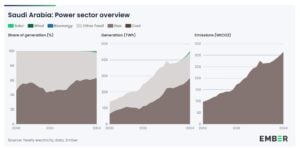
- However, under Vision 2030, it aims for 50% of electricity generation to come from renewable energy by 2030, with the remaining half supplied by natural gas.
- The government is targeting around 130 gigawatts (GW) of renewable energy capacity by the end of the decade through large-scale solar and wind projects.
The kingdom is also positioning itself as a future exporter of clean hydrogen while expanding carbon capture capacity to reduce industrial emissions.
These goals require significant international investment, engineering expertise, and technology—areas where Canadian companies have decades of experience.
Rising Electricity Demand Drives Investment
Saudi Arabia’s clean energy push is also being driven by rapidly rising electricity demand.
Population growth, industrial expansion, desalination plants, new manufacturing facilities, and mega-projects such as NEOM, The Line, and other Vision 2030 developments are increasing pressure on the country’s power system.
- Peak electricity demand has already surpassed 90 GW, and energy consumption is expected to continue rising throughout the next decade.
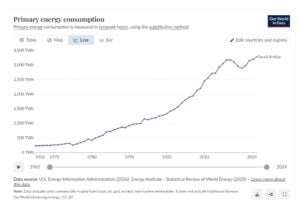
To meet this demand while reducing emissions, Saudi Arabia is rapidly expanding utility-scale solar and wind generation, battery storage, smart grids, and energy efficiency programs.
The country has already awarded dozens of renewable energy projects through its National Renewable Energy Program, making it one of the fastest-growing clean energy markets in the Middle East.
For Canadian developers, equipment suppliers, engineering firms, and clean technology companies, this represents a significant long-term opportunity.
AI Partnership Strengthens
Artificial intelligence was another major focus of the visit. The two governments signed an MOU to increase collaboration on AI development, deployment, commercialization, and innovation.
The announcement was accompanied by a landmark private-sector agreement between Canadian AI company Cohere and Saudi Arabia’s HUMAIN.
- Under the partnership, HUMAIN will dedicate at least 50 megawatts of AI computing capacity to support Cohere’s next generation of foundation models.
The collaboration aims to develop sovereign AI capabilities while strengthening advanced computing infrastructure in Saudi Arabia.
Meanwhile, Canadian cybersecurity company BlackBerry and Aramco Digital also announced discussions to explore secure communications technologies and industrial digital solutions.
These partnerships align with Saudi Arabia’s broader ambition to become a regional leader in AI and digital infrastructure while creating new export opportunities for Canadian technology firms.
Mining Becomes a Strategic Priority
Mining also featured prominently during the visit. Among the 13 commercial agreements are partnerships that will enable Canadian companies to support Saudi Arabia’s growing mining and critical-minerals sector.
Saudi Arabia has identified mining as the third pillar of its economy, after oil and petrochemicals. The kingdom estimates its untapped mineral resources—including gold, phosphate, copper, lithium, rare earth elements, zinc, and other critical minerals—are worth approximately US$2.5 trillion.
Developing these resources is considered essential for both economic diversification and the global clean energy transition.
Canada brings significant expertise to that effort.
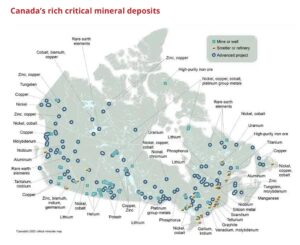
According to Natural Resources Canada, the country’s mining and mineral processing industry contributed approximately C$117 billion to Canada’s GDP in 2024, representing nearly 5% of the national economy.
Canada is also among the world’s leading producers of:
- Potash
- Uranium
- Nickel
- Cobalt
- Aluminum
- Gold
- Diamonds
Many of these minerals play a critical role in manufacturing batteries, electric vehicles, renewable energy equipment, and advanced electronics.
Canadian mining companies are internationally recognized for exploration, engineering, environmental management, financing, and mine development—expertise that Saudi Arabia is seeking as it expands its domestic mining industry.
More Than Commercial Deals
Beyond mining and energy, the agreements cover infrastructure, healthcare, education, and defence.
Canadian infrastructure companies are expected to participate in transportation projects supporting Vision 2030, including roads and railway developments.
Healthcare partnerships will introduce Canadian technologies ranging from patient monitoring systems to surgical intelligence platforms.
Educational institutions will also help train Saudi workers in skilled trades, engineering, healthcare, construction, and technology.
Together, these initiatives are designed to create long-term economic cooperation rather than increase exports.
Investment Ties Continue to Grow
The visit also laid the foundation for deeper investment flows.
Canada announced plans to lead a delegation of major pension funds to Saudi Arabia to explore investment opportunities, particularly in clean energy and AI. The two countries also agreed to conclude negotiations on a Foreign Investment Promotion and Protection Agreement (FIPA) by early 2027.
In addition, negotiations have begun on a new double taxation agreement that would simplify cross-border investment for businesses operating in both countries.
Canada also confirmed it will participate in Expo 2030 Riyadh, where Canadian companies will showcase technologies in clean energy, mining, advanced manufacturing, and digital innovation.
A Partnership Built Around the Energy Transition
Although Saudi Arabia remains one of the world’s largest oil exporters, its economic transformation is creating new opportunities in renewable energy, hydrogen, carbon capture, AI, and critical minerals.
Canada, meanwhile, possesses strengths in clean technology, sustainable mining, engineering, and advanced research.
By combining those capabilities, both countries hope to unlock new investment, diversify trade, and accelerate projects supporting the global transition to lower-carbon energy.
With more than C$1 billion in new commercial agreements already announced and broader investment negotiations underway, the partnership signals that clean energy, critical minerals, and advanced technologies are becoming central pillars of Canada–Saudi Arabia economic relations.