

Europe’s shift toward clean energy has created several major utility companies focused on renewable power, but few have expanded as successfully as Iberdrola (BME: IBE). The Spanish energy giant has built one of the world’s largest renewable electricity portfolios while also investing heavily in modern power grids that support the growing demand for electrification.
Unlike many renewable developers that rely on a single technology, Iberdrola combines wind, solar, hydroelectric power, battery storage, electricity networks, and retail energy businesses across multiple countries. This diversified model has helped the company deliver stable earnings while continuing to invest billions of euros in clean energy.
Recent company data for the first half of 2026 shows Iberdrola continues to expand its renewable portfolio, increase electricity distribution, and reduce carbon emissions. These trends are attracting investors looking for long-term exposure to the global energy transition.
Iberdrola Continues Expanding its Renewable Business
Iberdrola remains one of the world’s largest renewable energy utilities. During the first six months of 2026, the company increased its total generation capacity by nearly 4% to 56,827 megawatts (MW), adding around 2,300 MW of new capacity.
Most of this growth came from renewable technologies.
- Wind led the expansion, with more than 1,400 MW of new onshore and offshore wind capacity added over the past year. Offshore wind remained one of the company’s strongest-performing technologies, with production increasing 23% year over year.
- Solar also grew rapidly, contributing another 1,000 MW. Battery storage recorded one of the fastest growth rates. Iberdrola more than doubled its battery capacity, increasing it by 117% after bringing new storage projects online in Spain and Australia.
- Hydropower also played an important role. After generating more than 12,000 GWh from hydroelectric facilities, Iberdrola maintained reservoir storage above 8,200 GWh by the end of June, providing valuable flexibility for Spain’s electricity system.
Electricity Spreading to Major Markets: Europe and Australia
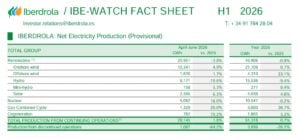
Iberdrola generated 61,318 GWh of electricity during the first half of 2026, about 1% more than a year earlier. The company’s expansion has been spread across several major markets.
Continental Europe and Australia recorded the largest increase, with more than 1,000 MW of additional renewable capacity. New wind farms in Australia, Greece, and Portugal, together with solar projects in Germany and Italy, supported this growth.
This diversified international strategy reduces dependence on any single market while allowing Iberdrola to benefit from growing clean energy demand worldwide.
- Electricity generation increased by 27.3% in the United Kingdom, and the generation portfolio expanded by approximately 400 MW.
- It added 8% in the United States, and 11.5% across the company’s other international markets. In the United States, renewable capacity increased by almost 800 MW
- Spain remained Iberdrola’s largest generation market, producing 32,732 GWh during the period. It added around 600 MW.
Electricity Demand Keeps Rising
Growing electrification continues to benefit Iberdrola’s network business.
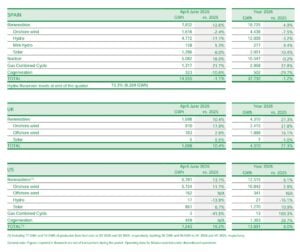
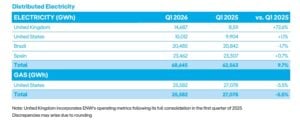
- During the first half of 2026, the company distributed 136,648 gigawatt-hours (GWh) of electricity worldwide, representing a 6.3% increase compared with the same period last year.
Electricity demand increased across every region where Iberdrola operates.
The strongest growth came from the United Kingdom, where electricity distribution rose 32.6%. This increase reflected higher electricity demand and the successful integration of Electricity North West into Iberdrola’s operations.
The trend highlights a broader shift taking place across many economies. As electric vehicles, heat pumps, data centers, and industrial electrification expand, electricity demand is expected to continue rising over the coming decades.
For utilities like Iberdrola, this creates opportunities beyond renewable generation. Modern electricity grids are becoming increasingly valuable because they connect renewable energy projects with homes, businesses, and industries.
Billions of Euros Committed to Clean Energy
Iberdrola continues backing its long-term growth with significant investment.
The company plans to invest approximately €21 billion in its Renewables and Customers businesses through 2028 as part of a broader strategy to accelerate electrification.
Its investment priorities include:
- Expanding renewable generation
- Building smarter electricity grids
- Increasing battery storage
- Developing digital energy systems
- Providing decarbonization solutions for customers
Rather than focusing only on renewable power plants, Iberdrola is investing across the entire electricity value chain.
Smart grids have become especially important because they allow electricity systems to manage distributed solar generation, electric vehicle charging, battery storage, and changing customer demand more efficiently.
This combination of regulated network assets and renewable generation gives Iberdrola a relatively balanced business model compared with many pure renewable developers.
Progress Toward Net-Zero Emissions
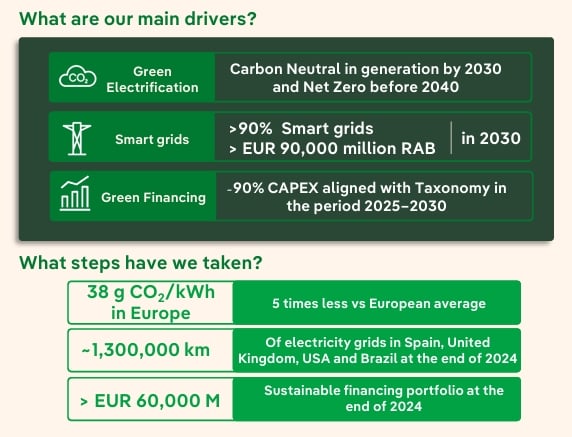
Reducing emissions remains a central part of Iberdrola’s strategy. It aims to reduce absolute emissions by 90% by 2039 before neutralizing the remaining emissions and achieving net-zero in 2040.
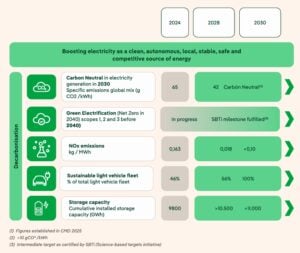
Its climate targets have been validated by the Science Based Targets initiative (SBTi), confirming they align with climate science. According to company data, direct greenhouse gas emissions have fallen by more than 30% over the past five years.
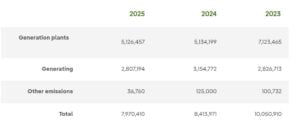
- Total emissions declined from 10.0 million tonnes of CO₂ equivalent (MtCO₂e) in 2023 to 8.4 MtCO₂e in 2024 and 7.9 MtCO₂e in 2025.
- The company also reduced its emissions intensity to 60 kgCO₂/MWh in 2025, down from 65 kgCO₂/MWh in 2024 and 77 kgCO₂/MWh in 2023.
One reason for this improvement is Iberdrola’s increasingly clean electricity mix. The company reports that 85% of its total electricity production in 2025 came from emission-free sources.
Additionally, in Europe, Iberdrola’s carbon intensity has fallen to approximately 55 grams of CO₂ per kilowatt-hour, significantly below many traditional European utilities.
How has Iberdrola Stock Performed?
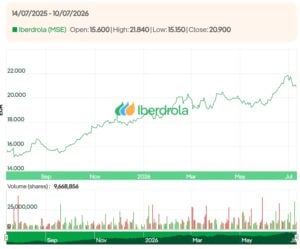
Iberdrola shares have delivered solid returns over the past year. Recent market data shows the stock has gained roughly 33% to 34% over the last 12 months, outperforming many traditional utility companies.
The company also posted a strong 41.9% gain during 2025, while shares have continued moving higher in 2026.
Strong operating performance, expanding renewable assets, and stable earnings from regulated electricity networks have supported investor confidence.
Because utilities generally generate predictable cash flows, many investors also view Iberdrola as a relatively defensive clean energy investment compared with more volatile renewable technology companies.
What do analysts think?
Wall Street and European analysts remain cautiously optimistic about Iberdrola. Most recent ratings fall into the Buy, Overweight, or Outperform categories, although many analysts also maintain Hold or Neutral recommendations.
This mixed outlook does not necessarily reflect concerns about the business itself. Instead, it suggests many analysts believe the company’s strong performance has already been reflected in its current share price.
With Iberdrola trading near the upper end of its 52-week range, future gains may depend on continued earnings growth, successful project delivery, supportive regulation, and rising electricity demand.
Is Iberdrola Well Positioned for the Energy Transition?
Iberdrola’s strategy extends well beyond building renewable power plants. The company is investing across generation, electricity networks, energy storage, digital technologies, and customer solutions—all areas expected to benefit from the global shift toward electrification.
This diversified approach provides multiple growth opportunities while helping reduce reliance on any single technology or market.
Like every utility, Iberdrola still faces risks. Changes in government regulation, interest rates, electricity prices, supply chain costs, and project execution could affect future performance.
However, its combination of regulated network assets, expanding renewable capacity, and long-term decarbonization strategy continues to make Iberdrola one of Europe’s strongest clean energy companies.
For investors seeking exposure to renewable infrastructure rather than higher-risk clean technology startups, Iberdrola remains one of the industry’s most established long-term renewable energy investments.