


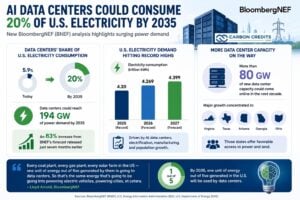
Artificial intelligence (AI) is creating a new challenge for the United States power sector. A new BloombergNEF (BNEF) analysis shows just how fast that demand is growing. It projects that data centers could consume about 20% of all U.S. electricity by 2035, up from 5.9% today.
The power demand of these facilities could reach 194 gigawatts (GW), an 83% increase from BNEF’s forecast released just seven months earlier. Lloyd Arnold, one of the report authors at BNEF, remarked:
“Every coal plant, every gas plant, every solar farm in the US — one unit of energy out of five generated by them is going to data centers. So that’s the same energy that’s going to be going into powering electric vehicles, powering cities, et cetera.”
The forecast signals more than an AI boom. It highlights a major change in the U.S. electricity system. Utilities, tech firms, and policymakers should now rethink how America generates, delivers, and decarbonizes power.
America’s Power Demand Is Surging Again
The U.S. power market has entered a new growth cycle. For nearly two decades, electricity demand in the country changed very little as homes, businesses, and appliances became more energy efficient. That trend has now ended.
AI, data centers, electric vehicles, new factories, and the wider shift toward electrification are pushing electricity demand to record highs.
According to the U.S. Energy Information Administration (EIA), electricity consumption reached a record 4.20 trillion kilowatt-hours (kWh) in 2025. The agency forecasts another record of 4,269 billion kWh in 2026, followed by 4,399 billion kWh in 2027. The increase comes from expanding AI data centers, electrification, manufacturing, and population growth.
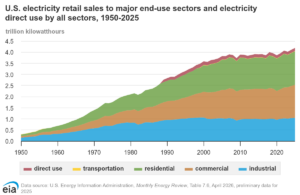
That marks a sharp change from the previous two decades, when electricity demand remained largely flat despite economic growth.
AI is becoming one of the biggest drivers behind this turnaround. Training large language models and running AI applications require thousands of advanced chips operating around the clock. Those servers also need large cooling systems that consume significant amounts of electricity.
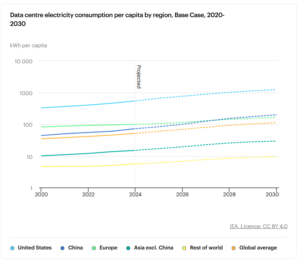
The International Energy Agency (IEA) says the United States leads the world in data center electricity use per person. In 2024, it is around 540 kilowatt-hours per capita. By the end of this decade, that figure could exceed 1,200 kWh per person, highlighting how quickly AI is reshaping electricity demand.
Clean Energy Must Keep Pace
Meeting that demand is not simply about generating more electricity. The United States is also working to reduce emissions from its power sector.
According to the EIA, renewable energy continues to expand rapidly while coal generation keeps falling. Renewables like wind, solar, and hydropower are providing more U.S. electricity. This growth is backed by record investments in battery storage and improved transmission.
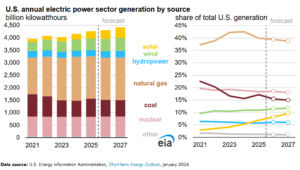
Natural gas remains the country’s largest electricity source. Meanwhile, nuclear power continues to provide the biggest source of emissions-free baseload generation.
The challenge is that AI is arriving just as the country is trying to modernize its electricity system. The U.S. Department of Energy (DOE) says no single technology can meet future demand alone. Instead, the country will need a balanced mix of:
- nuclear power,
- renewable energy,
- battery storage,
- geothermal energy,
- hydropower, and
- natural gas.
Moreover, major investments in transmission infrastructure are crucial to maintain reliability while lowering emissions. That shift is already underway.
Utilities and Tech Giants Are Racing to Secure Power
Microsoft has signed agreements to support new nuclear generation and geothermal projects. Google, Amazon, and Meta are investing billions in renewable energy, battery storage, and advanced nuclear technologies to power future AI operations.
According to BloombergNEF, corporate clean energy procurement reached record levels globally in 2024 (62 GW) before declining to 55.9 GW in 2025, with technology companies remaining among the largest buyers. Many tech firms are also looking beyond solar and wind.
Microsoft recently signed an agreement supporting the restart of the Three Mile Island nuclear plant. Amazon and Google have also invested in advanced nuclear and small modular reactor (SMR) projects. These investments reflect a growing need for around-the-clock electricity that can complement intermittent renewable energy.
These investments reflect a growing reality: electricity is becoming a competitive advantage in the AI race.
- INTERESTING READ: Data Center Giants Enter Carbon Credit Market as Hyperscalers Fuel a New Green Tech Gold Rush
The scale of future electricity demand is already changing how utilities and technology companies plan for growth.
According to the U.S. DOE, more than 80 gigawatts (GW) of new data center capacity could come online in the next decade. Many of these facilities are being built in states such as Virginia, Texas, Arizona, Georgia, and Ohio, where access to power and land remains relatively favorable.
Utilities are responding by accelerating investments in generation, transmission, and grid upgrades.
But The Grid May Be AI’s Biggest Bottleneck
Generating electricity is only part of the challenge. The United States must also deliver that power to where it is needed.
According to the DOE, transmission expansion has not kept pace with rising demand. Long permitting timelines and aging infrastructure continue to slow the connection of new power projects. Meanwhile, large data centers often require power levels comparable to those of small cities.
The IEA estimates that global investment in electricity grids must roughly double by 2030, US$600–750 billion, to support growing electrification and clean energy deployment. Electricity must move efficiently from generators to consumers, including the rapidly growing network of AI data centers.
A Test for America’s Climate Goals
The rapid growth of AI also raises an important climate question: If new electricity comes mainly from fossil fuels, emissions could rise even as other sectors become cleaner.
However, if the United States expands clean power fast enough, AI could accelerate investment in renewable energy, nuclear power, batteries, and grid modernization.
The IEA estimates that data centers worldwide will account for nearly one-tenth of all electricity demand growth through 2030. For the U.S., that share could more than double by the same period, according to S&P Global. But AI can also help cut emissions by:
- Improving power grid operations,
- Increasing industrial efficiency,
- Forecasting renewable energy output, and
- Optimizing transport systems.

That means the success of America’s clean energy shift relies on two things: how much electricity AI uses and how that electricity is made.
The country’s next challenge is not only generating more power but also building enough clean, reliable, and affordable electricity to support both economic growth and long-term climate goals.
AI Could Become Clean Energy’s Biggest Growth Driver
The growing electricity needs of AI present both risks and opportunities.
If utilities rely heavily on fossil fuels to meet new demand, emissions could rise. But if investment flows into renewables, nuclear power, battery storage, and grid modernization, AI could help drive the next phase of clean energy growth.
As data centers move toward consuming one-fifth of U.S. electricity by 2035, the country’s ability to build clean, reliable power at scale will play a major role in determining both its AI leadership and its long-term climate progress.