


Oman is turning a major waste problem into a potential carbon market opportunity. Oman Environmental Services Holding Company (be’ah) is expanding its work to capture landfill gas and develop carbon credits from the resulting emissions reductions. The state-owned waste-management company is also moving beyond simply burning the gas and plans to use recovered methane to generate electricity.
The effort focuses on the Al Multaqa and Barka landfills, where be’ah has already registered landfill gas recovery projects under Verra’s Verified Carbon Standard (VCS). The strategy could give Oman another way to cut methane emissions while creating potential revenue from carbon markets.
Landfill Methane Is Oman’s Major Emissions Source
Landfills are central to be’ah’s climate strategy because they produce large amounts of methane as organic waste breaks down.
Methane is a powerful greenhouse gas. Capturing it before it reaches the atmosphere can therefore create significant emissions reductions.
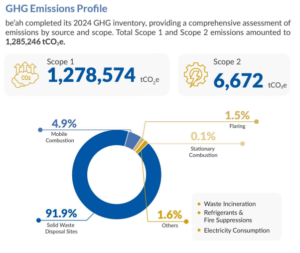
be’ah’s 2024 GHG inventory shows how important this issue is. The company reported 1.285 million tonnes of CO2e in combined Scope 1 and Scope 2 emissions. Scope 1 accounted for 1.279 million tonnes, while Scope 2 emissions stood at 6,672 tonnes.
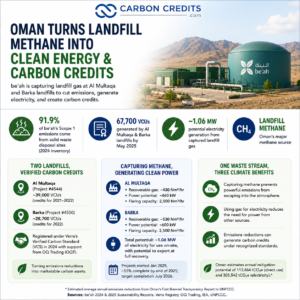
Solid waste disposal sites produced 91.9% of be’ah’s Scope 1 emissions. Mobile combustion, mainly from the municipal waste-collection fleet, contributed another 4.9%, while flaring accounted for 1.5%. That makes landfill methane the clearest target for emissions reductions.
Two Landfills Already Generate Carbon Credits
be’ah’s carbon credit program centers on the Al Multaqa and Barka landfill gas recovery projects. Moosa Al Aamri,
Landfill Operations Engineer at be’ah, remarked:
“The certification of carbon credits for Barka and Al Multaqa landfills marks a significant milestone in Oman’s waste management journey. Through landfill gas capture and greenhouse gas reduction, be’ah has transformed these sites into benchmarks of environmental responsibility and innovation. This achievement aligns with Oman Vision 2040’s goals of sustainability and economic diversification, underscoring the critical role of modern waste management in tackling global climate challenges.”
The projects were registered under Verra’s VCS in 2024 as Project #4544 for Al Multaqa and Project #4550 for Barka. Al Multaqa received credits for 2021 and 2022, while Barka received credits for 2022.
By May 2025, be’ah reported that the two projects had generated a combined 67,700 VCUs. Al Multaqa accounted for about 39,000 credits, while Barka generated about 28,700. One VCU represents one metric tonne of CO2e reduced or removed under the VCS.
The projects were developed with support from OQ Trading (OQT), which helps identify carbon credit opportunities and supports project development, certification, verification, and marketing.
This gives be’ah a potential new source of revenue while supporting its emissions reduction work.
Oman Wants to Turn Methane Into Power, Not Just Flare It
The next stage goes beyond carbon credits. be’ah is developing projects to capture landfill gas and turn it into electricity. The projects began in January 2025 and were scheduled for completion in July 2026. By the end of 2025, overall progress had reached about 55%, according to be’ah’s 2025 Annual Report.
At Al Multaqa, the existing flaring system has a capacity of 2,000 normal cubic meters per hour (Nm³/hr). The site has estimated recoverable landfill gas of about 430 Nm³/hr and potential electricity generation of around 460 kilowatts (kW).
At Barka, the flaring system has a capacity of 2,500 Nm³/hr. Estimated recoverable gas is about 530 Nm³/hr, with potential electricity generation of around 600 kW. Together, the two sites could therefore produce about 1.06 MW of electricity at the estimated recovery levels.
be’ah plans to use the electricity at the landfill sites. At full recovery capacity, it could also potentially export power.
One Waste Stream, Three Climate Benefits
Using landfill gas for electricity can create more than one environmental benefit.
- First, capturing methane prevents some of it from escaping into the atmosphere.
- Second, using the gas for power can reduce the need for electricity from other sources.
- Third, the emissions reductions can support carbon credit generation when projects meet the required standards.
Oman’s own climate reporting also identifies landfill gas recovery as an important mitigation measure.
In its first Biennial Transparency Report submitted to the UN Framework Convention on Climate Change, Oman listed landfill methane recovery for direct use and electricity generation among its waste-sector mitigation initiatives. The report estimated average annual emissions reductions of 113,864 tonnes of CO2e for direct methane use at Al Multaqa and 303,542 tonnes of CO2e for electricity generation at Barka and Al Multaqa.
These are estimated mitigation potentials, not verified carbon credits. That distinction is important. Actual credits depend on project monitoring, verification, methodology requirements, and issuance under the relevant carbon standard.
be’ah Builds a Wider Carbon Management System
The landfill projects form part of a broader carbon management plan. be’ah has created a Carbon Management Framework covering five stages:
- Carbon accounting,
- Identifying emissions-reduction projects,
- Carbon credit registration and verification,
- Issuing and selling or retiring credits, and
- Integrating carbon activity into financial management.
This approach could help be’ah identify more carbon projects across its waste operations. The company has already said it is exploring other opportunities in waste management and waste-to-energy. Its earlier sustainability reporting also identified possible projects involving other landfill cells and the use of captured gas.
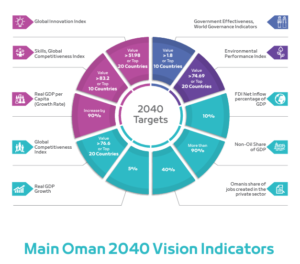
The strategy fits Oman’s wider Vision 2040 goals, which include economic diversification, environmental protection and more sustainable resource use.
More Waste Could Mean More Methane and More Carbon Projects
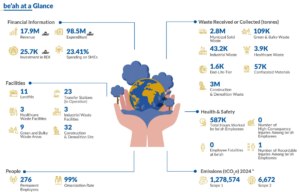
The need for better landfill management is also increasing as waste volumes rise. be’ah reported that Oman received 2.88 million tonnes of municipal solid waste in 2025, up from 2.57 million tonnes in 2024. Industrial waste intake also increased sharply to 43,216 tonnes, from 12,649 tonnes a year earlier.
- be’ah commissioned about 2.2 million tonnes of new engineered landfill capacity during 2025 and is developing another 3.4 million tonnes at Thumrait.
More waste means more landfill gas over time. That makes methane capture increasingly important if Oman wants to limit emissions from its waste sector. It also creates a larger potential base for future carbon projects.
Carbon Credits Could Turn Methane Cuts Into Revenue
The carbon credit opportunity is important because landfill gas projects can turn an emissions problem into a marketable environmental asset. be’ah’s partnership with OQ Trading gives the company support in developing, verifying, and marketing credits.
The projects’ registration under Verra also provides a recognized framework for measuring and issuing credits. But carbon credits are not guaranteed revenue.
Project developers must prove that emissions reductions occurred and meet monitoring and verification requirements. Credit volumes can also vary depending on how much gas a landfill produces and how much the project captures.
That means be’ah’s future carbon revenue will depend on actual gas recovery, project performance, and demand from carbon credit buyers.
Oman Tests a Waste-to-Carbon Model
Oman’s landfill strategy shows how carbon markets can support practical waste management projects. be’ah is targeting methane, which accounts for the vast majority of its measured emissions. It is also moving from simple gas flaring toward electricity generation at two major landfills.
The generated VCUs already provide an early example of how landfill emissions reductions can create tradable carbon assets. The next step will be scaling gas recovery and electricity generation while maintaining strong measurement and verification.
If be’ah can expand these projects across more landfills, Oman could develop a larger waste-based carbon market while reducing methane emissions and producing useful energy.