


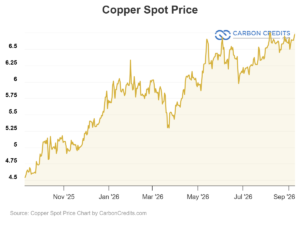
Copper price has hit another record high as supply disruptions, tight inventories and growing demand from artificial intelligence (AI), power grids and electrification push the metal deeper into record territory.
Three-month copper futures on the London Metal Exchange (LME) reached $14,728 per metric ton on September 8. September Comex copper also touched a record $6.739 per pound. LME copper has gained nearly 18% in 2026.
The rally is being driven by both short-term supply concerns and a deeper problem: the world may not be developing enough new copper mines to meet future demand. AI is adding to that pressure, but it is only one part of the story. Power grids, electric vehicles, renewable energy and other infrastructure are also increasing copper demand.
US Tariff Fears Tighten Global Supply
A major factor behind the latest copper price rally is uncertainty over US trade policy. Washington has already imposed tariffs on some copper products and has considered further measures.
A 2025 presidential proclamation directed the Commerce Department to assess whether a 15% tariff on refined copper from January 1, 2027, rising to 30% in 2028, would be warranted. That possibility has changed global trade flows.
Traders have moved more copper into the United States ahead of potential tariffs. This has increased US inventories while reducing available stocks in other major markets.
The result is a split market. Copper may be sitting in US warehouses, but other regions can still face tighter supplies. That can push copper prices higher as buyers compete for metal that is available outside the US.
Global Mine Supply Is Starting to Crack
The physical supply picture is also supporting prices. The International Copper Study Group (ICSG) reported that global copper mine production fell 1.1% in the first half of 2026. Copper concentrate output fell 2.6%. Declines in major producing countries, including Chile, Indonesia and the Democratic Republic of Congo, outweighed gains elsewhere.
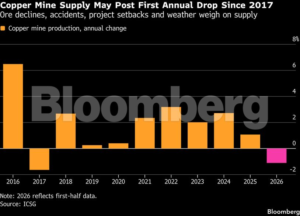
Chile shows the scale of the problem. Codelco, the world’s largest copper producer, reported first-half 2026 production of 564,000 metric tons, down 11% from 634,000 tons a year earlier. Lower output was linked mainly to operational restrictions at its El Teniente mine, along with declines at other operations.
The wider mining industry faces structural limits, too.
The International Energy Agency says average copper ore grades have fallen 40% since 1991, while average capital intensity for expanding existing projects has risen 65% since 2020. New copper projects also take about 17 years on average from discovery to production.
That makes the current supply shortage difficult to fix quickly.
AI Adds Fuel to Copper’s Demand Boom
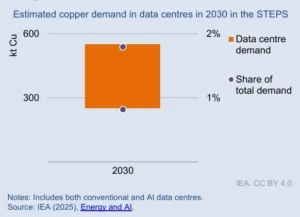
AI has become a new source of copper demand. Data centers use copper in electrical systems, power distribution, cooling equipment, and connections. But their bigger impact comes from the new power infrastructure needed to support them.
The IEA expects global data center electricity use to reach about 945 terawatt-hours (TWh) by 2030, roughly double the 2024 level. Electricity demand from accelerated servers, driven mainly by AI, is expected to grow by around 30% per year in the agency’s base case.
BHP estimates that each additional $200 billion in annual data center investment could require the equivalent of a new 150,000-ton-per-year copper mine to support computer hardware and power infrastructure. It also expects copper demand tied to data centers to rise about sixfold between 2024 and 2050, reaching around 3 million tons per year.
Still, AI is not the only demand driver.
SEE MORE: Why Copper Could Be One of the Biggest Commodity Bets of the AI Era
Electrification Makes Copper a Critical Energy Metal
Copper is essential to the broader energy transition. It is widely used in transmission lines, transformers, electric vehicles, charging networks, renewable power systems, and battery storage.
The IEA estimates that clean energy demand for copper could increase from 7.7 million tons in 2024 to 10.9 million tons in 2030 and 12.2 million tons in 2040 under its Stated Policies Scenario. Total copper demand could reach 34.1 million tons by 2040.
That creates a direct link between copper markets and decarbonization.
Copper is not a carbon credit or a carbon removal asset. However, it is a critical material for technologies that can reduce emissions. Grid expansion, renewable power and vehicle electrification all depend on reliable copper supply.
If copper shortages delay those projects, they could also slow the pace of emissions reductions.
The Supply Gap Could Get Much Larger
The biggest concern is not only today’s shortage but the potential gap later this decade and beyond. The IEA’s Global Critical Minerals Outlook 2026 projects a 25% copper supply deficit by 2035 based on the current pipeline of announced projects.
S&P Global sees an even larger risk. Its 2026 study estimates global copper demand will rise from about 28 million tons in 2025 to 42 million tons in 2040, a 50% increase. Without enough new supply, the market could face a potential 10 million-ton annual shortfall by 2040.
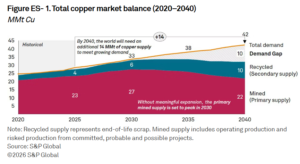
The drivers go well beyond AI. S&P points to traditional economic growth, the energy transition, data centers, and defense infrastructure as major sources of future demand. That makes copper one of the most important physical constraints for the global energy and digital buildout.
Recycling Can Help, But Not Fast Enough
Recycling can help, but it cannot solve the problem by itself. The IEA says available copper scrap could rise from about 16 million tons today to 19 million tons in 2030 and 27 million tons by 2050 under its Accelerated Policy Scenario.
Copper is highly recyclable, but much of the metal installed today remains in long-lived products and infrastructure. That limits how much scrap can return to the market in the near term.
New mines will therefore remain necessary as electricity networks, data centers and clean energy infrastructure expand. At the same time, mining companies face declining ore grades, higher development costs and long permitting timelines.
Record Prices Could Finally Unlock New Mines
Record prices should improve the economics of new copper projects and encourage more recycling. However, high prices alone cannot solve a supply problem that has been building for years.

S&P Global estimates that 2025 copper prices were high enough to make only about 60% of identified new projects potentially profitable. That highlights the challenge. Even when copper prices rise sharply, some deposits may still be too expensive or difficult to develop.
The market therefore needs both higher investment and faster project development.
Copper’s Rally Has More Than AI Behind It
Copper’s latest record is partly linked to US tariff fears and changing inventory flows. Yet, the underlying story is much broader.
Mine production fell in the first half of 2026. Major producers are facing operational problems. At the same time, AI infrastructure, grid investment, electric vehicles and renewable energy are creating new demand.
The IEA expects a major supply deficit by 2035, while S&P Global sees the potential for a 10 million-ton annual shortfall by 2040 without significant new investment. That does not mean copper prices can only rise. High prices can weaken demand, encourage recycling and accelerate new investment.
Yet, the structural trend is clear: the global economy is becoming more dependent on copper at the same time that new supply is becoming harder and slower to develop.
For the energy transition, that makes copper more than an industrial commodity. It is becoming a critical material that could help determine how quickly the world can build cleaner power systems and the infrastructure needed to reduce emissions.