

FedEx is expanding its sustainable aviation fuel (SAF) procurement as the air-cargo company works to reduce emissions from the part of its business that produces the largest share of its direct carbon footprint.
The company announced on September 15 that new agreements are projected to secure more than 20 million gallons of neat SAF through 2027. The agreements cover five U.S. airports:
- Newark Liberty International Airport
- Oakland International Airport
- Miami International Airport
- John F. Kennedy International Airport
- Dallas-Fort Worth International Airport
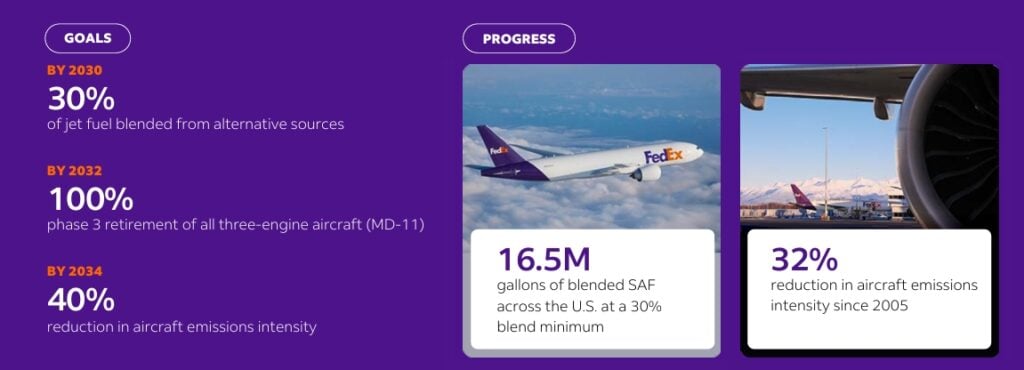
Depending on the airport, the fuel will be supplied at blend ratios ranging from 30% to 50%. FedEx said the agreements build on about 5 million gallons of neat SAF secured in 2025, which supported the deployment of 16.5 million gallons of blended SAF across five U.S. airports.
FedEx’s 2040 Climate Target
The expansion comes as FedEx works toward its goal of carbon-neutral operations by 2040. The target covers Scope 1 and Scope 2 emissions from its operations as well as Scope 3 emissions associated with contracted transportation.
It also includes SAF, aircraft modernization, and operational efficiency as part of its wider climate strategy.
Karen Blanks Ellis, chief sustainability officer and vice president of Environmental Affairs at FedEx, said:
“SAF is one of the most impactful decarbonization solutions available to aviation today and an important part of our approach to reducing emissions. For the market to grow, supply needs to be reliable, affordable, and sustainable. Expanding our procurement allows us to employ more SAF in our network while bolstering the demand for greater production and scale.”
Aviation Drives FedEx’s Emissions
FedEx reported 13.93 million metric tons of CO2e in Scope 1 emissions for FY2025. These direct emissions come mainly from aircraft, vehicles, and facilities.
The company reported another 952,744 metric tons of Scope 2 emissions, primarily from purchased electricity. Its reported Scope 3 emissions totaled 14.88 million metric tons of CO2e.
- Together, the three categories totaled 29.76 million metric tons of reported emissions in FY2025. FedEx notes that its Scope 3 inventory continues to expand, so the figure does not represent every possible Scope 3 category.
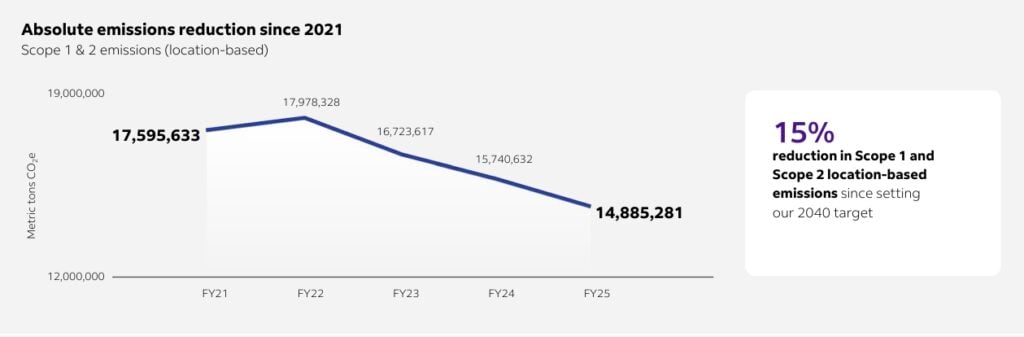
Aviation remains the biggest contributor to direct emissions. Owned aircraft accounted for about 79% of FedEx’s Scope 1 footprint, while aviation fuel use generated roughly 11 million metric tons of CO2e during the year.
The company also reports emissions from conventional air pollutants. In 2025, its operations produced about 71,432 metric tons of nitrogen oxides (NOx), 10,773 metric tons of sulfur oxides (SOx), and 640 metric tons of particulate matter (PM10). These pollutants are separate from FedEx’s greenhouse-gas emissions inventory.
Fleet Modernization Cuts Fuel Use
FedEx is not relying on SAF alone to reduce aviation emissions. The company is replacing older aircraft with newer, more fuel-efficient models and optimizing fleet operations. It operates nearly 700 aircraft and is retiring less-efficient three-engine aircraft. The company plans to complete that retirement by 2032.
Aircraft modernization avoided approximately 1.15 million metric tons of CO2e in FY2025, according to FedEx’s 2026 Corporate Responsibility Report. The company also saved more than 120 million gallons of jet fuel through aircraft modernization and related efficiency measures.
Those savings have also reduced operating costs. FedEx estimates that its aircraft modernization program saved about $284 million in fuel costs during FY2025.
Its Fuel Sense program provides another source of efficiency. The program uses operational improvements, flight planning, and technology to reduce fuel consumption across the air network.
To sum up, FedEx has reduced aircraft emissions intensity by 32% from its 2005 baseline and now targets a 40% reduction by 2034.
SAF Takes a Larger Role
The latest agreements increase the scale of SAF in FedEx’s U.S. network while addressing one of the industry’s biggest challenges: supply.
As mentioned before, the new contracts will secure more than 20 million gallons of neat SAF through 2027. Because the fuel will be blended before use, more finished blended fuel will enter the network.
FedEx has set a target of sourcing 30% of its jet fuel as blended fuel from alternative sources by 2030.

The company has already expanded SAF use at several major hubs. Its 2025 agreements supported SAF deployment at airports including Los Angeles, Chicago O’Hare, Miami, Dallas Fort Worth, and New York-JFK. FedEx also secured more than 3 million gallons of blended SAF from Neste for Los Angeles.
The company says SAF supply needs to become more reliable, affordable, and sustainable for the market to scale. Its latest agreements increase demand while allowing FedEx to build SAF into regular network operations rather than treating it only as a pilot project.
For FedEx, the latest SAF agreements add another piece to a broader effort to decarbonize a logistics network that depends heavily on aviation. New aircraft can reduce fuel consumption, operational improvements can lower fuel demand, and SAF can replace part of the fossil jet fuel used across the network.
The challenge is scaling all three at the same time. FedEx’s latest agreements show that SAF is moving from limited deployments toward a more significant role in the company’s long-term aviation emissions strategy.
Now let’s look inside the SAF market in the content below:
In the U.S. SAF Market Is Growing, But Supply Still Trails Demand
FedEx’s latest agreements come as the sustainable aviation fuel market expands in the U.S. and globally, although production remains a small fraction of aviation fuel demand.
DOE data revealed that U.S. production has increased sharply, but actual output remains well below that target. Federal agencies reported that domestic SAF production reached 30 million gallons in the first three quarters of 2024, up from 5 million gallons in 2021.
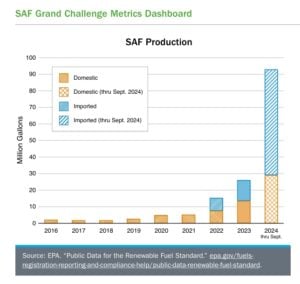
The government is targeting 3 billion gallons of domestic SAF production a year by 2030 and 35 billion gallons by 2050. The 2030 target would equal about 10% of projected U.S. jet-fuel demand.
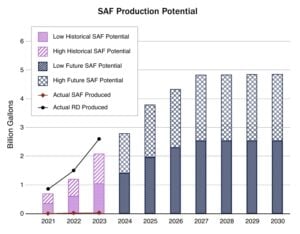
More recent EIA data also shows the U.S. is becoming an important supplier to international markets. In the second half of 2025, the U.S. exported nearly 50,000 barrels per day of renewable diesel and other biofuels, a category that includes SAF. Those exports represented about 20% of combined production in the category, with Canada and Europe taking most of the volumes.
Global SAF Supply Remains Small
Globally, SAF production is growing but has not kept pace with the industry’s ambitions.
The International Air Transport Association (IATA) estimates that global SAF production reached about 1.9 million metric tons in 2025, roughly double 2024 production. That still represented only about 0.6% of total jet-fuel consumption. IATA expects production to rise to approximately 2.4 million metric tons in 2026, but that would cover only about 0.8% of aviation fuel demand.
- The gap between production and potential demand remains significant. IATA estimates that airlines will spend about $4.3 billion on SAF in 2026, even though the fuel will supply less than 1% of global aviation fuel needs.
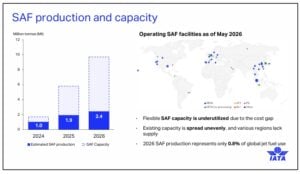
For FedEx, the latest commitment to secure more than 20 million gallons of neat SAF through 2027 fits into this broader market expansion. The company is effectively locking in a portion of future supply while SAF production capacity continues to scale.
The U.S. has the production targets and project pipeline to become a major SAF market, but the gap between announced capacity and actual production remains important. Globally, the same issue is even more pronounced: SAF output is growing rapidly from a small base, while aviation fuel demand remains measured in hundreds of millions of tonnes.