

Tesla (NASDAQ: TSLA) delivered more vehicles than Wall Street expected in the third quarter of 2026, giving investors a reason to turn more positive on the electric vehicle maker’s near-term outlook.
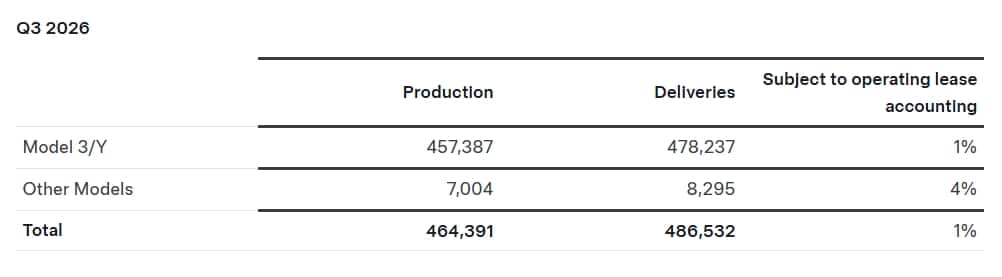
Tesla delivered 486,532 vehicles in Q3, beating the company-compiled analyst consensus of 461,974. Deliveries also rose 1.3% from 480,126 vehicles in Q2. However, they remained 2.1% below the 497,099 vehicles delivered in Q3 2025.
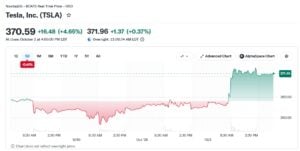
The stronger-than-expected result helped Tesla stock rebound. Shares closed at $370.59 on October 2, up 4.7% in the session. Reuters reported that the stock gained more than 5% earlier in trading after the delivery figures were released.
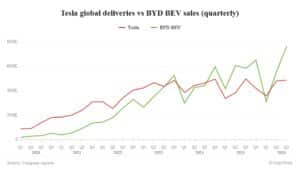
Still, Tesla faces a growing challenge from Chinese EV giant BYD. BYD’s battery-electric vehicle sales continued to pull further ahead of Tesla during the quarter.
Tesla Q3 Deliveries Beat Estimates
Tesla’s Q3 delivery result came in well above the latest company-compiled consensus.
Analysts surveyed by Tesla had expected 461,974 deliveries, with a median estimate of 463,406. Tesla ultimately delivered 486,532 vehicles, exceeding the consensus by about 24,600 vehicles.
The Model 3 and Model Y remained the company’s main volume drivers. Tesla delivered 478,237 Model 3/Y vehicles during the quarter, compared with just 8,295 deliveries across its other models.
Production, meanwhile, reached 464,391 vehicles.
Tesla also deployed 13.7 gigawatt-hours (GWh) of energy storage products during Q3. That figure was below the 15.9 GWh analyst consensus, highlighting that Tesla’s energy business remains an important part of the company’s broader growth story.
The delivery beat is significant because analysts had entered the quarter expecting a decline. FactSet estimates cited by MarketWatch had pointed to roughly 461,000 vehicles, or a 7% year-over-year decline.
Instead, Tesla limited the decline to about 2%.
Tesla vs. BYD: The EV Gap Is Growing
Despite Tesla’s better-than-expected quarter, its competition with BYD is becoming more intense.
BYD sold 762,478 battery-electric passenger vehicles during Q3, according to data compiled by CnEVPost. That was up nearly 31% from a year earlier and 37% from Q2.
As a result, BYD sold about 275,946 more battery-electric vehicles than Tesla during the quarter.
The comparison needs some context. Tesla reports deliveries of its vehicles, while BYD sells both battery-electric vehicles and plug-in hybrids under its broader new-energy vehicle category.
BYD sold 1.32 million new-energy vehicles in Q3, including both types. Total NEV sales rose 18.8% year over year.
BYD also recorded 463,561 new-energy vehicle sales in September alone, its strongest monthly result of 2026. Overseas passenger vehicle and pickup shipments jumped 153.9% year over year to 179,877 in September, Reuters reported.
This international expansion could become increasingly important for the global EV market. It also shows how competition is moving beyond traditional EV strongholds as Chinese manufacturers expand into overseas markets.
Sustainability Remains a Key Part of Tesla’s Story
Tesla’s delivery numbers also matter from a sustainability perspective because more EV sales can accelerate the shift away from gasoline-powered vehicles.
The International Energy Agency said global electric car sales exceeded 20 million in 2025, with EVs accounting for one in four new cars sold worldwide. China remained the largest EV market, accounting for six out of 10 electric cars sold globally.
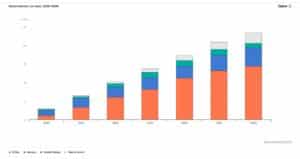
- Tesla says its products helped avoid 37 million metric tons of CO₂e emissions in its 2025 Impact Report. The company’s sustainability strategy also extends beyond vehicles to battery storage, solar energy, and its supply chain.
The company also highlighted the emissions benefit of its electric vehicles over their operating lives. It estimates that one Tesla vehicle can avoid about 32 metric tons of CO₂ emissions over its lifetime compared with a comparable gasoline-powered vehicle. However, the actual benefit varies by factors such as electricity generation, vehicle efficiency, and driving patterns.
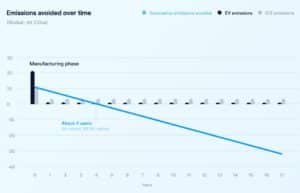
However, EV growth does not eliminate the environmental impact of manufacturing. Batteries require minerals such as lithium, nickel, graphite, and other materials, while vehicle production and electricity generation also create emissions.
That makes the growth of energy storage particularly relevant. Tesla deployed 13.7 GWh of storage products in Q3, while the company-compiled analyst consensus had expected 15.9 GWh.
Large-scale batteries can help integrate renewable power into electricity systems by storing electricity when supply is high and releasing it when demand rises.
Can Tesla’s Q3 Delivery Beat Support Its Stock?
Tesla stock entered October under pressure after a volatile year. Shares closed at $370.59 on October 2, although the latest delivery beat provided some relief.
Investors are now looking beyond vehicle sales. Tesla’s valuation increasingly depends on its plans for robotaxis, AI, robotics and energy storage, while its automotive business remains critical to funding those investments.
Tesla will report its full Q3 financial results on October 21. The earnings report should give investors a clearer view of vehicle margins, revenue, cash flow, and spending on its next-generation businesses.
For now, the delivery beat strengthens Tesla’s near-term position. However, BYD’s growing lead in battery-electric vehicle sales highlights the competitive pressure facing Tesla as global EV adoption accelerates.
The longer-term sustainability opportunity remains significant, but Tesla must balance EV growth with improving manufacturing efficiency, battery supply chains and the emissions impact of its operations.