

Japan’s Sumitomo Metal Mining expects the global nickel market to remain in surplus in 2027, even as demand from electric vehicles, stainless steel, and AI data centers continues to grow.
Reuters originally reported that the company forecasts a 34,000-metric-ton global nickel surplus in 2027, narrowing from an estimated 38,000 tons this year. The outlook highlights Indonesia’s continued influence on the global nickel market, with the country accounting for more than 60% of global production.
The forecast comes as nickel prices remain well below earlier-year peaks. At the same time, Indonesia is adjusting mining quotas and considering tighter controls on new processing capacity as it tries to prevent another prolonged period of oversupply.
Nickel Supply Set to Recover in 2027
Sumitomo expects:
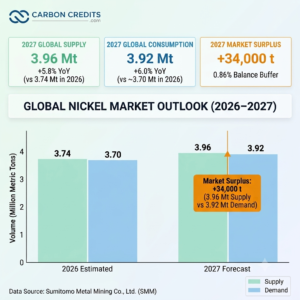
- Global nickel supply to increase 5.8% to 3.96 million tons in 2027, compared with 3.74 million tons estimated for 2026.
- Demand is also expected to grow strongly. Global nickel consumption will rise 6% to 3.92 million tons next year.
The difference leaves the market with a relatively small surplus of 34,000 tons.
Indonesia will remain the biggest factor behind the supply outlook. Sumitomo expects Indonesian nickel pig iron (NPI) production to rebound 11.9% to 1.88 million tons in 2027.
NPI is a lower-grade form of nickel mainly used to produce stainless steel. Sumitomo expects production to decline 2.3% in 2026 after rising 12.4% in 2025, following Indonesia’s decision to reduce mining quotas.
Lower sulfur and sulfuric acid prices could also reduce production costs and support higher output of nickel intermediates such as mixed hydroxide precipitate.
Indonesia Holds the Key to Nickel Prices
Indonesia has spent much of 2026 trying to balance its enormous nickel processing industry with a tighter supply of domestic ore.
The government initially set the 2026 nickel ore production quota at around 260 million to 270 million metric tons, well below the 379 million tons approved in 2025. The lower quota briefly pushed LME nickel prices toward $20,000 per ton in May.
But the rally did not last.
Reuters reported in September that nickel had fallen back to around $16,500 per ton as the market became less convinced that Indonesia could maintain tight supply. Higher quota allocations later in the year and rising imports from the Philippines added to that pressure.
- The latest LME data show three-month nickel closing at about $16,481 per ton on October 7, with exchange stocks at roughly 278,628 tons.
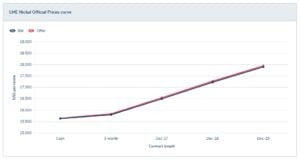
On October 7, three-month nickel was also reported at $15,840 per ton in Indonesian market data, underscoring the volatility across the market.
- CHECK LIVE: Nickel Prices
Indonesian Nickel Ore Prices Ease
The pressure is also visible in Indonesia’s domestic nickel ore market.
Shanghai Metals Market reported that Indonesia’s first-half October nickel benchmark price, or HMA, fell to $16,322.67 per ton, down 2.25% from $16,698 in the second half of September. Nickel ore prices also weakened as additional mining quotas entered the market.
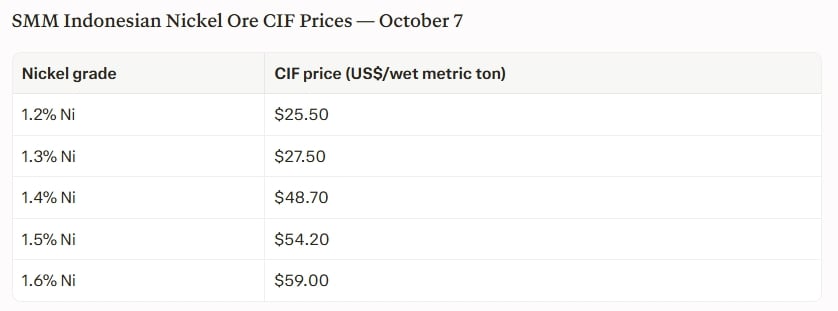
These prices matter because Indonesia’s large processing industry requires huge volumes of ore. Indonesian industry group FINI estimates the country’s 2026 processing capacity at about 2.7 million tons across RKEF and HPAL facilities, requiring roughly 340 million to 350 million wet metric tons of ore.
That creates a supply dilemma. Indonesia has restricted mining to support prices, but its large smelter base needs enough ore to keep operating.
Indonesia May Restrict New Nickel Processing Plants
Jakarta is now looking beyond mining quotas.
Indonesia is considering a moratorium on new processing facilities that produce partly processed nickel products, according to a Reuters report on October 7.
Coordinating Minister for Downstreaming and Energy Transition Bahlil Lahadalia said the government was considering limiting new plants producing semi-finished nickel because oversupply has pushed down prices.
Indonesia wants to encourage investment in higher-value finished products instead of adding more capacity for nickel pig iron, ferronickel and other semi-processed materials.
The policy could become increasingly important if Indonesia continues adding processing capacity faster than global demand grows.
Nickel Demand Gets a Boost From EVs and AI
The supply outlook remains bearish, but demand is not standing still.
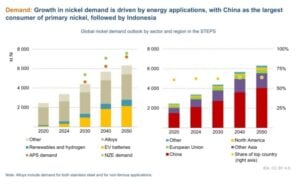
Sumitomo expects global nickel demand to rise 6% next year, helped by stable stainless steel consumption and increasing demand for specialty steel used in AI data centers.
- Battery demand should also improve. Sumitomo expects global nickel demand from batteries to rise to 620,000 tons in 2027, up from 560,000 tons in 2026.
- Significantly, earlier Benchmark also forecasted that over 50% of nickel demand growth by 2030 will come from batteries. By the end of the decade, battery nickel demand could hit 1.5 million tonnes annually.
Chinese EV sales remain an important driver of this growth. However, the battery market is changing. Lithium iron phosphate (LFP) batteries do not use nickel, limiting how quickly EV growth translates into higher nickel demand.
Sumitomo also expects continued declines in Chinese cathode production to reduce the surplus of high-purity Class 1 nickel. At the same time, a recovery in Indonesian NPI production could ease the shortage of Class 2 nickel, creating different supply conditions across nickel products.
Nickel Market Faces a Delicate 2027 Balance
The latest outlook points to a nickel market that is moving closer to balance but has not reached it yet.
Indonesia’s production decisions will remain the biggest variable. Lower quotas can tighten ore availability and support prices, while higher allocations can quickly bring additional supply back into the market.
At the same time, battery demand is growing, but LFP technology limits nickel intensity in EVs. Stainless steel remains the largest demand driver, while AI data center construction is creating a newer source of specialty-steel demand.
For investors and mining companies, the key question is whether Indonesia can restrain supply faster than global demand expands.
However, as of now, Sumitomo’s forecast suggests the answer is no. The 34,000-ton surplus expected in 2027 is much smaller than previous oversupply estimates, but it still leaves the nickel market vulnerable to renewed downward price pressure if Indonesian production rebounds faster than expected.