


Google and Constellation Energy have signed a 20-year power purchase agreement (PPA) to add 890 megawatts (MW) of new nuclear capacity to the PJM electricity grid.
The agreement will support more than $4.3 billion of investment by Constellation to upgrade 11 existing nuclear units across Illinois, Pennsylvania, and New Jersey. The upgrades are expected to increase the plants’ output without building new reactors from scratch.
The first upgraded capacity is expected to reach the grid in 2028, with the full 890 MW targeted by the end of 2032. Constellation says the additional power is roughly equivalent to adding a large new nuclear reactor to the PJM system.
Amanda Peterson Corio, global head of energy and power at Google, said:
“We’re committed to meeting our growth responsibly by actively investing in clean, reliable power that brings new capacity to our nation’s grids. Our agreement with Constellation to fund nuclear reactor uprates will strengthen the PJM grid, which serves 67 million people, all while protecting energy affordability and supporting local union jobs.”
Google Is the Anchor Customer
Google’s role in the deal is important to understand. The tech giant is not building or operating the nuclear plants. Instead, it has committed to buying the additional electricity under the 20-year PPA.
That long-term commitment gives Constellation greater revenue certainty to invest in upgrades at its existing reactors. In other words, Google is acting as the anchor customer that helps make the nuclear uprates commercially viable.
Constellation will fund and carry out the physical upgrades, including improvements to turbines, steam generators, and digital control systems. These changes can increase the amount of electricity produced by an existing reactor without requiring a completely new plant.
The agreement is expected to:
- Add 890 MW of new, firm nuclear capacity to PJM.
- Support more than $4.3 billion of investment by Constellation.
- Sustain about 4,400 existing jobs.
- Create roughly 7,200 construction jobs during the upgrade program.
- Bring the first additional capacity online in 2028.
Google and Constellation also signed a separate 15-year agreement covering another 2,700 MW from Constellation’s PJM generation fleet.
Importantly, this second 2,700 MW should not be described as new nuclear capacity. It covers additional electricity from Constellation’s existing PJM generation assets and provides longer-term revenue certainty for those facilities. Combined, the two agreements cover 3,590 MW of electricity supply.
The Importance of Existing Nuclear Plants
The 890 MW expansion is based on nuclear uprates rather than new reactor construction.
A nuclear uprate involves upgrading an existing reactor so it can produce more electricity. This can be faster than developing a new nuclear plant because the facility already has its site, grid connection, and operating infrastructure.
The approach is becoming more important as the U.S. looks for additional firm electricity to meet growing demand.
The U.S. had 94 operating commercial nuclear reactors at 54 nuclear power plants as of March 2026, with a combined net summer generating capacity of 98,441 MW, according to the Energy Information Administration (EIA). The average nuclear capacity factor was 91% in 2025, showing how intensively the existing fleet is used.
EIA also expects U.S. electricity demand to reach new records in 2026 and 2027. Its latest outlook puts total U.S. electricity consumption at 4,288 billion kilowatt-hours in 2026 and 4,356 billion kWh in 2027. Nuclear power is expected to account for about 18% of generation in both years.
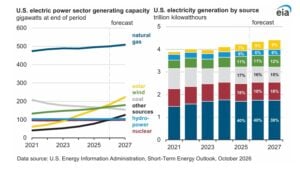
That makes additional output from existing nuclear plants an important option for meeting demand without waiting for entirely new reactors.
PJM Faces Rapid Load Growth
The Google-Constellation deal is particularly significant for PJM.
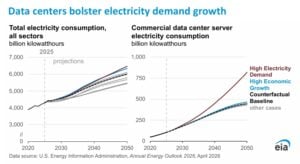
The PJM Interconnection operates the largest U.S. power market, covering 13 states and serving about 67 million people. The region is facing rapidly rising electricity demand from large data centers and other industrial customers.
PJM has proposed a “Bring Your Own Power” approach for large new electricity users. The idea is that companies adding major loads should also help bring additional generation onto the system.
The Google-Constellation agreement provides a practical example of that model.
Instead of simply connecting new data centers to the existing grid and increasing demand, Google is supporting additional generation capacity through a long-term purchase commitment.
This could help address one of the biggest challenges facing the U.S. power sector: adding electricity supply quickly enough to keep up with new demand. i.e., primarily from data centers.
Google Links Nuclear Power to Its Clean Energy Goals
The nuclear agreement also fits Google’s broader clean-energy strategy.
Google aims to operate its data centers and campuses on carbon-free energy 24 hours a day, every day, by 2030. The company has already matched 100% of its annual electricity consumption with renewable energy purchases since 2017, but its 24/7 goal is more demanding because electricity must be carbon-free at the time and location it is consumed.
The rapid expansion of AI has made that target more difficult.
Google’s 2026 Environmental Report said the company signed agreements for more than 12 GW of net-new clean energy in 2025. Between 2010 and 2025, it signed more than 240 agreements covering nearly 35 GW of new clean-energy capacity. At the same time, Google said its AI infrastructure is growing faster than the grid is decarbonizing.
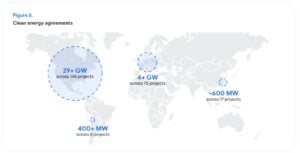
Nuclear power gives Google access to carbon-free electricity that can operate around the clock, complementing variable renewable sources such as wind and solar.
The company said its nuclear agreements, including this latest deal, have now enabled more than 1.5 GW of new nuclear capacity for the U.S. power system through uprates and reactor restarts.
Ratepayer Protection Adds Another Layer
The agreement also aligns with the White House’s Ratepayer Protection Pledge, launched in March 2026.
Google was among seven major technology companies that initially signed the pledge. Under it, participating companies committed to build, bring, or buy the power needed for their data centers and pay for new power-delivery infrastructure required to serve them.
The pledge also calls on companies to pay for power and infrastructure brought online for their facilities even when they do not use all of that electricity.
The broader goal is to prevent the cost of rapidly growing data-center electricity demand from being shifted to residential and other existing electricity customers.
As of October 2026, the White House says the pledge has expanded to more than 300 organizations, covering about 80% of the electricity delivered to U.S. homes and businesses.
The Google-Constellation agreement fits this model because the company is helping support new power supply rather than relying only on existing grid capacity.
AI, Nuclear Power and the Grid
The deal points to a changing relationship between technology companies and the power sector.
For Constellation, it provides a long-term customer and supports billions of dollars in nuclear upgrades. For Google, it secures additional firm, carbon-free electricity while supporting its 24/7 clean-energy ambitions.
More broadly, the deal shows how large electricity users could play a bigger role in financing new power supply as the U.S. grid enters a period of rapid load growth.
Rather than waiting only for new power plants to be built, companies can help unlock additional capacity from existing infrastructure.
And lastly, for PJM, that could mean more reliable electricity. For Google, it means more power for AI and data centers. And for the U.S. nuclear industry, it creates another commercial pathway to expand generation from an existing fleet that already provides nearly one-fifth of the country’s electricity.