


Xpansiv has surpassed 1.5 million tonnes in trading volume for carbon credits eligible under the first compliance phase of the Carbon Offsetting and Reduction Scheme for International Aviation (CORSIA). The milestone highlights growing demand from airlines as the aviation industry prepares to meet its carbon offsetting obligations.
The trading activity took place across Xpansiv’s CBL spot exchange and the International Air Transport Association’s (IATA) Aviation Carbon Exchange (ACE). Aviation companies purchased more than 50% of the eligible emissions units (EEUs) traded across the two platforms. More than 40 of these companies have registered to participate in IATA ACE’s Phase 1 procurement events.
The first CORSIA compliance phase covers 2024 through 2026. Airlines must purchase and cancel eligible carbon credits to cover their assigned emissions obligations under the scheme.
John Melby, CEO, Xpansiv, said:
“We are seeing broader and more active participation from the aviation sector. Xpansiv and IATA have worked together for years to deliver practical tools and infrastructure for CORSIA market participants. This volume milestone demonstrates the value of our collaboration and of market-based mechanisms to streamline access for the airline community, provide price transparency, and support robust execution and automated settlement to all market participants.”
CORSIA Carbon Credit Trading Gains Momentum
Of the 1.5 million tonnes traded, more than 1 million tonnes came through the CBL GEO CORSIA CP1 contract. This standardized contract allows market participants to trade eligible carbon credits through a centralized order book.
The remaining volume came from project-specific EEUs, which have recorded more than 500,000 tonnes in trading activity across CBL and IATA ACE.
Airlines and other participants can choose between standardized contracts and credits from individual eligible projects. This flexibility allows buyers to compare available supply and manage their carbon credit portfolios more efficiently.
The CBL GEO CORSIA CP1 contract also supports transparent price discovery. By bringing eligible credits into one trading system, it makes it easier for airlines, brokers, intermediaries, and other market participants to access the market.
How the IATA Aviation Carbon Exchange Supports Airlines
Xpansiv and IATA launched the Aviation Carbon Exchange in 2020 to create a centralized marketplace for aviation-related carbon credits.
ACE allows airlines, airports, aircraft manufacturers, and other market participants to buy and sell CORSIA-eligible emissions units. The platform also supports voluntary carbon offsetting.
Its settlement system connects with IATA’s Settlement Systems and Clearing House. This helps airlines complete transactions and settle payments through an established financial infrastructure.
The exchange offers several services to CORSIA participants:
- Centralized trading: Buyers can access eligible carbon credits through a common marketplace.
- Project-specific trading: Participants can select credits from individual projects.
- Standardized contracts: The CBL GEO CORSIA CP1 contract simplifies transactions through a common trading instrument.
- Flexible settlement: Integrated settlement systems help airlines manage payments and transactions.
- Portfolio management: Airlines can manage eligible credits across multiple registries without opening primary accounts at each registry.
These services could become increasingly important as airlines move closer to their compliance deadlines.
Aviation Emissions Put More Pressure on Carbon Markets
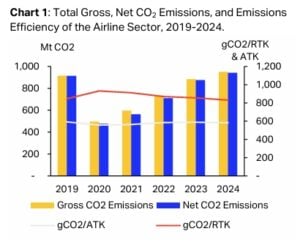
The growth in CORSIA trading comes as global air travel continues to expand. Aviation remains a major source of transport-related carbon emissions, and reducing its climate impact remains a challenge.
According to the Air Transport Action Group (ATAG), worldwide flights generated approximately 942 million tonnes of CO2 in 2024. This represented around 2% of global human-caused CO2 emissions.
Airlines are working to reduce their environmental footprint through more fuel-efficient aircraft, improved flight operations, sustainable aviation fuel (SAF), and carbon offsetting.
However, these measures will take time to scale. Carbon credits provide another tool for airlines to address emissions covered by CORSIA while the industry works toward longer-term decarbonization.
CORSIA Creates a Large Market for Eligible Carbon Credits
ICAO introduced CORSIA to address the growth in international aviation emissions. Under the scheme, participating airlines must offset covered emissions above the applicable baseline by purchasing and cancelling eligible carbon credits.
For the first phase, which runs from 2024 to 2026, the baseline is set at 85% of 2019 international aviation emissions covered by the scheme.
Not every carbon credit qualifies. The International Civil Aviation Organization (ICAO) approves eligible emissions unit programmes based on specific environmental and social integrity criteria.
As of the latest ICAO eligibility updates in April 2026, eight programmes can supply eligible units for the first compliance phase. These include:
- American Carbon Registry (ACR)
- Architecture for REDD+ Transactions (ART)
- Climate Action Reserve (CAR)
- Global Carbon Council (GCC)
- Gold Standard
- Isometric
- Premium Thailand Voluntary Emission Reduction Program
- Verified Carbon Standard (VCS)
Credits must also meet applicable authorization requirements to prevent countries and airlines from claiming the same emissions reductions.
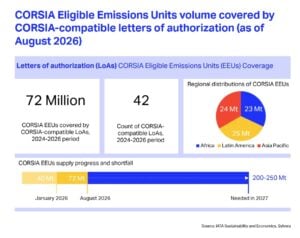
The market could see substantial demand as the first compliance period approaches its final stage. IATA estimates that airlines will need to purchase more than 200 million CORSIA-eligible emissions units by January 2028 to meet their obligations for the 2024–2026 period.
Carbon Credit Supply Remains a Key Challenge
Despite growing trading activity, the availability of eligible credits remains a concern.
IATA’s September 2026 analysis estimated that approximately 72 million emissions units had the required CORSIA-compatible Letters of Authorization (LoAs) as of August 2026. This left a potential supply gap of around 150 million units against expected demand of 200–250 million credits.
Host countries play an important role in closing this gap. They must authorize eligible emissions reductions for CORSIA use and apply corresponding adjustments to prevent double counting under the Paris Agreement.
This creates opportunities for carbon project developers and credit suppliers that can meet ICAO’s requirements and secure the necessary country authorizations.
For airlines, access to reliable supply and transparent pricing will become increasingly important as they prepare to meet their obligations.
What Xpansiv’s Trading Milestone Means for the Aviation Carbon Market
Xpansiv’s 1.5-million-tonne milestone shows that dedicated trading infrastructure is beginning to support a more active CORSIA carbon market.
The next challenge will be connecting airlines with enough eligible credits before the first compliance cycle closes. As demand grows, standardized contracts, project-level trading, and reliable settlement systems could help improve market access.
With CORSIA entering the final year of its first compliance phase in 2026, airlines, carbon project developers, and market intermediaries will need to accelerate procurement and supply arrangements.
The development of a transparent and liquid market will be important not only for meeting current obligations but also for supporting CORSIA’s expansion into its second phase, which begins in 2027.