

Masdar has raised US$600 million through its first blue bond to support eligible marine renewable energy projects, including offshore wind. The five-year bond is the fourth issuance under its US$6 billion Global Medium Term Note Programme. It also expands the company’s use of sustainable finance to support its global clean energy plans.
As per the press release, S&P Global Ratings and Fitch Ratings have both assigned the bond an AA- rating. According to the company, this makes it the highest-rated public blue bond issued by a corporate globally to date.
Issued on the London Stock Exchange’s International Securities Market, the bond carries a 5.875% US dollar coupon. The company then swapped the proceeds into euros at a yield of 4.374%, matching the funding with its European investment needs.
Investor demand remained strong despite difficult market conditions. The orderbook reached US$1.5 billion, making the final US$600 million issue 2.5 times oversubscribed. This means investors placed orders worth 2.5 times the amount offered.
Mazin Khan, Chief Financial Officer, Masdar, said:
“For two decades, Masdar has been a driving force in the development, deployment and commercialization of renewable energy solutions across the world. Our first blue bond issuance under our updated Green Finance Framework provides yet more opportunities for investors to join us in building the clean energy system of the future. This benchmark offering will ensure capital can be delivered where it will have the most impact, supporting the development of a more resilient blue and green economy.”
What Are Blue Bonds?
Blue bonds are debt instruments that raise money for projects linked to the protection and sustainable use of oceans and water resources. They work much like green bonds but focus on marine and water-related environmental goals.
Companies and governments can use them to fund ocean conservation, wastewater treatment, sustainable marine infrastructure, and eligible offshore wind projects.
Investors buy these bonds and receive interest payments under agreed terms. The issuer must direct the money toward eligible projects and report how it uses the funds.
However, a blue bond label alone does not guarantee environmental benefits. Clear project rules, regular reporting, and checks on possible harm to marine life help maintain investor trust.
For the renewable energy developer, this financing route creates another way to fund offshore wind and other eligible projects while supporting the sustainable use of marine resources.
Masdar Updated Green Finance Framework Adds Blue Projects
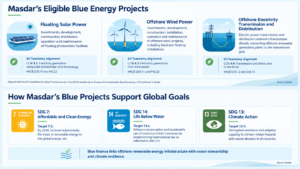
In September 2026, the company updated its Green Finance Framework to include eligible blue projects. The framework sets the rules for selecting projects, allocating funds, and reporting their environmental impact.
Under the updated rules, green financing instruments can fund eligible green and blue projects. Blue financing instruments form a separate category, with all proceeds reserved exclusively for eligible blue projects.
The framework follows the Green Bond Principles of the International Capital Market Association (ICMA). It also considers the International Finance Corporation’s (IFC) blue finance guidelines and the 2023 guide to financing the sustainable blue economy, published by several international organizations.
Eligible Blue Projects
Moody’s Gives Its Highest Sustainability Score
Moody’s assigned the framework an SQS1, or Excellent, Sustainability Quality Score. This is the highest score available under its sustainability assessment system.
The framework also requires environmental checks to identify and reduce potential harm to biodiversity. Where feasible, eligible projects must align with relevant European Union Taxonomy criteria for climate change mitigation.
These safeguards matter for offshore wind developments. While offshore wind generates electricity without burning fossil fuels, construction and operation can affect marine habitats and wildlife. Careful planning and environmental checks can help reduce these risks.
Bond Funding Supports Renewable Energy Growth
The latest issuance brings the total raised through the company’s bond programme to US$3.35 billion since 2023. Before this deal, it had raised US$2.75 billion through the programme.
By the end of 2025, US$2.3 billion had been allocated to 30 renewable energy projects across 10 countries. These projects had a combined gross capacity of more than 16 gigawatts (GW).
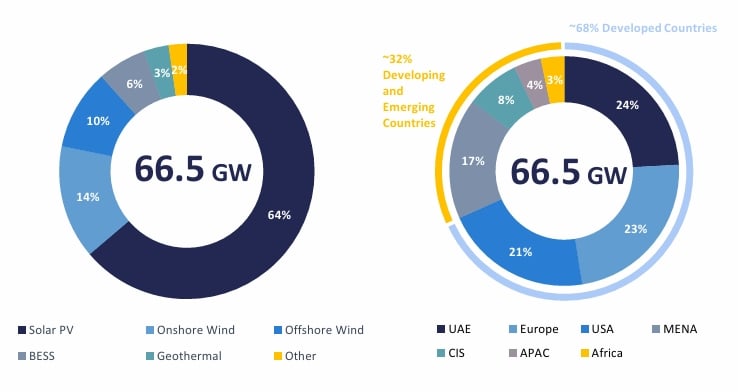
The company now reports more than 65 GW of renewable energy capacity across global markets. Its portfolio includes solar power, onshore and offshore wind, battery storage, and hybrid energy systems.
It aims to increase this capacity to 100 GW by 2030. Reaching that target will require further investment in project development, construction, and supporting infrastructure.
The blue bond adds another source of capital for this expansion. It also links fundraising with specific environmental goals and may attract investors seeking opportunities in sustainable finance.
What Does the Blue Bond Mean for Investors?
The deal shows how sustainable finance is expanding beyond traditional green bonds. Blue bonds give investors another way to support environmental projects, with a focus on oceans and water resources.
Strong demand for the issuance points to investor interest in this type of financing. The AA- ratings from S&P and Fitch also reflect the agencies’ assessment of the issuer’s credit quality. However, credit ratings do not guarantee returns or eliminate investment risks.
The bond’s environmental value will depend on how the company uses the proceeds and how it measures results. Investors will need to review project selection, biodiversity safeguards, and impact reports to assess whether the funded activities meet their stated goals.
As the company works toward its 2030 capacity target, blue financing could help fund eligible offshore wind and other marine-related renewable energy projects. The deal also shows how specialised bonds can link corporate funding plans to measurable environmental objectives.