


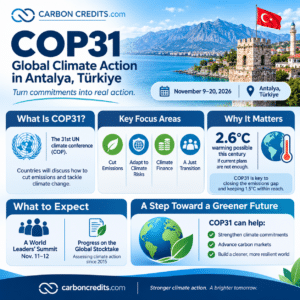
The world’s climate leaders will meet in Antalya, Türkiye, from November 9 to 20, 2026, for COP31. The annual United Nations climate conference brings together governments to negotiate how to limit global warming, cut greenhouse gas emissions, and help countries deal with climate change.
This year’s conference comes at a critical time. Countries have made climate commitments, but global emissions remain too high to keep the world on a path toward limiting warming to 1.5°C. Governments also face growing pressure to provide climate finance and turn their promises into real action.
For carbon markets, COP31 could bring further progress on international carbon trading, climate finance, and the rules that govern carbon credits under the Paris Agreement.
Here is what you need to know about COP31, the main issues on the agenda, and why the outcomes matter for carbon markets and the global energy transition.
What Is COP31?
COP31 stands for the 31st meeting of the Conference of the Parties to the United Nations Framework Convention on Climate Change (UNFCCC). The convention is an international treaty adopted in 1992 that provides the basis for global climate negotiations.
The annual COP meetings bring together almost every country to discuss how to respond to climate change. Governments negotiate agreements, review progress, and decide on further action to reduce emissions and support countries facing climate impacts.
COP31 is also linked to two other formal meetings. These are the Kyoto Protocol parties’ 21st meeting and the Paris Agreement parties’ eighth meeting.
The Paris Agreement, adopted in 2015, aims to keep global warming well below 2°C and pursue efforts to limit it to 1.5°C above pre-industrial levels. Countries submit their climate plans, called Nationally Determined Contributions (NDCs). These plans outline their targets and actions to cut emissions and tackle climate change.
COP meetings help countries review these plans, negotiate common rules, and agree on ways to strengthen global climate action. However, COP decisions do not automatically force every country to adopt the same domestic policies. Countries must implement their commitments through their own laws, regulations, and national plans.
When and Where Is COP31?
COP31 will take place from November 9 to 20, 2026, in Antalya, Türkiye, at the Antalya Expo Center. Türkiye will host the conference, while Australia will lead the formal negotiations. This shared arrangement followed discussions between the two countries over hosting the event.
Türkiye’s Environment, Urbanisation and Climate Change Minister, Murat Kurum, has been nominated as COP31 President. Australia’s Climate Change and Energy Minister, Chris Bowen, will serve as President of Negotiations.
The two roles have different responsibilities. Türkiye will host the conference and lead the presidency’s broader agenda. Australia will steer the formal negotiations between countries.
A World Leaders’ Summit is scheduled for November 11 and 12. It will allow heads of state and government to discuss climate priorities and build political support for the negotiations.
The conference will also bring together scientists, businesses, investors, Indigenous Peoples, youth groups, and civil society organizations. These groups can share research, announce initiatives, and encourage action, although formal decisions are negotiated by governments.
Why Is COP31 Important?
COP31 takes place as the gap between current climate commitments and the action needed to limit warming remains large. The UN Environment Programme’s Emissions Gap Report 2026 estimates that the world could face around 2.6°C of warming this century if countries fully implement their current NDCs. That would be well above the Paris Agreement’s 1.5°C goal.
The report states that global greenhouse gas emissions must drop by 45% by 2035. They need to decrease by 69% by 2040, compared to 2025 levels. This change is crucial to keep warming under 1.5°C.
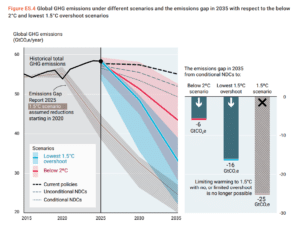
By comparison, full implementation of current NDCs would reduce emissions by only 11% to 15% by 2035, relative to 2025 levels. These estimates show why countries face pressure to strengthen their climate plans and speed up implementation. They also show that meeting existing commitments alone will not be enough to put the world on the report’s lowest-overshoot pathway.
COP31 is expected to focus on turning commitments into practical results. The main issues are:
- Cutting emissions,
- Adapting to climate impacts,
- Financing climate action in developing countries, and
- Supporting a fair transition for workers and communities.
The conference will also continue work on the Global Stocktake, the process used to assess collective progress under the Paris Agreement. The first stocktake concluded at COP28 in 2023. The second process begins with gathering information in 2026 and is expected to continue through 2028.
The findings will help countries assess whether global climate action is on track and what further measures may be needed.
What Are the Main Topics at COP31?
Several issues are expected to shape the negotiations and related climate initiatives.
-
Cutting greenhouse gas emissions
Countries will discuss how to reduce emissions from energy, industry, transport, buildings, and other sectors. This includes expanding clean energy, improving energy efficiency, and reducing reliance on fossil fuels.
Türkiye’s presidency has also highlighted cleaner industry, electrification, circular economy measures, and more resilient cities as priorities for wider climate action.
-
Climate finance
Developing countries need funding to cut emissions, adapt to climate impacts, and strengthen infrastructure. Negotiations will address how this money can be mobilized and delivered, including the roles of public funding, private investment, and international cooperation.
A key challenge is ensuring that financial commitments lead to actual funding for projects and communities.
-
Adaptation and resilience
Countries are already facing the effects of climate change, including extreme heat, floods, droughts, and rising sea levels. COP31 will continue discussions on helping vulnerable countries prepare for these impacts and measure progress on adaptation.
-
A fair energy transition
Governments must consider how to reduce emissions while protecting workers, communities, and economies that depend on carbon-intensive industries. The pace and cost of the transition remain major points of disagreement between countries.
-
International cooperation
Countries will continue discussions on how to work together to meet climate goals. This includes carbon markets, technology sharing, financial support, and other forms of cooperation under the Paris Agreement.
What Could COP31 Mean for Carbon Markets?
Carbon markets allow companies or governments to support emissions reductions or removals through carbon credits. Each credit generally represents one metric tonne of carbon dioxide equivalent reduced or removed, subject to the rules of the program that issues it.
At COP31, talks will focus on carbon markets. There will be key discussions about climate finance and Article 6 of the Paris Agreement. Article 6 provides rules for countries to cooperate in meeting their climate targets, including through the transfer of approved emissions reductions.
There are two main carbon trading routes under Article 6.
Article 6.2: Trading Between Countries
Article 6.2 allows countries to transfer authorized emissions reductions to other countries under bilateral or other cooperative arrangements. For example, one country could support a renewable energy or methane reduction project in another country and use the resulting authorized reductions toward its climate target, subject to the agreed rules.
These transfers require careful accounting. When a country transfers an authorized reduction for another country to use, it generally must make a corresponding adjustment to avoid both countries counting the same reduction toward their climate targets.
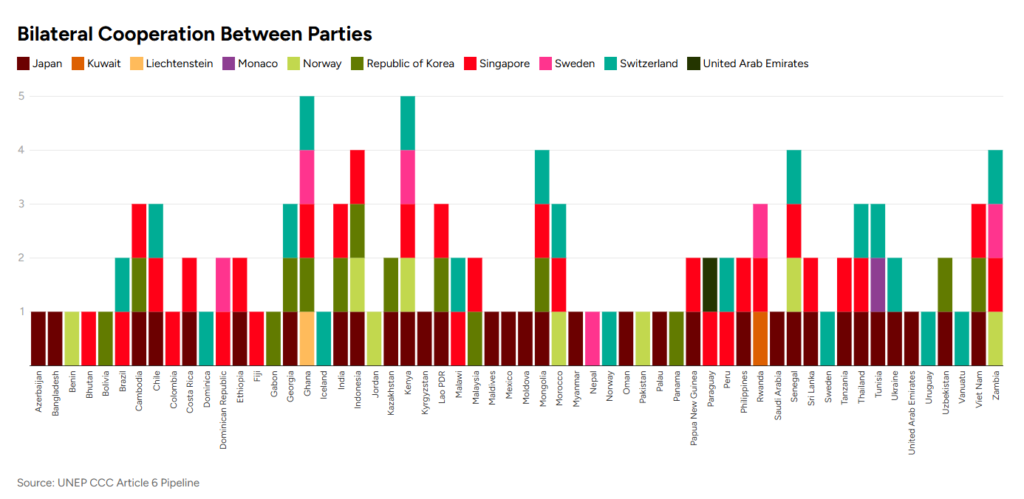
At COP31, discussions are expected to include the reporting systems, technical reviews, registries, and funding needed to support these arrangements. These systems help countries track transfers and show how they account for the emissions reductions.
Article 6.4: The UN Carbon Crediting Mechanism
Article 6.4 established a United Nations-supervised carbon-crediting mechanism. It is designed to issue credits for eligible activities that reduce or remove greenhouse gas emissions under approved methodologies and rules.
The mechanism is now known as the Paris Agreement Crediting Mechanism (PACM).
Work on methodologies and the transition of eligible activities from the former Clean Development Mechanism continues. COP31 will provide an opportunity to review progress and discuss the resources needed to operate the system.
However, carbon markets are not the only focus of COP31, and the conference is not expected to rewrite the entire Article 6 rulebook. The main challenge is putting the existing rules into practice and ensuring that the supporting systems work effectively.
Why Climate Finance Matters to Carbon Markets
Carbon markets could help direct funding toward emissions-reduction projects, including renewable energy, methane control, forest protection, and carbon removal. However, they cannot replace all forms of climate finance.
Credit purchases depend on project quality, demand, and the rules governing how credits can be used. Many climate needs, particularly adaptation and public infrastructure, may not generate credits that can be sold.
Abatable’s analysis ahead of COP31 highlights the need to fund the systems that support Article 6 cooperation, including reporting, registries, technical reviews, and capacity-building. It also points to wider debates over how countries should finance climate action.
For carbon market participants, the practical developments to watch include new bilateral agreements, national rules for authorizing credits, updates on Article 6 implementation, and efforts to strengthen the credibility of international transfers.
These developments could influence future market access and demand, although their effects will depend on what governments agree and how they implement those decisions.
What Is the COP31 Action Agenda?
Alongside formal negotiations, the COP31 presidency will promote a wider Climate Action Agenda. This is a separate but related track that brings together businesses, cities, investors, civil society, and other groups to encourage practical climate action.
The Action Agenda focuses on areas such as clean energy, green industry, circular economy measures, sustainable agriculture, resilient cities, and climate finance.

The presidency has also highlighted three headline targets: increasing electricity’s share of global final energy demand from just over 20% to 35% by 2035, halving the growth in global waste by 2035, and reducing energy-use intensity in buildings by at least 25% by 2035.
These are priorities for mobilizing action, not automatically binding targets for every country. Their impact will depend on the commitments made by participants, the resources available, and whether progress can be measured.
The distinction matters because announcements made alongside COP negotiations do not have the same status as formal decisions adopted by governments. The Action Agenda can help businesses and other groups contribute to climate solutions, while the negotiations set the international framework for cooperation.
What Should You Watch During COP31?
For people following climate policy and carbon markets, several developments will be worth watching.
- National climate plans: Whether more countries strengthen their emissions targets and explain how they will meet them.
- Climate finance: Whether governments make progress on funding for emissions cuts, adaptation, and vulnerable communities.
- Article 6 implementation: Whether countries advance the systems needed to authorize, track, and report international carbon-credit transfers.
- Carbon market cooperation: Whether countries announce new agreements or rules that create clearer paths for approved credit transfers.
- Action Agenda commitments: Whether companies, investors, and other organizations announce measurable projects and funding rather than broad ambitions alone.
These developments will help show whether COP31 can move climate action forward. However, announcements alone will not prove that emissions are falling. The real test will be whether governments and businesses deliver measurable results over time.
The Bottom Line
COP31 will bring governments and other climate stakeholders together in Antalya from November 9 to 20, 2026, to address emissions, climate finance, adaptation, and international cooperation.
For carbon markets, the conference is an important opportunity to advance the implementation of Article 6 and discuss how carbon finance can support wider climate goals. It is also a chance to strengthen the systems that make international transfers transparent and accountable.
Still, carbon markets are only one part of the global climate response. Their contribution will depend on credible emissions reductions, clear accounting, effective oversight, and real demand for high-quality credits.
Ultimately, COP31 will be judged not only by the decisions and announcements made in Antalya, but by whether countries and other participants turn them into lasting climate action.