

The United States is taking another step to reduce its reliance on foreign critical minerals. The U.S. Army has awarded Perpetua Resources up to $40 million to evaluate the potential production of tungsten in Idaho, as the country seeks to strengthen its domestic supply of the metal.
The 36-month agreement will support exploration drilling, laboratory testing, and engineering work at the historic Stibnite Mining District. The project aims to determine whether tungsten can be produced in that mining location at a technical and economic scale.
The award comes as China remains the world’s leading tungsten producer. The mineral is important to manufacturing, construction, mining, and defense. It also supports industrial equipment and infrastructure used in the energy transition.
For the United States, developing a domestic source could improve supply security. Any new mining operation must also consider its environmental impact. This includes energy use, emissions, water effects, and land disturbance.
US Army Funds Tungsten Exploration in Idaho
The U.S. Army’s Defense Ordnance Technology Consortium provides funding to Perpetua Resources. It’s a cost-sharing program between the company and the U.S. government. The Army could contribute up to $40 million over three years. Perpetua has agreed to match that amount, bringing the potential combined investment to $80 million.
The first 18 months of work are expected to cost about $18 million, shared equally by the company and the Army. Funding for later phases will depend on the results of earlier work and approval of additional funding.
The program will focus mainly on tungsten mineralization beneath the Hangar Flats area of the Stibnite Mining District. Planned activities include:
- Drilling to find a potential tungsten resource.
- Collecting samples.
- Conducting metallurgical tests to check if the material can be processed into tungsten concentrate.
The partners will also work on the design, permitting, and possible construction of an exploration decline. This underground access would allow further evaluation of mineral deposits beneath the planned open-pit area.
Importantly, the award does not mean that commercial tungsten production has been approved or that a mine is ready to operate. The work is intended to establish whether production is technically and economically feasible.
China Controls Most of the World’s Tungsten Supply
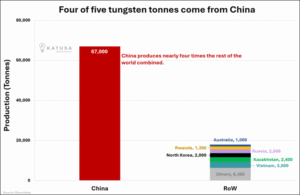
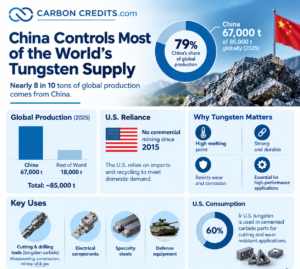
The project reflects growing concern about the concentration of critical mineral production in a small number of countries. According to the U.S. Geological Survey (USGS), China produced an estimated 67,000 metric tons of tungsten in 2025 out of about 85,000 metric tons worldwide. That represents nearly 79% of global mine production.
The United States, meanwhile, has not mined tungsten commercially since 2015. It relies on imports and recycling to meet domestic demand.
China’s dominance matters because tungsten is difficult to replace in many industrial applications. Its high melting point, strength, and resistance to wear make it valuable for products that must operate under extreme conditions.
The metal is widely used in tungsten carbide cutting and drilling tools. These tools are essential in metalworking, construction, mining, and oil and gas operations. Tungsten is also used in electrical components, specialty steels, and defense equipment.
- The USGS estimates that about 60% of U.S. tungsten consumption goes into cemented carbide parts used for cutting and wear-resistant applications.
China’s export controls have added to concerns about supply reliability. Countries that rely on imported tungsten face risks. Restrictions or disruptions can impact manufacturers and industries that require a steady supply.
Why Tungsten Matters to Energy and Industrial Supply Chains
Tungsten is not a major battery or renewable energy material like lithium, nickel, or copper. However, it plays an important supporting role in the industrial systems needed to build and maintain infrastructure.
Its hardness and resistance to heat make tungsten carbide useful in cutting, drilling, and wear-resistant tools. These tools help manufacture metal parts, build infrastructure, and extract other minerals used in energy systems.
Mining equipment, for example, supports the production of materials needed for electricity networks, renewable energy projects, and battery supply chains. Industrial cutting tools also help manufacturers produce components for a wide range of technologies.
This creates an indirect link between tungsten supply and the energy transition. A reliable supply of industrial materials can support the manufacturing and infrastructure needed to expand clean energy systems.
However, this does not make tungsten mining automatically climate-friendly. The environmental impact varies based on how the mineral is extracted, processed, and transported. It also depends on the energy sources used in the supply chain.
- READ MORE: The metal in your pocket has no price
Mining Expansion Brings Environmental Questions
Developing a domestic tungsten source could reduce the United States’ dependence on overseas suppliers. Yet, increasing local production also raises questions about the environmental cost of mining.
Mining and mineral processing require energy to operate equipment, move rock, crush ore, and separate valuable materials. Depending on the energy mix, these activities can produce significant greenhouse gas emissions.
Projects can also affect land, water quality, and local ecosystems. These risks make environmental planning and monitoring important parts of any new mining development.
At Stibnite, the tungsten exploration work is linked to a larger proposed mining project that also contains gold and antimony. Perpetua has reported tungsten and antimony mineralization beneath the Hangar Flats pit, including high-grade drilling results.
- The company has also said that the exploration program will test an existing 550-kilogram sample containing 4.2% tungsten and 9.2% antimony.
Any development beyond the currently permitted mine plan would require additional regulatory review and permitting. The company has not established that the new tungsten work will lead to commercially viable production.
For climate-focused investors and supply chain planners, the key issue is therefore not simply where tungsten comes from. It is also how efficiently and responsibly it can be produced.
US Government Funding for Critical Minerals Grows
The Army’s award is part of a wider U.S. effort to strengthen domestic supplies of materials considered important to national security and manufacturing. Perpetua said the new agreement brings its total U.S. government awards for critical mineral work to $126 million since 2022.
The company is also developing the Stibnite Gold Project, which contains antimony resources alongside gold. Antimony is another critical mineral used in defense applications and industrial products.
The USGS reported that the United States had no commercial tungsten mine production in 2025. However, the country has companies capable of processing tungsten concentrates, powders, and scrap into metal products and chemicals.
Domestic mining can help one part of the supply chain. However, it doesn’t eliminate the need for processing capacity, recycling, and steady access to other inputs.
Can Domestic Tungsten Supply Support a Lower-Carbon Economy?
The Army’s investment highlights the connection between mineral security, industrial development, and the energy transition.
Clean energy technologies depend on a broad network of materials and manufacturing processes. While tungsten is not a leading renewable energy mineral, it supports the tools and equipment used across industrial supply chains.
Building domestic supply could improve access to the metal and reduce exposure to overseas disruptions. But the climate benefits will depend on how new production is developed and powered.
The Stibnite program is still at the evaluation stage. Its results will help determine whether the deposit can support future tungsten production and what additional work would be needed.
As the United States seeks to secure more critical minerals at home, the challenge will be to balance supply chain resilience with responsible resource development. That means looking beyond production targets to include energy use, emissions, water management, and long-term environmental protection.